CHAPTER TWO
A Book of Whispers
The aftermath was a tableau of magnificent chaos. Signora Bellini, now utterly silent, communicated her distress through a series of increasingly frantic gestures and wide-eyed glares, primarily directed at her pale and trembling assistant, Luca. The other patrons, their quiet afternoon shattered, huddled in small groups, whispering theories in hushed, excited tones. Professor Albinoni, ever the performer, looked on with an expression of deep, scholarly concern, as if observing a fascinating, albeit tragic, historical event.
Ispettore Salomone arrived within the hour, a man whose weary posture suggested he was perpetually braced for the absurdities of village life. He navigated the scene with a practiced, cynical air, his presence a splash of cold, hard reality in Moira’s fragrant, whimsical world. He listened to the babble of witnesses, his face an impassive mask, his questions clipped and to the point.
“Signorina Hopes,” he said, turning his tired gaze on her. “This custom blend of yours. What is in it?”
“Licorice root, marshmallow leaf, a touch of fennel,” Moira replied, her voice steady despite the tremor in her hands. “Everything is perfectly harmless. I’ve served it for years. She added the ‘sweetener’ herself.”
Salomone inspected the shattered remains of the cup, his eyes lingering on the faint residue of white powder mingling with the dark tea leaves. He bagged the fragments as evidence, but his sigh spoke volumes. To him, this was not a crime scene; it was the stage for a diva’s latest performance. “A psychosomatic episode, most likely,” he muttered to his subordinate, just loud enough for Moira to hear. “The pressure of the upcoming gala.”
The next morning, the Ispettore returned, his headache now compounded by a second, more concrete crime. Professor Albinoni’s room at the local pensione had been ransacked. The Etruscan cat was gone. “Silvio has no alibi,” Salomone stated, rubbing his temples. “He was seen walking near the pensione late last night, still angry from the argument. A clear motive, an obvious suspect.” It was a neat, tidy solution, and the Ispettore seemed relieved to have it.
But for Moira, nothing was tidy. Two mysteries had bloomed in her quiet shop, and the official explanations felt as thin and brittle as dried tea leaves. Her reputation was tangled in both, and a deep, instinctual loyalty to the truth—and to the gruff but honest Silvio—pricked at her conscience. That night, long after the last lamp in Speranza had been extinguished, she sat in the deep silence of her shop, the soft, rhythmic purring of her cats the only sound. Desperate, she found herself drawn to the strange book she’d found at the market.
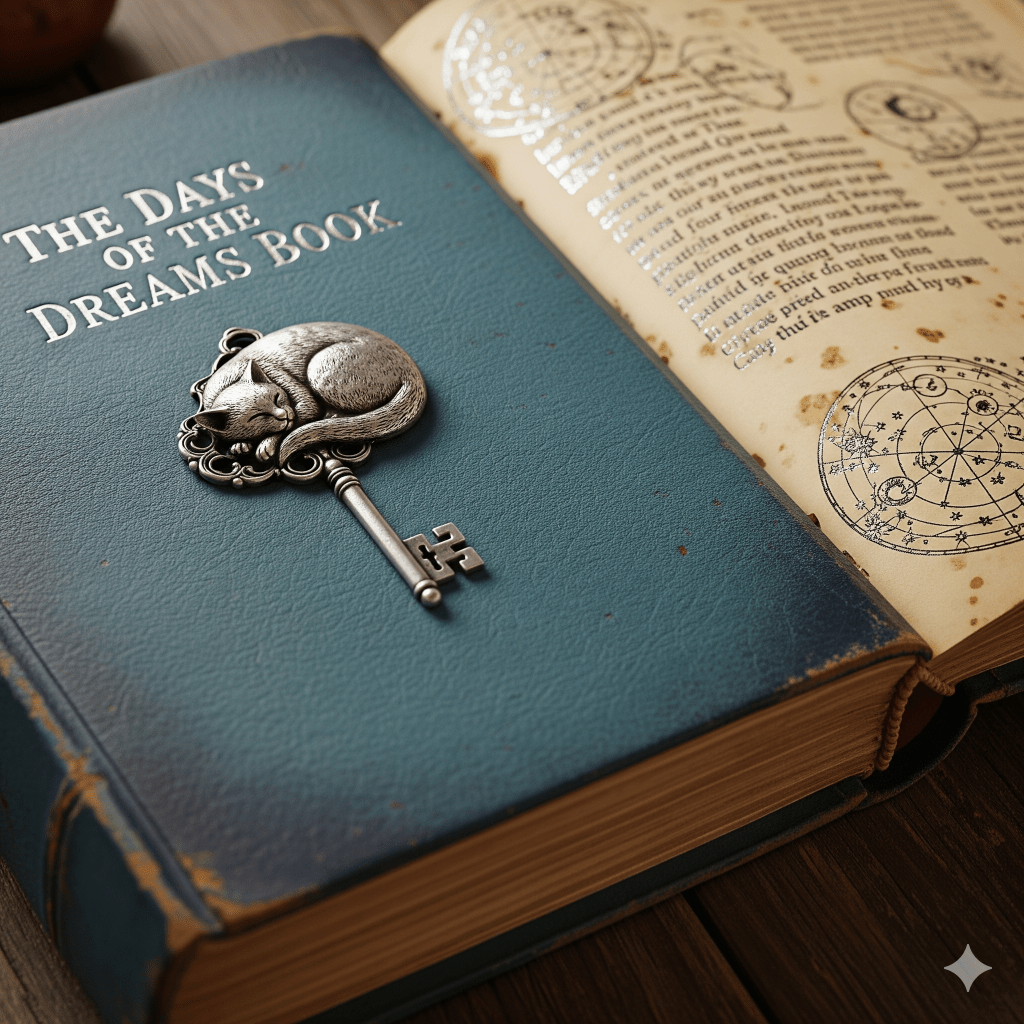
She ran her hand over the peacock-blue leather, its surface cool and smooth beneath her fingertips. Hesitantly, she opened it. The pages, yellowed with an age she couldn’t guess, released a faint smell of dust and pressed flowers, a scent of forgotten gardens and quiet libraries. This is absurd, she thought, her heart sinking as she traced the elegant, silver script. I’m relying on riddles from a flea market book to solve a theft and a poisoning. Salomone is chasing the obvious, and only I seem to notice that nothing feels right. What else is there? The silver ink of the riddles seemed to shimmer and shift in the lamplight, as if the words themselves were alive, holding a secret knowledge she felt foolish for even considering.
She scanned the strange table of contents, her finger tracing titles like “On the Interpretation of Rain” and “A Compendium of Moonlight.” Finally, she found a chapter that seemed to resonate with the chaos of the past two days. She found a cryptic couplet that seemed to span both mysteries, a single, intertwined prophecy: The songbird cages itself; the fox runs for the serpent. Look not for the stolen prize, but the unseen debt.
The words were beautiful, poetic, and utterly baffling. Frustrated, she closed the book. Sleep offered no answers, only a restless tossing in sheets that felt too thin.
The next morning, the investigation began, not with human logic, but with feline intuition. While Moira was attempting to decipher the riddle, her furry assistants were already gathering evidence. In Albinoni’s ransacked room, which Moira had been allowed to visit to retrieve a forgotten tea tray, she noticed Ashwaganda’s peculiar behavior. The ginger cat, who had been utterly dismissive of the “priceless” Etruscan relic, now completely ignored the mess of overturned furniture and scattered papers. Instead, he was fascinated by the Professor’s expensive leather briefcase, which lay open on the bed. He sniffed at its silk lining with a low, inquisitive growl, his whiskers twitching, as if he detected a scent that was deeply offensive to his refined sensibilities.
Meanwhile, Toe, the sleek black shadow, was on his own mission. Unseen by the humans, he darted under a heavy, antique rug that had been partially displaced during the ransacking. A moment later, he emerged, batting a tiny, peculiar clump of bright, ochre-colored clay across the polished floorboards. It was a shade of earth entirely different from the dark, rich soil of the Speranza hills, a vibrant, unnatural yellow-orange. Moira carefully scooped it up into a napkin, her mind racing. Look not for the stolen prize, but the unseen debt. Was this it? A debt to authenticity?
Later that day, back at the tea shop, the second half of the riddle began to unfold. Viviana’s handbag had been left behind in the chaos. While Salomone’s team had searched it for the “sweetener” sachet and found nothing, Toe now treated it as the most fascinating object in the world. He ignored the expensive leather, the silk lining, everything except the ornate clasp. He sat before it for an hour, occasionally reaching out a single black paw to bat at the silver ouroboros—the serpent eating its own tail.
At the same time, Ashwaganda provided the final piece of the puzzle. He jumped onto the counter and sat pointedly before a pot of calendula flowers Viviana had brought as a gift the day before. He stared intently at their golden-orange petals, then looked directly at Moira, his amber eyes piercing and insistent—the cat’s gold stare.
The riddle seemed to fall into a neat, simple pattern. Too neat. Moira felt a surge of excitement, the thrill of a puzzle locking into place. Albinoni was a forger (the fox), using the strange clay to create a fake. Luca, the ambitious understudy, had poisoned Viviana (the songbird), but the calendulas held the cure. And the serpent? Perhaps it was merely a symbol for Luca’s deceit. It was a tidy solution, separating the two dramas into two distinct cases with two obvious culprits. She now had a theory, a path to follow, a way to bring clarity to the chaos. Confident, she picked up the phone to call Ispettore Salomone, ready to present him with her discoveries, unaware that the elegant solution she had constructed was merely the first, deceptive layer of a far more complex and dangerous game.
THIS is a guide to some of the terms, places, and botanicals featured in the stories of Moira Hopes and “La Pagina che Fa le Fusa.”
Part 1: Italian Terms & Places
- Speranza
- Explanation: The name of the fictional Italian hill village where the story is set. The word literally translates to “Hope” in English, adding a layer of gentle optimism to the setting.
- Pronunciation: speh-RAHN-tsah (The ‘z’ sound is sharp, like the ‘ts’ in “cats”).
- La Pagina che Fa le Fusa
- Explanation: The whimsical name of Moira’s tea shop. It translates literally to “The Page that Purrs,” perfectly capturing the shop’s dual themes of books and cozy cats.
- Pronunciation: lah PAH-jee-nah kay fah lay FOO-sah.
- Signorina
- Explanation: A formal and polite Italian title for an unmarried woman, equivalent to “Miss” in English. It’s used by Ispettore Salomone when addressing Moira Hopes.
- Pronunciation: seen-yo-REE-nah.
- Ispettore
- Explanation: The Italian title for a police “Inspector.” It is the proper rank for the character Salomone in the Italian police force (Polizia di Stato or Carabinieri).
- Pronunciation: ees-pet-TOH-ray.
- Pensione
- Explanation: A type of guesthouse or small, family-run hotel common in Italy. It suggests a more modest and intimate lodging than a large hotel, fitting for a small village like Speranza.
- Pronunciation: pen-see-OH-nay.
- Erboristeria
- Explanation: An Italian herbalist’s shop. These stores specialize in medicinal herbs, tinctures, natural cosmetics, and herbal remedies.
- Pronunciation: er-boh-rees-teh-REE-ah.
- Salomone
- Explanation: The surname of the police inspector. It is the Italian version of the name “Solomon,” famously associated with wisdom.
- Pronunciation: sah-loh-MOH-nay.
Part 2: Teas, Herbs, and Key Substances
A note on herbal use: The descriptions below are for informational purposes based on traditional and modern understanding. The uses within the story, particularly for poisons and antidotes, are fictional plot devices.
- Rosemary (Rosmarino)
- Usage & Meaning: A staple Mediterranean herb, its pine-like, pungent aroma perfumes the air around Moira’s shop. In Italy, it’s used extensively in cooking (especially with roasted meats and potatoes). Symbolically, it’s associated with remembrance and clarity of mind.
- Approach with Care: While a common culinary herb, concentrated rosemary oil can be potent and should be used with caution, especially during pregnancy.
- Lapsang Souchong
- Usage & Meaning: A Chinese black tea known for its signature smoky aroma and flavor, achieved by smoke-drying the leaves over burning pinewood. Its bold, savory, and powerful character makes it a very distinctive and acquired taste.
- Approach with Care: Like all black teas, it contains caffeine.
- Chamomile (Camomilla)
- Usage & Meaning: One of the most popular herbal teas in Italy and worldwide. It is renowned for its calming and soothing properties, often taken in the evening to promote relaxation and restful sleep. Its flavor is gentle, apple-like, and floral.
- Approach with Care: Generally very safe, but individuals with allergies to the daisy family (like ragweed) may have a reaction.
- Licorice Root (Radice di Liquirizia)
- Usage & Meaning: Used in Moira’s blend for Signora Bellini. It has a long history of use for soothing sore throats and coughs due to its demulcent properties. It has a naturally intense, sweet flavor.
- Approach with Care: Overconsumption or long-term use of licorice root can lead to increased blood pressure and low potassium levels. It should be used with caution by individuals with hypertension or heart conditions.
- Marshmallow Leaf (Foglia di Altea)
- Usage & Meaning: Another key ingredient in the diva’s tea. Like the root, the leaf contains mucilage, a gel-like substance that coats and soothes irritated mucous membranes, making it a traditional remedy for throat and lung issues.
- Approach with Care: It is generally considered safe but can sometimes interfere with the absorption of other medications if taken at the same time.
- Calendula
- Usage & Meaning: Also known as “pot marigold.” Traditionally, its bright golden-orange petals are not primarily used for tea but are infused in oils to create salves and creams for skincare. It is prized for its anti-inflammatory and wound-healing properties. In the story, its role as a magical antidote is a key fictional element.
- Approach with Care: Primarily for topical use, though sometimes used in teas. Those with allergies to the daisy family should be cautious.
- Yew Tree (Tasso)
- Usage & Meaning: This tree was featured in an earlier version of the story as a poison source. In reality, the Yew is a common ornamental evergreen.
- EXTREME WARNING: All parts of the Yew tree (needles, bark, seeds) are highly toxic to humans and animals. Ingesting even a small amount can be fatal due to cardiotoxins that cause cardiac arrest. It should never be handled without care or consumed in any form. Its use in the story highlights the existence of potent, natural poisons.
General Rule for Approaching Herbal Products: Always consult with a qualified healthcare professional or a certified herbalist before using any herbs for medicinal purposes. This is especially critical if you are pregnant, breastfeeding, have a pre-existing medical condition, or are taking other medications, as herbs can have powerful effects and interact with pharmaceuticals.

 SummerSimo Travel Troubles Notes and The Purring Page
Leave a comment