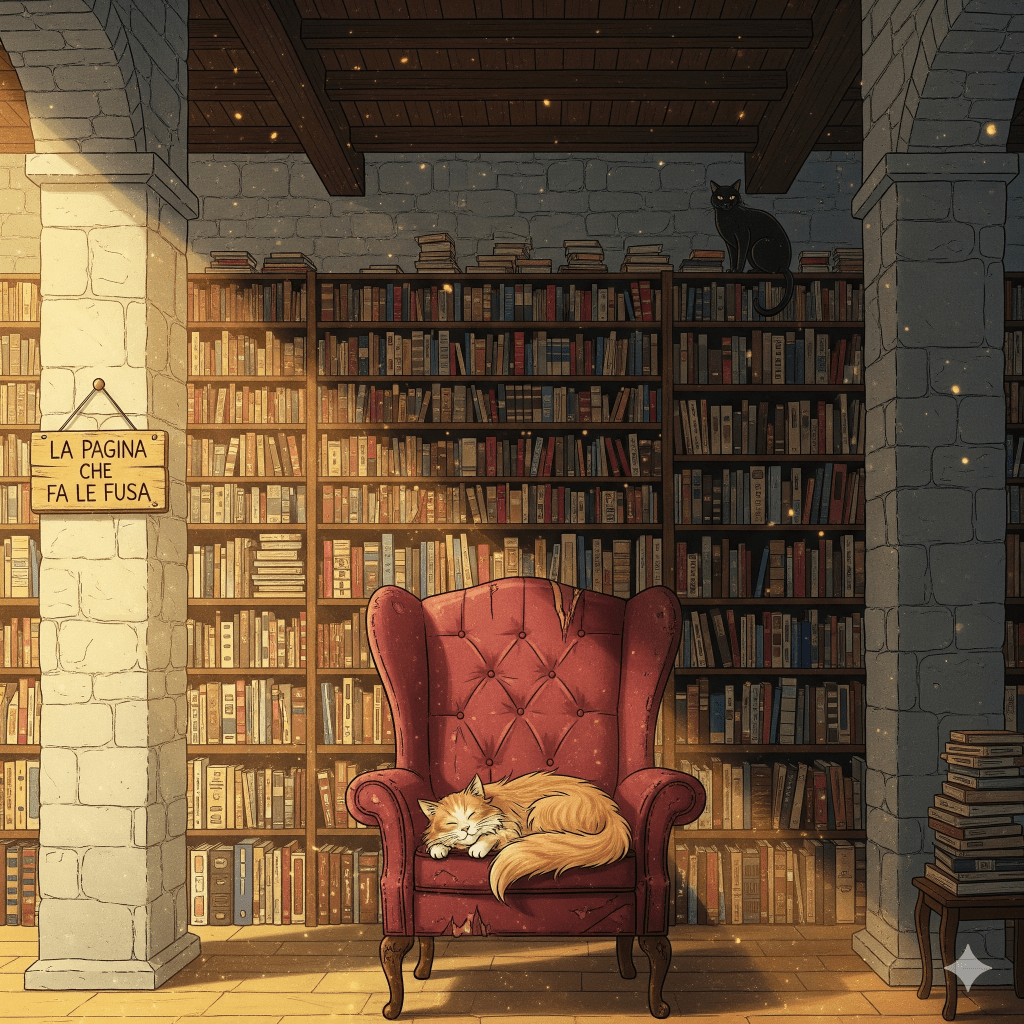
The Purring Page: The Case of the Silent Nightingale and the Etruscan Deception
CHAPTER ONE
An Overture of Shadows
The first week of September in Speranza began with the arrival of two seemingly separate storms, each preceded by an almost imperceptible change in the atmosphere of “La Pagina che Fa le Fusa.” The first omen was a scent. Beyond the comforting, evergreen aroma of rosemary from the terracotta pots flanking the door and the familiar, sweet dust of aging paper, a new note had entered Moira Hopes’s tea shop: the sharp, metallic tang of ambition. It arrived with Professor Albinoni, a man as smooth and polished as the river stones in the valley below. An art historian from Florence, he moved with a practiced grace that seemed out of place against the rustic, unhurried backdrop of the village. His voice was a perfectly modulated instrument, each word a carefully chosen note in the composition of his charm.
Moira watched him from behind the polished oak of her counter, a place that was both her stage and her sanctuary. As she steeped his jasmine tea, the steam coiling into the quiet air, she felt a flicker of profound unease, a dissonance that pricked at the edges of her intuition. Why do his stories feel so smooth, so rehearsed? she wondered, her hands moving with the familiar, steady rhythm of her craft. She had served academics before—fussy, distracted men with ink stains on their cuffs and a genuine, chaotic passion in their eyes. The Professor, however, was different. He speaks of history, but his eyes… his eyes are only watching his audience. They were the eyes of a performer, gauging reactions, adjusting his delivery, seeking not to inform but to enchant.
When she placed the delicate porcelain cup before him, her gaze dropped to his hands as he accepted it. They were not the hands of a scholar. Instead of the clean, academic hands of a man who handled only books, she saw a faint, yellowish stain under his fingernails, the kind of stubborn pigment that comes from chemicals, not dust. It was a detail so small, so out of place with his immaculate tweed jacket and silk tie, that she mentally filed it away as simply odd, a minor flaw in an otherwise perfect facade.
His prize, the centerpiece of his daily performance, was unwrapped from a bolt of crimson velvet with the reverence of a priest unveiling a holy relic. It was a small bronze cat, no bigger than her fist, its form stylized in the lean, elegant manner of the ancient Etruscans. Its patina was a mottled masterpiece of verdigris and dark, earthy tones. Ashwaganda, Moira’s fluffy ginger cat and the undisputed sage of the establishment, had been napping on a nearby bookshelf. He lifted his head, blinked his amber eyes once, gave the statue a single, disdainful sniff, and promptly turned his back to attend to the far more pressing matter of washing a thoroughly uninteresting patch of his own fur. The dismissal was so absolute it was almost comical.
“Ah, the patina on this bronze tells a story, you see,” Albinoni said, his voice dropping to a conspiratorial whisper, drawing the other patrons closer. “A narrative of soil, time, and the very soul of the Etruscan people. It speaks of the earth it slept in for two millennia. One must know how to listen to it.”
Later, when the shop was quieter, the Professor allowed Moira to hold the statue. The moment her fingers closed around it, her initial unease solidified into certainty. It felt wrong. It lacked the deep, cold weight of true, ancient bronze. There was a hollowness to it, a subtle lack of density that belied its appearance. And the patina, so convincing from a distance, felt subtly powdery and uniform under her thumb, like a clever coat of paint rather than the organic chaos of centuries of oxidation. She placed it back on its velvet bed, her mind a quiet turmoil of unspoken doubts.
The second storm arrived just as the afternoon sun began to bleed into gold, casting long shadows through the village. Signora Viviana Bellini did not so much enter the tea shop as she did conquer it. A retired opera diva, she was a whirlwind of lavender silk and dramatic sighs, her presence a tidal wave of perfume that momentarily overwhelmed the scent of rosemary. Trailing in her wake was her assistant, Luca, a young man whose nervous energy seemed to be physically absorbed by the calming atmosphere of the shop. Moira had seen him earlier that day, lingering near the old erboristeria down the alley, his hands fidgeting with a small, empty atomizer.
“Signorina Hopes!” Viviana boomed, her voice a rich, resonant contralto that made the porcelain cups on the shelves tremble. “I require a brew for the gods! Something to soothe the throat of a nightingale before my imminent performance at the provincial gala.”
As Viviana gestured, a flash of silver at her wrist caught Moira’s eye. It was the clasp of her handbag—an ornate, intricately detailed serpent eating its own tail, an ouroboros. A strange choice, Moira thought, a shiver tracing a path down her spine. It looks sharp enough to bite.
Luca fussed around the diva, straightening her shawl. “Oh, Signora,” he cooed, his voice a deferential murmur. “Perhaps you have just strained yourself in rehearsals. You must not push so hard. Allow me to help.”
The two dramas, simmering on opposite sides of the room, were destined to collide. The catalyst was Silvio, a local farmer whose face was a roadmap of grievances etched by sun and hard work. He stormed into the now-crowded shop, his muddy boots leaving a trail on Moira’s clean floorboards, silencing the gentle hum of conversation. His eyes, burning with indignation, were fixed on Albinoni.
“That thing’s as old as last week’s bread!” Silvio roared, a work-worn finger stabbing the air in the direction of the bronze cat. “My grandfather farmed those hills for fifty years and found nothing but rocks and roots! You city folk, you see a bit of green rust and think you’ve found a king’s treasure.”
Albinoni merely chuckled, a sound like honey being stirred into cream. “My dear man,” he said, his calm a stark contrast to Silvio’s fury, “archaeology requires a delicate eye, not a heavy plow.” The other patrons, charmed by the Professor’s wit, tittered, and Silvio, red-faced and defeated, retreated from the shop, muttering curses into the autumn air.
In the ensuing commotion, as the village gossips began to whisper, Viviana retrieved a small, silver sachet from her serpent-clasped handbag. “A special sweetener,” she explained to Moira with a conspiratorial wink. “A secret from Vienna.” With a flourish, she stirred the fine white powder into the custom blend of licorice root and marshmallow leaf Moira had prepared. She raised the cup, took a long, theatrical sip, and froze.
Her eyes, moments before sparkling with dramatic flair, widened in genuine terror. Her free hand flew to her magnificent throat. She opened her mouth, but what emerged was not a sound but the absolute absence of one. There was only a dry, rasping click, like a key turning in a lock that won’t catch. She tried again, a desperate, silent gasp. Panic flared in her eyes. Her sacred instrument, the voice that had once filled opera houses from Milan to Moscow, was now a prison of silence. The teacup slipped from her trembling fingers, shattering on the stone floor with a sharp crack that seemed, in the sudden, horrified hush of the room, as loud as a gunshot.
THIS is a guide to some of the terms, places, and botanicals featured in the stories of Moira Hopes and “La Pagina che Fa le Fusa.”
Part 1: Italian Terms & Places
- Speranza
- Explanation: The name of the fictional Italian hill village where the story is set. The word literally translates to “Hope” in English, adding a layer of gentle optimism to the setting.
- Pronunciation: speh-RAHN-tsah (The ‘z’ sound is sharp, like the ‘ts’ in “cats”).
- La Pagina che Fa le Fusa
- Explanation: The whimsical name of Moira’s tea shop. It translates literally to “The Page that Purrs,” perfectly capturing the shop’s dual themes of books and cozy cats.
- Pronunciation: lah PAH-jee-nah kay fah lay FOO-sah.
- Signorina
- Explanation: A formal and polite Italian title for an unmarried woman, equivalent to “Miss” in English. It’s used by Ispettore Salomone when addressing Moira Hopes.
- Pronunciation: seen-yo-REE-nah.
- Ispettore
- Explanation: The Italian title for a police “Inspector.” It is the proper rank for the character Salomone in the Italian police force (Polizia di Stato or Carabinieri).
- Pronunciation: ees-pet-TOH-ray.
- Pensione
- Explanation: A type of guesthouse or small, family-run hotel common in Italy. It suggests a more modest and intimate lodging than a large hotel, fitting for a small village like Speranza.
- Pronunciation: pen-see-OH-nay.
- Erboristeria
- Explanation: An Italian herbalist’s shop. These stores specialize in medicinal herbs, tinctures, natural cosmetics, and herbal remedies.
- Pronunciation: er-boh-rees-teh-REE-ah.
- Salomone
- Explanation: The surname of the police inspector. It is the Italian version of the name “Solomon,” famously associated with wisdom.
- Pronunciation: sah-loh-MOH-nay.
Part 2: Teas, Herbs, and Key Substances
A note on herbal use: The descriptions below are for informational purposes based on traditional and modern understanding. The uses within the story, particularly for poisons and antidotes, are fictional plot devices.
- Rosemary (Rosmarino)
- Usage & Meaning: A staple Mediterranean herb, its pine-like, pungent aroma perfumes the air around Moira’s shop. In Italy, it’s used extensively in cooking (especially with roasted meats and potatoes). Symbolically, it’s associated with remembrance and clarity of mind.
- Approach with Care: While a common culinary herb, concentrated rosemary oil can be potent and should be used with caution, especially during pregnancy.
- Lapsang Souchong
- Usage & Meaning: A Chinese black tea known for its signature smoky aroma and flavor, achieved by smoke-drying the leaves over burning pinewood. Its bold, savory, and powerful character makes it a very distinctive and acquired taste.
- Approach with Care: Like all black teas, it contains caffeine.
- Chamomile (Camomilla)
- Usage & Meaning: One of the most popular herbal teas in Italy and worldwide. It is renowned for its calming and soothing properties, often taken in the evening to promote relaxation and restful sleep. Its flavor is gentle, apple-like, and floral.
- Approach with Care: Generally very safe, but individuals with allergies to the daisy family (like ragweed) may have a reaction.
- Licorice Root (Radice di Liquirizia)
- Usage & Meaning: Used in Moira’s blend for Signora Bellini. It has a long history of use for soothing sore throats and coughs due to its demulcent properties. It has a naturally intense, sweet flavor.
- Approach with Care: Overconsumption or long-term use of licorice root can lead to increased blood pressure and low potassium levels. It should be used with caution by individuals with hypertension or heart conditions.
- Marshmallow Leaf (Foglia di Altea)
- Usage & Meaning: Another key ingredient in the diva’s tea. Like the root, the leaf contains mucilage, a gel-like substance that coats and soothes irritated mucous membranes, making it a traditional remedy for throat and lung issues.
- Approach with Care: It is generally considered safe but can sometimes interfere with the absorption of other medications if taken at the same time.
- Calendula
- Usage & Meaning: Also known as “pot marigold.” Traditionally, its bright golden-orange petals are not primarily used for tea but are infused in oils to create salves and creams for skincare. It is prized for its anti-inflammatory and wound-healing properties. In the story, its role as a magical antidote is a key fictional element.
- Approach with Care: Primarily for topical use, though sometimes used in teas. Those with allergies to the daisy family should be cautious.
- Yew Tree (Tasso)
- Usage & Meaning: This tree was featured in an earlier version of the story as a poison source. In reality, the Yew is a common ornamental evergreen.
- EXTREME WARNING: All parts of the Yew tree (needles, bark, seeds) are highly toxic to humans and animals. Ingesting even a small amount can be fatal due to cardiotoxins that cause cardiac arrest. It should never be handled without care or consumed in any form. Its use in the story highlights the existence of potent, natural poisons.
General Rule for Approaching Herbal Products: Always consult with a qualified healthcare professional or a certified herbalist before using any herbs for medicinal purposes. This is especially critical if you are pregnant, breastfeeding, have a pre-existing medical condition, or are taking other medications, as herbs can have powerful effects and interact with pharmaceuticals.

 SummerSimo Travel Troubles Notes and The Purring Page
Leave a comment