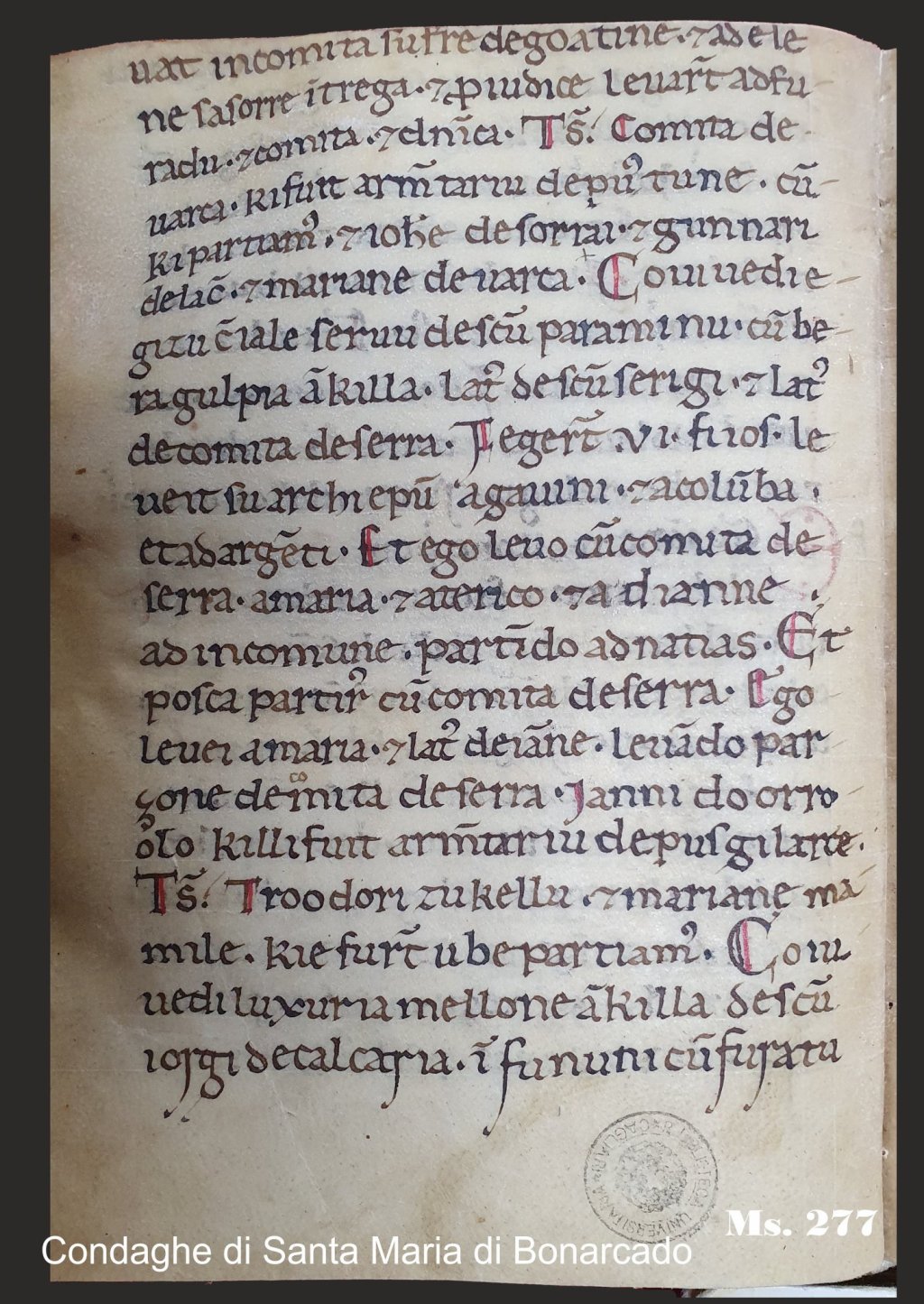
Condaghes, meticulously crafted on parchment between the 11th and 13th centuries, are the earliest known written documents in the Sardinian language. These documents primarily served as legal records, documenting transactions such as purchases, sales, and donations, often in favor of the Church.
The term “Condaghe” derives from the Greek word “Kontakion,” referring to a wooden rod used to roll up sewn-together parchments, a common practice for many ancient writings. Over time, scribes transitioned from rolling to folding the vellum parchment into “diernos,” “triernos,” and “quadernos,” depending on the length of the text. This practice ultimately led to the modern Italian word “quaderno” (notebook).
Beyond Legal Records: A Window into Medieval Sardinian Society
Condaghes offer invaluable insights into the social, economic, and legal structures of medieval Sardinia. They shed light on land ownership, agricultural practices, social hierarchies, and the role of the Church in daily life. These documents also provide glimpses into the evolution of the Sardinian language, showcasing its unique vocabulary, grammar, and syntax.
Preservation and Accessibility:
Many Condaghes have been preserved in monastic archives and libraries across Sardinia. While some are available in digital format, accessing and interpreting these ancient documents often requires specialized knowledge of the Sardinian language and medieval paleography.
Significance for Sardinian Identity:
Condaghes are not merely historical artifacts; they are symbols of Sardinian identity and cultural heritage. They represent the island’s unique linguistic and historical trajectory, distinct from mainland Italy. The study and preservation of condaghes are essential for understanding Sardinia’s rich past and for promoting its linguistic and cultural diversity.
Further Exploration:
For those interested in delving deeper into the world of condaghes, here are some resources:
- The Condaghe of Santa Maria di Bonarcado: This is one of the most well-known and studied condaghes, providing a wealth of information on medieval Sardinian society.
- The National Archive of Cagliari: This institution houses a vast collection of condaghes and other historical documents related to Sardinia.
- University of Cagliari: The university’s Department of Philology and Literature offers courses and research opportunities on the Sardinian language and its historical documents.
Biblioteca Universitaria di Cagliari -University Library of Cagliari
The oldest documents owned by the university library are the two CONDAGHI of Santa Maria di Bonarcado and San Nicola di Trullas, two of the three (that of San Pietro di Silki is owned by the Sassari University Library) who have been received in the original version. A quarter condaghe, that of San Michele di Salvennor, has received a late Spanish translation. Produced in the XII and XIII centuries within the two convents of Bonarcado, in the Oristani and Trullas near Semesterne, in the Logudoro, both belonging to the Benedictines of Camaldoli, are registers that collect the patrimonial and administrative transactions relating to the life of the convents, As purchases, sales, exchanges and donations, but also founding formal acts of the life of the convents themselves. Not only that, within the CONDAGHI we find the detailed reports of judicial disputes (the so -called “chertos”) in the area.
Among the patrimonial transactions, very frequent are the donations by wealthy benefactors, carried out for the remission of sins and the salvation of the soul. The language of the Condaghi is the Sardinian, in the Campidanese Arborense variant for that of Bonarcado, in the Logudorese variant for that of Trullas. These documents are precious sources to reconstruct history, language, culture, institutions, landscape, onomastic and toponymy of the XII and XIII centuries. They have been and are the subject of study by the philologist, of the Glottologist, the historian, the scholar of legal institutions, the paleographer, the Codologist, very cited in many bibliographies, the subject of numerous degree theses.
A debate animated the scholars who dealt with the Condaghi, and concerned the literary value of the documents contained in them. By now we are no longer inclined to consider them mere arid contracts of contracts. They open a gash on the society of the time, allow you to know names of person and archaic names, no longer in use, lead us inside the “chertos” mentioned before, whose reports emerge from the voices of the contenders who express themselves with a Curious language, capable of combining elements proper to bureaucratic language, with elements of colloquial language, which give the stories a fresh and lively tone.
After this general information, we briefly enter specifically of the individual CONDAGHI in our possession: the first is that of Santa Maria di Bonarcado (ms. 277 of our “manuscript fund”), produced, as already mentioned, within the convent Camaldolese annexed to the Romanesque church of Santa Maria di Bonarcado, in the Hystanese. The code, of somewhat robust parchment, of simple workmanship, is drawn up on a single writing column; The ink used is generally dark, in some faded cards, but in many cases there are parts of text drawn up in red, like the initial letters. The cards were drawn up by the prior of the convent therefore, since there were many prior times during such a long time span, we find many different writing hands; Equally different are the types of writing used: tiny Carolina, Gothic and late Gothic. The code, consisting of 91 cards, is the product of a series of tabs bound, often without respecting the chronological order. The binding, probably seventeenth or eighteenth -century, of rigid parchment, closed by hallmated leather laces, was restored in 1983. The upper margins of the code were trimmed, that is, equalized when the first binding was carried out and consequently they reduced.
The code opens with the solemn constitutive act of the monastery, affiliated to the abbey of San Zeno in Pisa, which constitutes the oldest document of the Condaghe, drawn up in its first part in Latin. This act is entrusted to the voices of Constantine the judge of Arborea (“In appointments of the Patris et Filii et Spirictu Sancti, amen. Ego Gostantine iudice de Arborea …”) which with the authority of his role formally sanctions the birth of the convent and of the Condaghe. It should be noted that the CONDAGHE does not report dates, but we know the date of affiliation, 1110. Another document refers to the consecration of the new church of Santa Maria (there was already a church of Our Lady of Bonaccattu), which took place in 1146/ 1147. Of the priori editors of documents, we know the names, because they often mentioned them after the ritual formula: “In nomine domains. Amen. Ego, Petrus (or Nicolaus, or Grigoriu, or Benedictu) Priore de Bonarcatu … “
The Condaghe of San Nicola di Trullas was instead produced inside the convent contained to the small church of San Nicola di Trullas, near Semesterne, in Logudoro. The church still exists, and can be visited on some occasions, while the convent was destroyed by a fire. Like his counterpart from Bonarcado, Trullas’s Condaghe is a parchment code, consisting of 94 cards, a little smaller format than the previous one, which however has the particularity of being drawn up for most of the text by a only hand of writing, a beautiful tiny Carolina late, while for the remaining part there are several hands and different types of writing: tiny late Carolina, tiny transition and tiny Gothic. This could suppose that it is a transcription of documents that have not received in the original drafting. Even in the case of Trullas code, the ink used is mainly dark, with some parts and initials entitled.
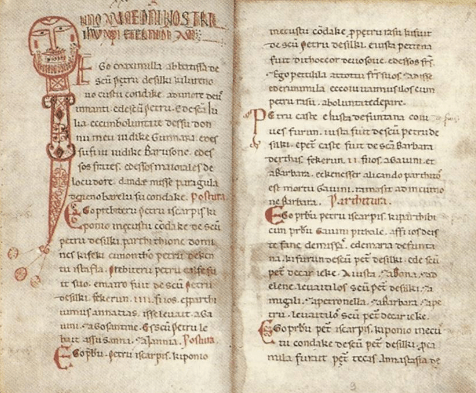
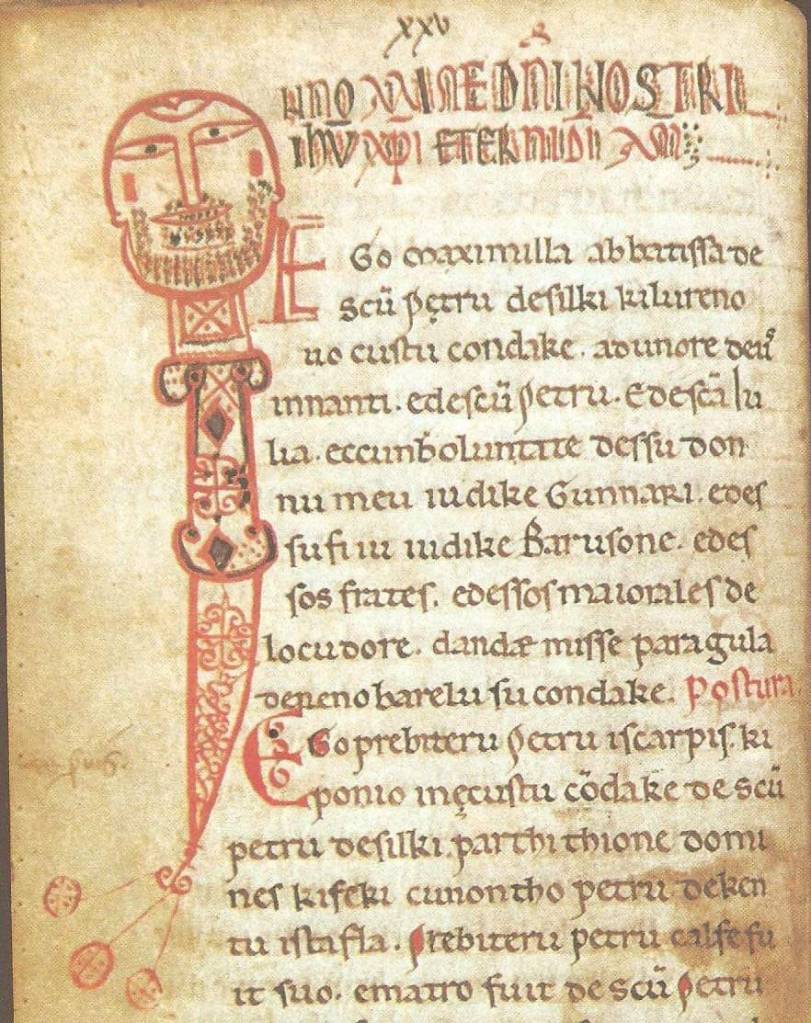
The oldest document referred to, is also in this case the act of foundation, with which in 1113 Petru Athen affiliates the church of Trullas to that of San Salvatore di Camaldoli. The time span of the Condaghe goes from the first quarter of the XII century to the middle of the thirteenth century.
Both Condaghi, already belonging by hereditary succession to Baron Guillot, and even earlier to the Simon brothers of Alghero, were purchased by the University Library in 1936. At the time, the direction was entrusted to Bianca Bruno, who had managed to conclude the long transaction for The purchase, which began even in 1900. Until that date, the existence of the Condaghe of Trullas was not known. The path that led them outside the convents, when they ceased their history, is not known of both Condaghi. Traces are lost until their presence in the Library of the Simon brothers and subsequently of Baron Guillot.
The rest is known history: the Condaghi are carefully guarded at the library and with due precautions, they are the ones that most often leave their space in the wardrobes to be shown to small groups of visitors, curious to admire the oldest original documents in history Sardinian.

 SummerSimo Travel Troubles Notes and The Purring Page
Leave a comment