
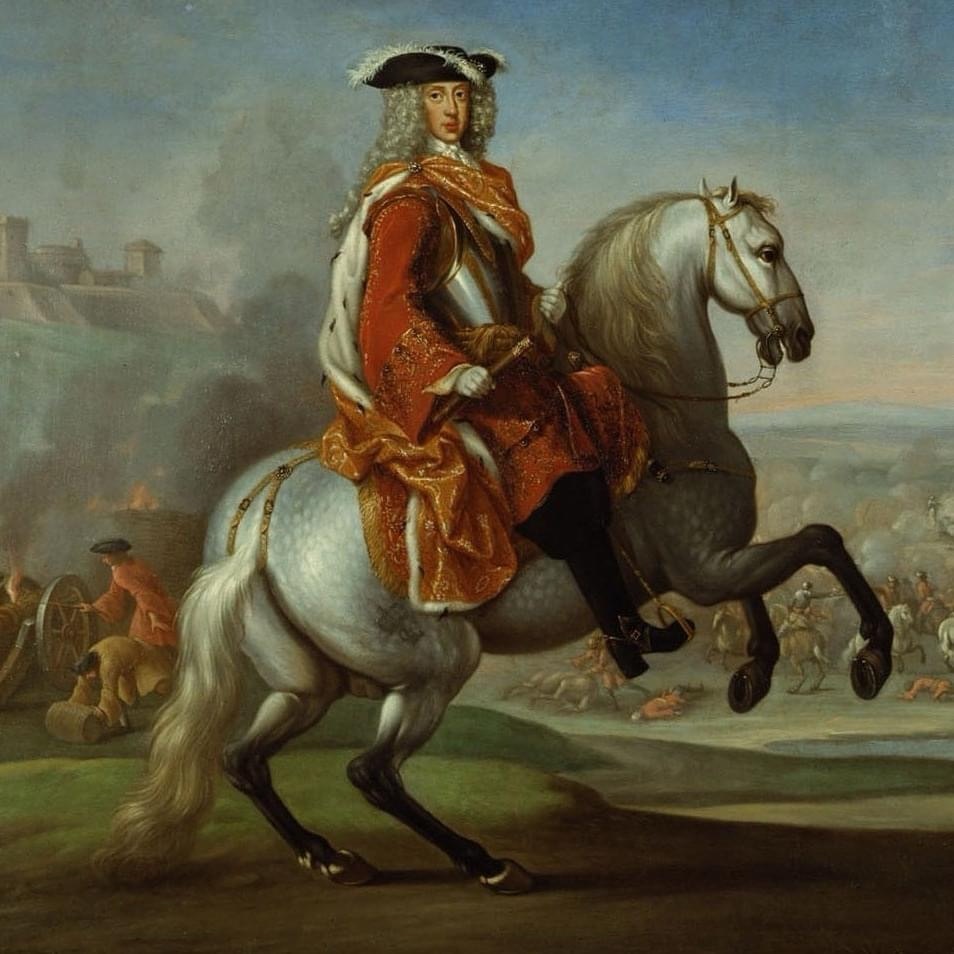
Emperor Leopold I of the Holy Roman Empire and King of Hungary and Bohemia appointed Charles V, Duke of Lorraine (Lotharingiai Károly) to lead the allied Christian forces.
During the late spring of 1684, the Duke set out with his army of 40,000 men to take Buda castle back. They took back Visegrád castle after a few days of siege, then they defeated the army of Pasha Mustafa of Aleppo at Vác, on 27 June.
The Duke also took the castle of Vác. It was a crushing victory, mainly because of the better artillery and firearms of the Imperials. The Duke lost only 50 men while the Ottomans 3,000 soldiers and the Hungarian Hussars cut down 700 of them.
After this fight, the Imperials rested for two days, then they set out toward Pest on the left bank of the Danube River on 29 June.
The enemy gave up the town of Pest quickly but before withdrawing, they slaughtered every Christian inhabitant.
They also burned the bridge behind themselves to prevent the Imperial army from crossing the river to the Buda side.
The Battle of Vác (1684) was a significant engagement during the Great Turkish War (1683–1699), where the Habsburg Monarchy, led by Charles V, Duke of Lorraine, clashed with the Ottoman Empire. The battle took place near the town of Vác (Waitzen in German) in present-day Hungary.
Background:
The Great Turkish War was a pivotal conflict in European history, marking a turning point in the Ottoman Empire’s expansion into Central Europe. The Ottoman siege of Vienna in 1683 had been decisively repulsed by a coalition of European forces, and the Habsburgs were eager to press their advantage and liberate territories occupied by the Ottomans.
The Battle:
In the summer of 1684, Charles V, Duke of Lorraine, led a Habsburg army into Hungary to confront the Ottoman forces. The two armies met near Vác on July 27, 1684. The battle was fierce, with both sides suffering heavy casualties. However, the superior tactics and discipline of the Habsburg forces, combined with their effective use of artillery, ultimately led to a decisive victory.
Aftermath:
The Battle of Vác was a significant victory for the Habsburgs and a major setback for the Ottoman Empire. It marked the beginning of a series of Habsburg successes that would eventually lead to the liberation of much of Hungary from Ottoman rule. The victory also boosted the morale of the Christian forces and cemented Charles V’s reputation as a skilled military commander.
Legacy:
The Battle of Vác is remembered as an important turning point in the Great Turkish War and a key moment in the history of Central Europe. It demonstrated the growing strength of the Habsburg Monarchy and the weakening of the Ottoman Empire, ultimately leading to a shift in the balance of power in the region.
Official Sources:
While there may not be official documents readily available online, information about the Battle of Vác can be found in historical archives and libraries. The following sources may be helpful for further research:
- The War History of the House of Austria (1246-1748) by Friedrich Schiller
- The History of the Decline and Fall of the Roman Empire by Edward Gibbon (This work provides context for the wider conflict between the Habsburgs and the Ottomans)
- Military History of Austria by Geoffrey Wawro
Additionally, academic libraries and historical archives in Austria and Hungary may hold valuable primary sources and documents related to the battle.

 SummerSimo Travel Troubles Notes and The Purring Page
Leave a comment