
Unveiling the Megaflood:
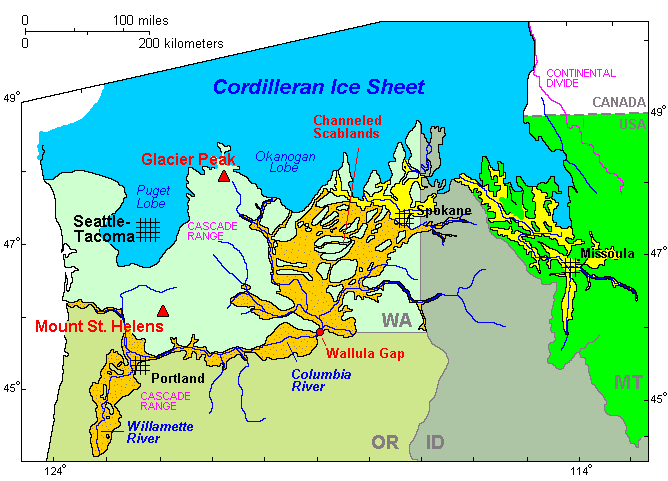
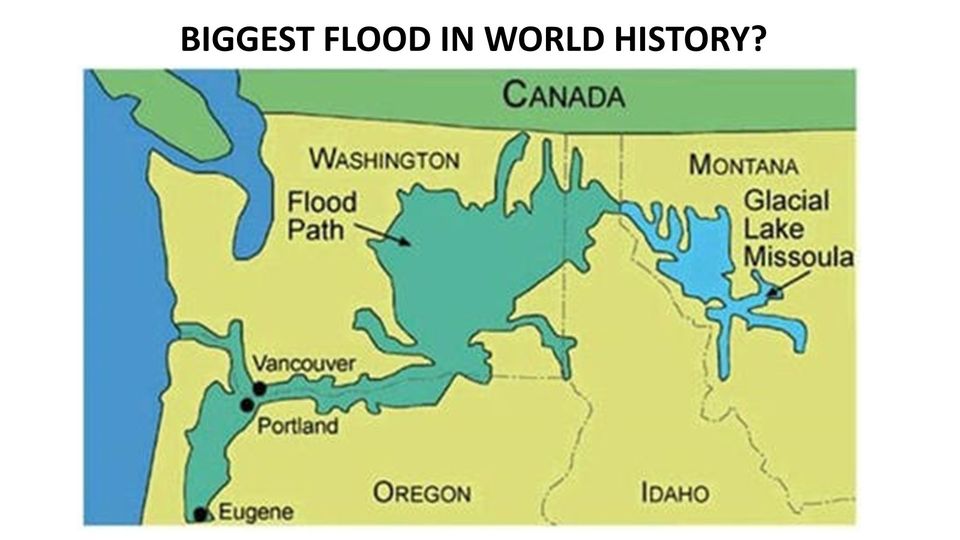
The Missoula Floods were not a single event but a series of cataclysmic outbursts that occurred repeatedly between 15,000 and 13,000 years ago during the Pleistocene epoch. The floods originated from Glacial Lake Missoula, a massive body of water formed when the Cordilleran Ice Sheet dammed the Clark Fork River in western Montana.
Evidence from the Landscape:
The floods left an indelible mark on the landscape of eastern Washington and parts of Idaho and Oregon. The most prominent feature is the Channeled Scablands, a vast region of deep coulees (dry canyons), giant ripple marks, and scattered erratic boulders. These features were initially perplexing to geologists, who struggled to explain their formation.
J. Harlen Bretz’s Groundbreaking Theory:
In 1923, geologist J. Harlen Bretz proposed a radical theory: the Scablands were not formed by gradual erosion, but by catastrophic floods of unimaginable magnitude. Bretz’s hypothesis was met with skepticism and ridicule from his peers, who favored a more uniformitarian view of geological processes.
Accumulating Evidence:
Despite the initial resistance, Bretz continued to amass evidence supporting his theory. He meticulously documented the unique features of the Scablands, including:
- Giant Ripple Marks: These massive undulations in the landscape, some as tall as 50 feet, were unlike anything formed by normal river flows.
- Erratic Boulders: Huge boulders, some weighing hundreds of tons, were scattered across the landscape, far from their geological origin.
- Dry Falls: This 3.5-mile-wide cataract, now dry, once carried a greater volume of water than all the rivers in the world combined.
Acceptance and Vindication:
By the 1950s, a growing body of evidence, including aerial photography and the discovery of similar flood features in other parts of the world, began to sway the geological community. Bretz’s theory was finally accepted, and he received the Penrose Medal, the highest honor of the Geological Society of America, in 1979.
Scientific Investigations:
Subsequent research has further refined our understanding of the Missoula Floods. Scientists have used a variety of methods, including:
- Geomorphology: The study of landforms and the processes that shape them.
- Sedimentology: The study of sedimentary rocks and the processes that deposit them.
- Paleohydrology: The study of ancient water systems.
- Computer Modeling: Simulation of the floods to understand their dynamics.
Scale and Magnitude:
The largest of the Missoula Floods is estimated to have had a peak discharge of around 17 million cubic meters per second (600 million cubic feet per second), which is ten times the combined flow of all the rivers in the world today. The water depth in some areas may have reached up to 1,000 feet.
Impacts:
The Missoula Floods had a profound impact on the landscape, carving out the Channeled Scablands, depositing vast amounts of sediment, and creating unique geological features. They also likely had a significant impact on the climate and ecosystems of the region.
Sources:
- United States Geological Survey (USGS): The USGS website has a wealth of information on the Missoula Floods, including maps, photos, and scientific publications.
- Ice Age Floods Institute: This non-profit organization is dedicated to the study and education of the Missoula Floods. Their website offers a variety of resources, including videos, educational materials, and information on field trips.
- “The Channeled Scablands of Eastern Washington: The Geologic Story of the Spokane Flood” by Bruce Bjornstad: This book provides a comprehensive overview of the Missoula Floods, including their geological history, scientific evidence, and cultural significance.
The Missoula Floods are a testament to the immense power of nature and the dynamic processes that shape our planet. They also serve as a reminder of the importance of understanding past events in order to prepare for potential future hazards.

 SummerSimo Travel Troubles Notes and The Purring Page
Leave a comment