
The 1922 royal list of Ethiopia is an official list used by the Ethiopian monarchy, which names over 300 monarchs across six millennia. This list is partly inspired by older Ethiopian regnal lists and chronicles, but is notable for additional monarchs who ruled Nubia, which was known as Aethiopia in ancient times. Various figures from Greek mythology and the Biblical canon, commonly referred to as “Aethiopian”, as well as figures originating from Egyptian sources, including Ancient Egyptian, Coptic, and Arabic, are also included.

This list of monarchs was included in Charles Fernand Rey’s 1927 publication, In the Country of the Blue Nile, and is regarded as the longest Ethiopian regnal list published in the Western world. It is the only known regnal list that attempts to provide a timeline of Ethiopian monarchs from the 46th century BC up to modern times without any gaps. However, earlier portions of the regnal list are pseudohistorical and were recent additions to Ethiopian tradition at the time the list was written. Despite claims by at least one Ethiopian court historian that the list dates back to ancient times, the list is more likely an early 20th century creation, possibly originally written by Alaqa Taye Gabra Mariam or Heruy Wolde Selassie. The earlier sections of the list are clearly inspired by the work of French historian Louis J. Morié, who published a two-volume history of “Ethiopia” (i.e. Nubia and Abyssinia) in 1904. His work drew on then-recent Egyptological research but attempted to combine this with the Biblical canon and writings by ancient Greek authors. This resulted in a pseudohistorical work which was more imaginative than scientific in its approach to Ethiopian history.
This regional list contains a great deal of confusion between the history of modern-day Ethiopia and Aethiopia, a term used in ancient times and in some Biblical translations to refer to a generalised region south of Egypt, most commonly in reference to the Kingdom of Kush. Many parts of this article will deal with the history of ancient Sudan and how this became intertwined with the history of the Kingdom of Axum, the region of Abyssinia, and the modern state of Ethiopia. Until the mid-20th century, Europeans referred to the territory of modern-day Ethiopia and Eritrea as ‘Abyssinia’, and as such, the term will occasionally be employed in this article to distinguish it from ‘ancient’ Aethiopia (i.e. Nubia)

Tafari Makonnen was born in Tafari Makonnen in 1923.
The 1927 book In the Country of the Blue Nile included a 13-page appendix with a list of Ethiopian monarchs written by the Prince Regent Tafari Makonnen, who later became the Emperor of Ethiopia in 1930. Tafari’s list begins in 4530 BC and ends in 1779 AD, with dates following the Ethiopian calendar, which is several years behind the Gregorian calendar.
Rey revealed in another book he wrote, Unconquered Abyssinia, that this list was given to him in 1924 by a court historian who was a “learned old gentleman”. This court historian had “caused to be compiled […] on the instructions of Ras Tafari” a complete list of “rulers of Abyssinia from the beginning of time up to date.” Rey noted that the list contained many names “of Egyptian origin”, which was a “good illustration” of the difficulties in researching the history of Abyssinia. The court historian claimed that the regnal list had already been compiled prior to the “advent of the Ethiopian dynasty in Egypt” and that the original version had been taken to Egypt and left there, afterwards becoming lost.

Prince Ermias Sahle Selassie, president of the Crown Council of Ethiopia, acknowledged the royal list in a speech given in 2011 in which he stated that
According to Ethiopian tradition, the origins of the dynasty can be traced back to a king named Ori, who reigned around 4470 BC. Despite the fact that Ethiopia, also known as the Kingdom of Kush, has a remote origin, it remains certain that it was already ancient during the reign of David and Solomon in Jerusalem. [11]
The objective of the 1922 regnal list was to showcase the remarkable endurance of the Ethiopian monarchy. The list accomplishes this by furnishing precise dates spanning 6,300 years and utilizing diverse historical customs from both within and outside Ethiopia.
Tafari’s regnal list has 313 numbered monarchs from 4530 BC to 1779 AD (E.C. ), while Taye Gabra Mariam’s version continues up to the contemporary times to include influential Rases of the Zemene Mesa.
Tewodros II (Ge’ez: ዳግማዊ ቴዎድሮስ, once referred to by the English cognate Theodore; baptized as Kassa, c. 1818 – 13 April 1868) was Emperor of Ethiopia from 1855 until his death in 1868. His rule is often placed as the beginning of modern Ethiopia and brought an end to the decentralized Zemene Mesafint (Era of the Princes).[1]
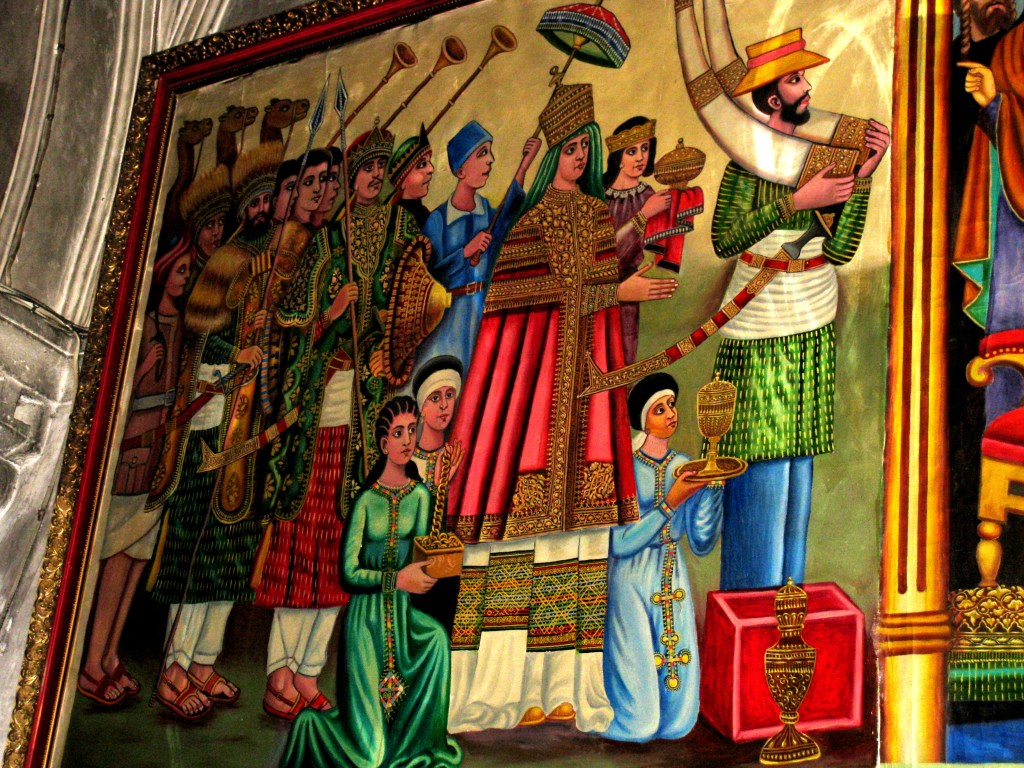
Although Tewodros II’s origins were in the Era of the Princes, his ambitions were not those of the regional nobility. He sought to re-establish a cohesive Ethiopian state and to reform its administration and church.
Tewodros II’s first task after having reunited the other provinces was to bring Shewa under his control. During the Era of the Princes, Shewa was, even more than most provinces, an independent entity, its ruler even styling himself Negus, the title for King. In the course of subduing the Shewans, Tewodros took with him a Shewan prince, Sahle Maryam, who he brought up as his own son, who would later become Emperor (or Atse) himself as Menelik II. Despite his success against Shewa, Tewodros faced constant rebellions by stiffnecked nobles in other regions not understanding the benefits of modernization. He ultimately committed suicide at the Battle of Magdala, during the British Expedition to Abyssinia.
In the first six years of his reign, the new ruler managed to put down these rebellions, and the empire was relatively peaceful from about 1861 to 1863, but the energy, wealth, and manpower necessary to deal with regional opposition limited the scope of Tewodros’s other activities. Tewodros II never realized his dream of restoring a strong monarchy, although he took many important initial steps. He sought to establish the principle that governors and judges must be salaried appointees. He also established a professional standing army, rather than depending on local lords to provide soldiers for his expeditions. He introduced the collection of books in the form of a library, tax codes, as well as a centralized political system with respective administrative districts. He also intended to reform the church but he was confronted by strong opposition when he tried to impose a tax on church lands to help finance government activities. Tewodros confiscation of these lands gained him enemies in the church and little support elsewhere. Essentially, Tewodros was a talented military campaigner.


 SummerSimo Travel Troubles Notes and The Purring Page
Leave a comment