The Lateran was the most important complex of the Roman Church from its origins until the 14th century and the abandonment of the city following the transfer of the papacy to Avignon.
The complex was built on the ruins of the Castra Nova equitum singularium, or “new fort of the Equites singulares,” which served as a base for the emperor’s cavalry corps, the Equites singulares Augusti. The area was probably donated by Constantine to the Roman Church for the construction of his first major cathedral (the Basilica of the Savior, now St. John Lateran).
The Lateran lies against the Aurelian Wall and thus i an eccentric position in relation to the center of Rome: from the beginning, it had to contend with the Palatine (seat of imperial administration) for the role of the city’s most important authority.
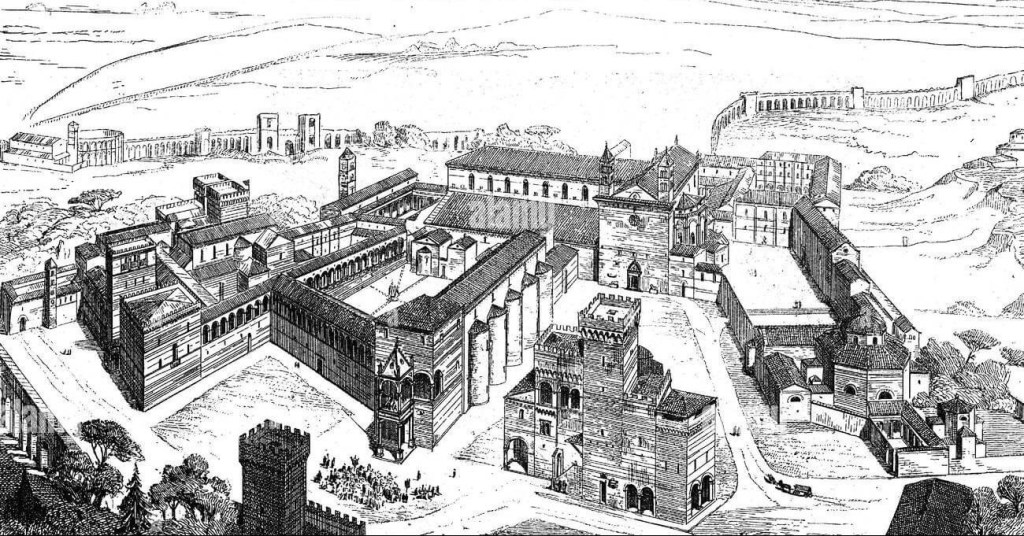
By the eighth century, the complex (called the “Patriarchio” because it was the seat of the Patriarch of Rome) was divided into two zones: one included the palace proper, with the Pontiff’s personal chapel, connected directly to the Basilica of the Savior; another was located further northwest and was connected to the main palace by a long colonnade (the Matrona). Very little of this remains today, because the palace was radically rebuilt in the 16th century at the behest of Pope Sixtus V: a fragment of the “second pole” is the so-called “holy staircase,” which today stands on the opposite side of the square from the Lateran Palace, clarifying how vast the complex was in the Middle Ages.
The Palace was enlarged and embellished by virtually all medieval popes, with the construction of Oratories, Triclini (large reception rooms) and dear other buildings. In the main square, stood the Marcus Aurelius, believed at the time to be the statue of Constantine (later moved to the Capitol). Also part of the complex was the Lateran Baptistery (pictured right), octagonal in shape and perhaps the progenitor of all octagonal baptisteries in Europe, built in the time of Constantine or immediately after.

 SummerSimo Travel Troubles Notes and The Purring Page
Leave a comment