Lady Katherine Gordon, daughter of the Scottish Earl of Huntly, emerges as a fascinating figure in the tumultuous Tudor era. While her first husband, Perkin Warbeck, falsely claimed to be Richard, Duke of York, one of the Princes in the Tower, this essay focuses on Katherine’s life and resilience rather than the veracity of Warbeck’s claim.
Katherine’s story begins with her marriage to Warbeck in 1496, encouraged by King James IV of Scotland to potentially secure an alliance with England. Letters supposedly from Warbeck to Katherine, reveal his admiration for her beauty and noble lineage. Following their marriage, Katherine was referred to as the Duchess of York, a title that would later be revoked upon the exposure of Warbeck’s true identity.
Their alliance with Scotland ultimately failed, leading them to seek support in Ireland and Cornwall. However, Warbeck’s rebellion was crushed, and both he and Katherine were captured by King Henry VII. While Warbeck was imprisoned, Katherine, due to her noble status, was treated leniently and placed in the Queen’s household.

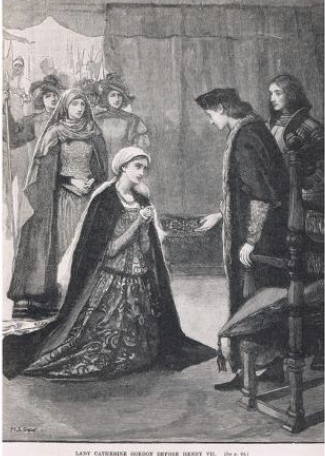
Despite the revelation of Warbeck’s deception, which invalidated their marriage, Henry VII showed Katherine kindness, providing her with new clothes and a position in the Queen’s household. This marked a turning point in Katherine’s life, as she transitioned from a royal captive to a trusted member of the English court.
Following Warbeck’s execution in 1499, Katherine remained at court, even serving as a chief mourner at Queen Elizabeth of York’s funeral. She continued to be favored by the King, playing cards with him, obtaining medicines, and creating artwork for him.
After Henry VII’s death, Katherine was granted land in Berkshire, on the condition that she would not leave England. She subsequently married three more times, enjoying a comfortable life with her husbands, who held positions at court.
Katherine’s life demonstrates remarkable resilience and adaptability. She navigated the complexities of Tudor politics and court life, overcoming adversity and building a new life for herself in England. While her marriage to Warbeck was based on deception, Katherine’s subsequent relationships and her position at court highlight her ability to forge her own path.
Katherine died in 1537, leaving behind a legacy of resilience and adaptability. Her story serves as a reminder of the challenges and opportunities faced by women in the Tudor era, and the importance of social status and connections in navigating a turbulent political landscape.
Sources:
- Calendar of State Papers Relating to Scotland and Mary, Queen of Scots 1547-1603, Vol. 1 (1547-1563), ed. Joseph Bain (Edinburgh, 1898), pp. 72-79
- Nathen Amin, Henry VII and the Tudor Pretenders (Amberley Publishing, 2017)
- Susan Abernethy, “The Life of Lady Katherine Gordon,” The Freelance History Writer
- Amy Licence, The Sixteenth Century in 100 Women (Amberley Publishing, 2023)

Additional Resources:
- The National Archives: http://www.nationalarchives.gov.uk/
- British History Online: http://www.british-history.ac.uk/
- The Tudor Society: https://www.tudorsociety.com/

 SummerSimo Travel Troubles Notes and The Purring Page
Leave a comment