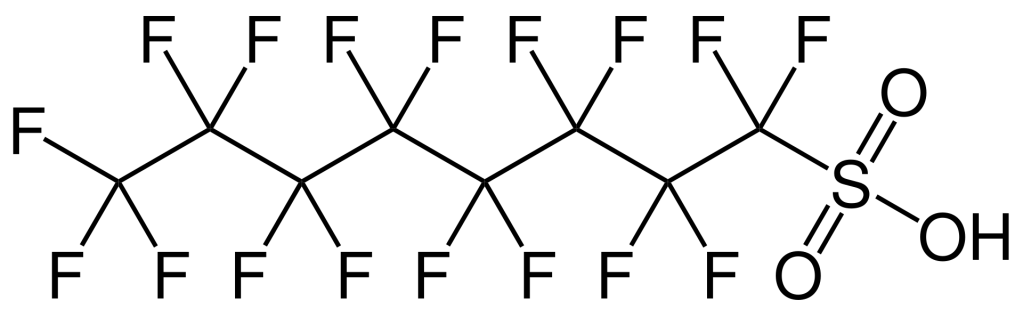
Due to their water- and oil-resistant properties, PFAS, a class of over 4,700 synthetic chemicals, have become ubiquitous in modern life. These chemicals have been linked to a wide range of adverse health effects, often referred to as “forever chemicals” due to their persistence in the environment and the human body.
Technical properties and uses are described below.
PFAS are distinguished by their robust carbon-fluorine bonds, rendering them highly resistant to degradation. This unique chemical structure is why they are so useful in a variety of applications.

PFAS, especially perfluorooctanoic acid (PFOA) and perfluorooctane sulfonate (PFOS), were widely used in the production of non-stick cookware due to their ability to absorb heat.
PFAS are used to treat fabrics in order to make them water- and stain-resistant, often found in outdoor clothing, carpets, and upholstery.
Aqueous film-forming foams (AFFF) containing PFAS have been extensively employed in firefighting, particularly for extinguishing fuel-based fires.
Some food packaging materials, such as microwave popcorn bags and fast food wrappers, contain PFAS due to their grease-proofing properties.
Health concerns and environmental impacts are discussed.
PFAS, despite their widespread use, have raised significant health and environmental concerns. Research has linked exposure to PFAS to a variety of health effects, including:

Cancer: Studies have demonstrated correlations between PFAS exposure and an elevated risk of kidney, testicular, and other cancers.
PFAS can interfere with the endocrine system, leading to developmental, reproductive, and metabolic issues.
The exposure to PFAS may weaken the immune system, making people more susceptible to infections.
PFAS have been associated with liver damage and elevated cholesterol levels.
The impact of PFAS on the environment is equally concerning. These chemicals are persistent and can accumulate in the environment, such as soil, water, and wildlife. Studies have revealed the presence of PFAS in a diverse range of organisms, including fish and polar bears, prompting apprehensions regarding their potential impact on ecosystems.
News and recent developments include the latest news and recent developments.
In recent years, there has been increasing awareness and concern regarding the risks associated with PFAS. This has resulted in an increase in research, regulatory actions, and litigations.
Several countries and states have imposed regulatory restrictions on the use of certain PFAS, including PFOA and PFOS.
A number of lawsuits have been filed against companies that produce or use PFAS, seeking compensation for environmental contamination and health effects.
Research progresses: ongoing research is providing new insights into the health and environmental impacts of PFAS, as well as potential solutions for remediation and prevention.
Emerging Research and Unknown Facts.
Despite the extensive knowledge regarding the potential hazards of polyfluoroalkyl substances (PFAS), there remain numerous unanswered inquiries. Several emerging areas of research include:
The effects of low-level exposure to PFAS are well-documented, but the long-term consequences of low-level exposure are still being investigated.
Certain populations, such as pregnant women, children, and firefighters, may be more vulnerable to the adverse effects of PFAS.
As certain PFAS chemicals are being phased out, new ones are being introduced, causing apprehensions regarding their potential hazards.
To conclude,
PFAS constitute a significant obstacle for both human health and the environment. As research continues to uncover the full extent of their impact, it is essential to prioritize efforts to reduce exposure, develop safer alternatives, and remediate contaminated sites. The growing awareness and regulatory actions around PFAS offer hope for a future where these “forever chemicals” no longer pose a threat to our well-being and the planet.
The developing landscape of PFAS regulation and litigation is changing.
As scientific understanding of PFAS toxicity deepens, regulatory agencies worldwide are taking steps to limit their use and mitigate environmental contamination. The U.S. Environmental Protection Agency (EPA) has issued health warnings regarding the presence of PFOA and PFOS in drinking water, and is currently engaged in the development of enforceable standards. Several states have taken further steps, enacting stricter regulations and even banning the use of certain PFAS in certain products.

In Europe, the European Chemicals Agency is restricting the use of PFAS under the REACH regulation, and the European Commission is considering further restrictions. The Stockholm Convention on Persistent Organic Pollutants also requires countries to take measures to eliminate or restrict their production and use.
The legal landscape surrounding PFAS is also evolving rapidly. Thousands of lawsuits have been filed against manufacturers of PFAS, claiming that they were aware of the dangers of these chemicals, but failed to disclose them. Some of these lawsuits have resulted in substantial settlements, wherein corporations have agreed to fork over billions of dollars to clean up contaminated sites and compensate individuals who have been adversely affected by PFAS exposure.
Emerging research and questions remain unanswered.
Although the harmful effects of PFAS are becoming increasingly clear, there are still many unknowns that require further research. The impact of low-level exposure to PFAS is an area of ongoing investigation. Although high levels of exposure have been linked to a range of health problems, the long-term effects of low-level exposure are still unclear. Studies are currently underway to ascertain whether even modest amounts of PFAS may have detrimental health consequences over a prolonged period.
Another area of research is centered around the impact of PFAS on vulnerable populations. Pregnant women, children, and individuals with compromised immune systems may be more susceptible to the detrimental effects of PFAS. Research is needed to better understand how PFAS exposure affects these populations and to develop strategies to protect them.
Additionally, the development of new PFAS chemicals poses a challenge. Since some PFAS are being phased out, manufacturers are introducing new, replacement PFAS. Despite the possibility of being less persistent or toxic, the long-term effects of these novel chemicals remain uncertain. Research is needed to evaluate the safety of these new PFAS and ensure that they do not pose similar risks to human health and the environment.

Strategies for remediation and prevention.
The remediation of PFAS-contaminated sites is a complex and expensive undertaking. Numerous technologies are currently being developed and evaluated to eliminate PFAS from water and soil. These include granular activated carbon filtration, ion exchange resins, and advanced oxidation processes. However, these technologies can be expensive and not always effective for all types of PFAS.
Preventive measures are key to addressing the PFAS problem. This entails reducing the utilization of PFAS in both consumer products and industrial processes, as well as identifying safer alternatives. Certain corporations are voluntarily eliminating PFAS, while others are compelled to do so by regulatory mandates. It is also crucial for reducing our reliance on these harmful chemicals to develop innovative technologies that can replace PFAS in various applications.
The significance of consumers and communities.
Consumers and communities can also play a significant role in addressing the PFAS issue. People can contribute to the effort to reduce PFAS exposure and protect public health by choosing products that are PFAS-free, supporting policies that restrict the use of PFAS, and advocating for clean water and environmental protection.
Communities that have been impacted by PFAS contamination have the opportunity to take appropriate measures. This may entail organizing to demand clean water, participating in research studies, and advocating for more stringent regulations. By collaborating, communities can raise awareness about the PFAS issue and demand accountability from those accountable for the contamination.
The future of the PFAS is uncertain.
The prospects for PFAS are uncertain. Although there is increasing awareness about the risks associated with these chemicals, there is also strong resistance from some industries that rely on them. The development of safer alternatives and the implementation of stringent regulations will be pivotal in effectively addressing the PFAS issue in the long run.

However, the challenge of PFAS is not only technical or regulatory. In addition, it is a social and ethical issue. We must confront the question of how to reconcile the benefits of modern conveniences with the risks they pose to our health and the environment. We must also consider corporations’ responsibility to produce safe products and to disclose the risks associated with their use.
The PFAS problem is a complex one, but it is not impossible to overcome. Through working together, scientists, policymakers, industry leaders, and communities can find solutions to reduce our reliance on PFAS and protect the health of both people and the planet.
As we progress, it is imperative to bear in mind that the PFAS issue is not solely concerned with safeguarding ourselves and our families. It aims to protect the environment for future generations. By taking action now, we can create a world in which PFAS are no longer a threat to our well-being and the health of our planet.
Additional resources are available below.
The Environmental Protection Agency (EPA) on PFAS is available at https://www.epa.gov/pfas.
The Agency for Toxic Substances and Disease Registry (ATSDR) on PFAS can be found at: https://www.atsdr.cdc.gov/pfas/index.html.
The Environmental Working Group (EWG) on PFAS: https://www.ewg.org/areas-focus/toxic-chemicals/pfas-chemicals#:~:text=We%20need%20your%20help%20to%20protect%20our%20environment%20from%20toxic%20PFAS%20chemicals.&text=PFAS%20contamination%20in%20the%20U.S.,are%20known%20to%20be%20contaminated.
We can achieve a world without the harmful effects of PFAS.

 SummerSimo Travel Troubles Notes and The Purring Page
Leave a comment