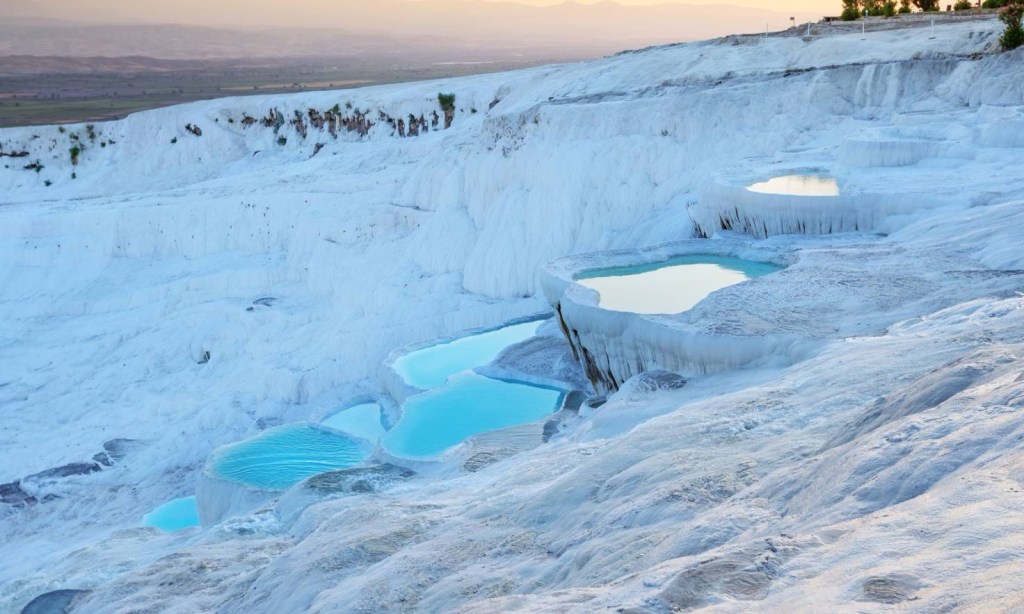
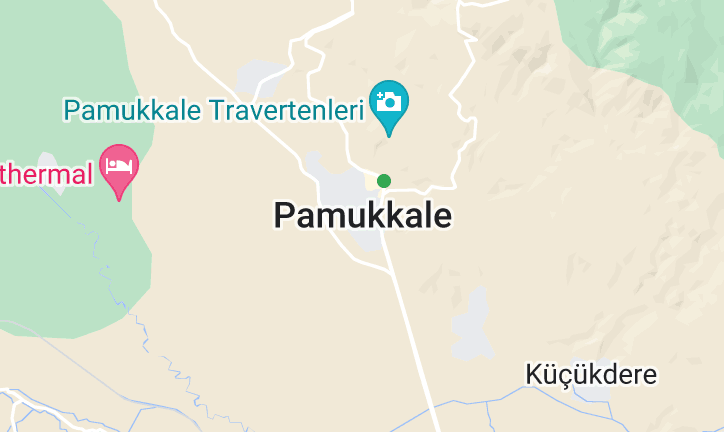
Pamukkale, which means “cotton castle” in Turkish, is a natural site in southwestern Turkey, in the province of Denizli.The ancient Greek city of Hierapolis was built on top of the travertine formation which is in total about 2,700 metres (8,860 ft) long, 600 m (1,970 ft) wide and 160 m (525 ft) high. It can be seen from the hills on the opposite side of the valley in the town of Denizli, 20 km away. This area has been drawing visitors to its thermal springs since the time of classical antiquity.The Turkish name refers to the surface of the shimmering, snow-white limestone, shaped over millennia by calcite-rich springs. Dripping slowly down the mountainside, mineral-rich waters collect in and cascade down the mineral terraces, into pools below.
Pamukkale’s terraces are made of travertine, a sedimentary rock deposited by mineral water from the hot springs. In this area, there are 17 hot springs with temperatures ranging from 35 °C (95 °F) to 100 °C (212 °F). The water that emerges from the spring is transported 320 metres (1,050 ft) to the head of the travertine terraces and deposits calcium carbonate on a section 60 to 70 metres (200 to 230 ft) long covering an expanse of 24 metres (79 ft) to 30 metres (98 ft). When the water, supersaturated with calcium carbonate, reaches the surface, carbon dioxide de-gasses from it, and calcium carbonate is deposited. Calcium carbonate is deposited by the water as a soft gel which eventually crystallizes into travertine.
Tectonic movements have not only caused frequent earthquakes, but have also allowed the emergence of numerous hot springs.
The water that flows from it is overlaid with calcium ions and carbon dioxide, which forms carbonic acid with the water.
As it emerges, the water loses much of its carbon dioxide, shifting the chemical balance from bicarbonate to calcium carbonate, which, partly because of the drop in temperature precipitates giving rise to the characteristic formations, consisting of thick white layers of ice limestone.
Pamukkale is indeed a fascinating natural phenomenon. The chemical reaction you describe is a classic example of calcium carbonate precipitation. When water rich in calcium bicarbonate emerges from the hot springs, the loss of carbon dioxide (CO₂) causes a change in the chemical equilibrium:
Ca(HCO3)2→CaCO3+H2O+CO2
This process causes insoluble calcium carbonate (CaCO_3) to precipitate, forming those beautiful white terraces that look like they are made of cotton or ice. The beauty of Pamukkale is a perfect example of how geological phenomena and chemical reactions can create breathtaking natural landscapes. Thanks for sharing this interesting piece of natural science!



 SummerSimo Travel Troubles Notes and The Purring Page
Leave a comment