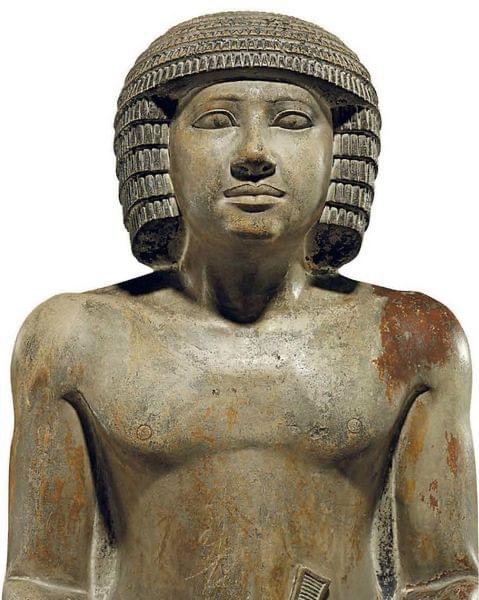
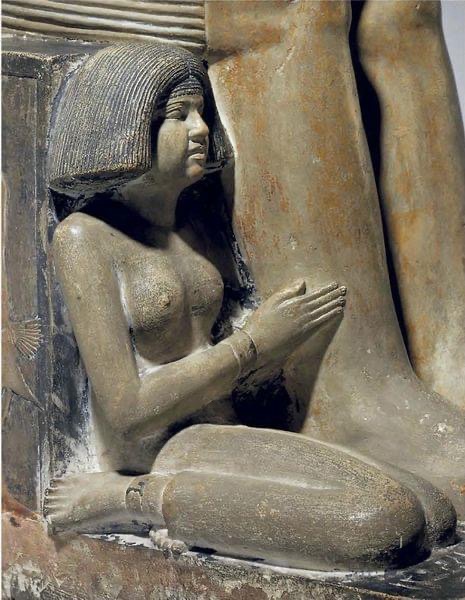
Depicts the scribe Sekhemka with his wife Sitmerit.
The statue was found in Saqqara in the royal cemetery in the mid-19th century. The hieroglyphic inscription on the statue reads: “Inspector of scribes at the house of the master of bounty, one revered before the great god, Sekhemka
Polychrome limestone.
Al-Ahram Weekly reports that one account describes the statue as being acquired by the Northampton Museum in 1849 from the Ottoman Sultan, while another version claims it was acquired by the 2nd Marquess of Northampton during a trip to Egypt, after which his son donated it to Northampton Museum in the 19th century. T. G. H. James noted in 1961 that the Northampton Museum did not have precise information about the acquisition of the statue, but that it was presented to the museum around 1870 by the 3rd Marquess of Northampton and, based on the record from 1899, it was likely that he was acquired by the 2nd Marquess during a trip to Egypt in 1850.
“The Curse of Sekhemka”
In July 2013, a local politician who opposed the sale of the statue commented: “I read that there is a curse on Sekhemka, and if it falls on anyone, it should fall on this administration for not having the courage to change your opinion.” The day before the scheduled sale, the office of the Marquess of Northampton’s estate, Ashby Castle, caught fire, leading to stories of the “Curse of Sekhemka”. Firefighters from three counties battled the fire.
Auction
Christie’s sold the Sekhemka statue for £15.76 million at auction on July 10, 2014, to an anonymous buyer. The auction was briefly stopped by a protester who declared that “no one should bid or buy it… stolen property” while a small group of Egyptian protesters demonstrated outside. The final auction price was almost £10 million above Christie’s guide price. The resulting price broke the existing world record for a piece of Ancient Egyptian art sold at auction.


 SummerSimo Travel Troubles Notes and The Purring Page
Leave a comment