Old London Bridge, a marvel of medieval engineering and urban planning, stood as a bustling thoroughfare and a vibrant residential area from its completion in the early 13th century until it was replaced in the 19th century. This bridge wasn’t just a passageway over the River Thames; it was a lively, self-contained community and a significant commercial hub, earning its place as one of the wonders of the world during its time.
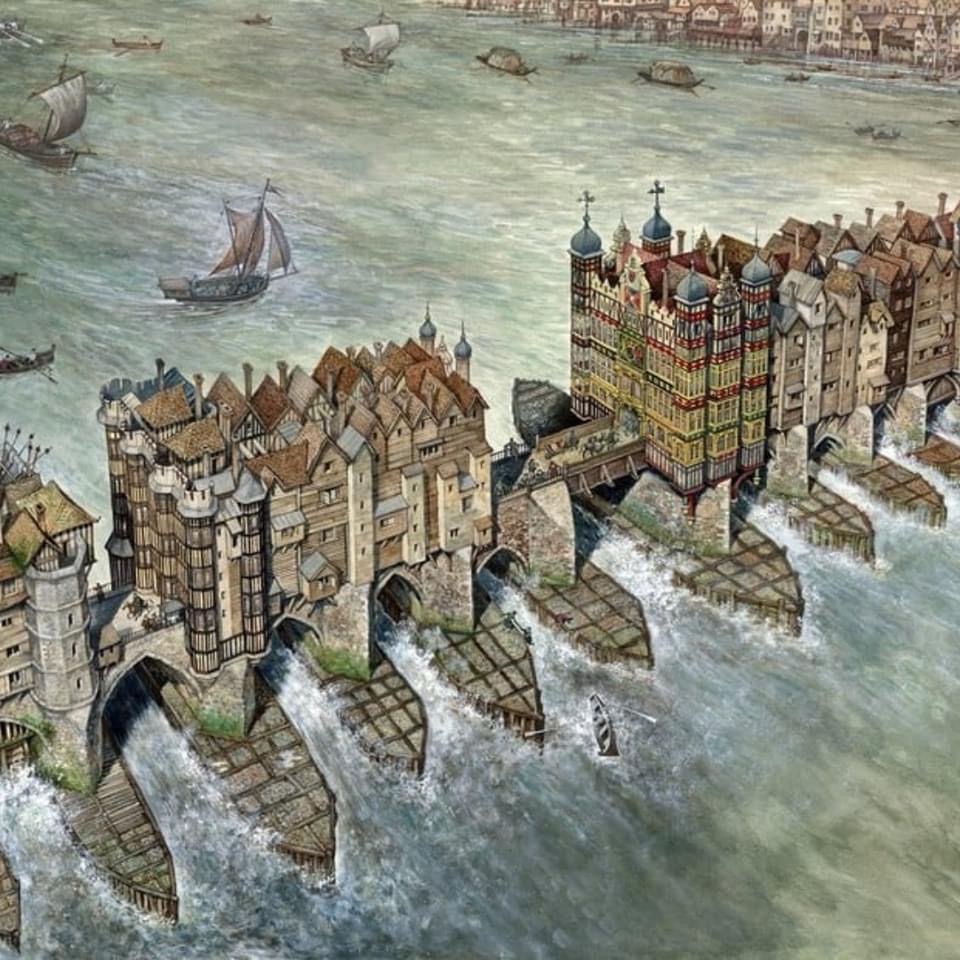
Constructed starting in 1176 and completed in 1209, Old London Bridge was an architectural and societal phenomenon. Its length spanned over 900 feet (approximately 275 meters), and at its peak, it supported a chaotic ensemble of buildings, some of which reached up to seven stories high. The variety of structures included not just shops and houses, but also pubs, churches, and gatehouses. This made the bridge a bustling miniature town perched above the river.
The idea of building such a bridge came from the necessity to replace a succession of timber bridges that had previously spanned the Thames but were vulnerable to fire and decay. The stone bridge designed by Peter of Colechurch was a solution to this problem, offering a more durable crossing that could support the weight of numerous buildings and the throngs of people and goods moving across it daily.
The bridge’s construction was a monumental task. It featured 19 narrow arches, which, while sturdy, significantly impeded the flow of the river. This created strong rapids that could be dangerous to boats and contributed to the freezing of the river during severe winters. Despite these challenges, the bridge thrived as a commercial center. Its shops and residences were highly sought after, with rents contributing to the maintenance of the bridge.
One of the most notable features of Old London Bridge was the southern gatehouse, which displayed the heads of executed traitors on spikes—a grim warning to those entering the city. Over the centuries, the bridge underwent numerous modifications and repairs. By the 18th century, the structures on the bridge were deemed unsafe and started to be removed, with the bridge itself being replaced between 1824 and 1831 by a new structure designed by John Rennie.
Today, while the Old London Bridge no longer stands, its legacy lives on. It set a precedent for bridge construction and urban development, symbolizing the ingenuity and ambition of London throughout the ages. Its memory is preserved in art, literature, and history, continuing to fascinate people with its stories of commerce, community, and architectural wonder.
The story of Old London Bridge is a testament to the ingenuity and resilience of medieval engineering and urban planning. Its existence bridged not only the banks of the Thames but also the historical periods, serving as a critical artery in the life of London for over 600 years. The bridge was more than a mere structure; it was a lively, bustling microcosm of London’s broader society, encapsulating the vibrancy, challenges, and the spirit of its era.
The daily life on Old London Bridge was unlike anywhere else in the city. Imagine walking through a narrow street flanked on both sides by buildings leaning towards each other, nearly touching at the top, with the river flowing rapidly underneath. The bridge was alive with the sounds of merchants hawking their wares, blacksmiths clanging, bakers selling fresh loaves, and the chatter of the myriad of people passing through. It was a place where Londoners lived, worked, and socialized, creating a unique community suspended over the Thames.
One cannot overlook the strategic and symbolic importance of Old London Bridge. It was the only physical connection between the city of London on the north bank and the Southwark district on the south bank until Westminster Bridge was opened in 1750. This made it a key point for trade and defense, as well as a significant bottleneck for river traffic and an occasional flashpoint during periods of unrest and rebellion.
The technical aspects of the bridge’s construction also speak volumes about the capabilities of medieval builders. Constructing such a long, stone-arch bridge in the fast-flowing Thames was an enormous challenge. The piers of the bridge had to be built on wooden caissons, which were essentially watertight chambers sunk into the riverbed. This required innovative techniques and a deep understanding of hydraulic engineering, stonemasonry, and carpentry.
Despite its architectural marvels, the bridge had its drawbacks. The narrow arches created a bottleneck for river traffic and were a hazard during floods, leading to the famous “London Bridge is falling down” nursery rhyme, believed to reflect the recurring need to repair and rebuild the bridge. Furthermore, the weight and vibrations caused by the heavy traffic and the buildings took a toll on the structure, necessitating constant maintenance.
In its later years, as the medieval city gave way to a more modern London, Old London Bridge seemed increasingly anachronistic. The decision to replace it was driven by the needs of a growing city in the throes of the Industrial Revolution, requiring wider, more stable crossings to accommodate larger volumes of traffic and trade.
The legacy of Old London Bridge is a reminder of London’s medieval past, a period when the city emerged as a political, economic, and cultural powerhouse. The bridge might have been replaced, but its memory lingers in the city’s collective consciousness, a symbol of London’s enduring spirit and its capacity to evolve while cherishing its rich history.

 SummerSimo Travel Troubles Notes and The Purring Page
Leave a comment