The Polish saber, known in Poland as the “szabla,” holds a significant place in the military history and cultural heritage of Poland. By the 18th century, it had evolved into a symbol of the Polish nobility (szlachta) and was a key element of their military and social identity. The Polish saber was not just a weapon but also a work of art, often richly decorated and carefully crafted.
Historical Background
The szabla’s design was influenced by the military needs of the Polish-Lithuanian Commonwealth, which faced conflicts on multiple fronts against a variety of opponents. Its curved, single-edged blade was ideal for cavalry charges, enabling riders to slash effectively at enemies without getting stuck as straight swords might. The design of the saber was influenced by the sabers used by the Ottoman Turks, Hungarian hussars, and Tatars, with whom the Poles had extensive contact, whether through warfare or alliances.
Characteristics of the 18th Century Polish Saber
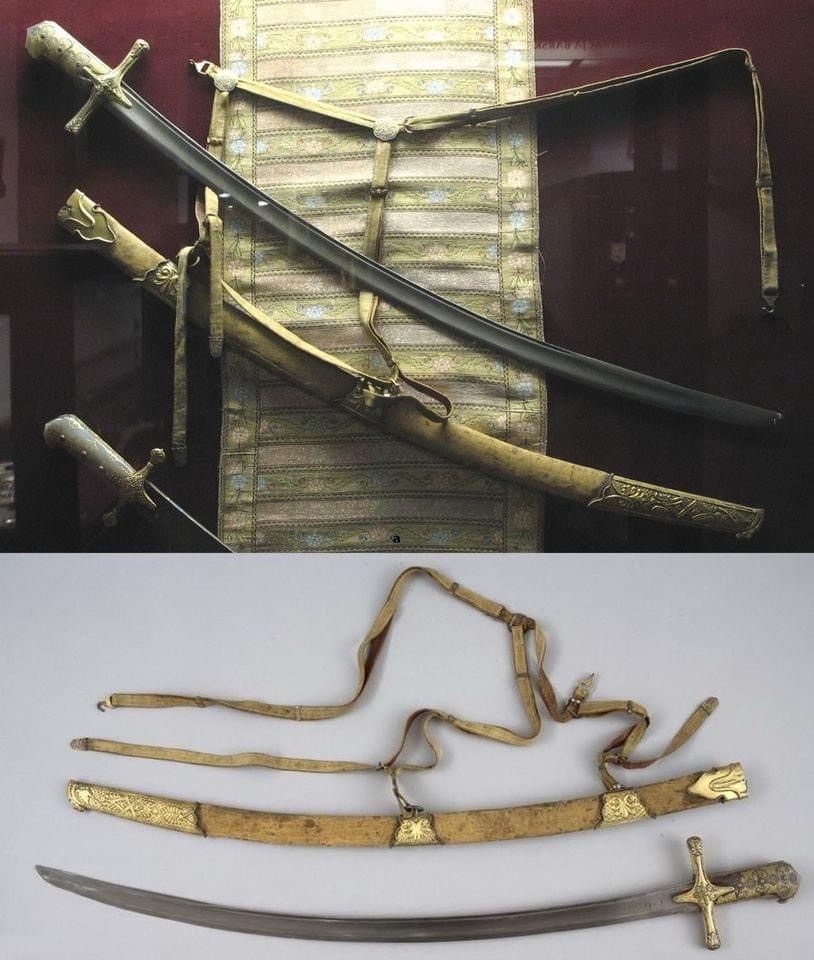
- Blade: The blade of an 18th-century Polish saber typically had a gentle curve and was single-edged, though it might have had a false edge near the tip. The curve was optimized for the slashing attacks used by cavalry.
- Hilt: The hilt often featured an open guard with a knuckle-bow, which provided protection for the hand. The grip was designed to fit snugly in the hand, allowing for precise control of the blade.
- Decoration: High-status examples were lavishly decorated with gold or silver inlay, featuring intricate designs, coats of arms, and sometimes inscriptions. These were not only weapons but also status symbols and works of art.
- Use: Beyond its military use, the saber was a key part of traditional Polish attire for the nobility. It was worn both as a symbol of social status and for personal defense.
Cultural Significance
The saber’s importance extended beyond the battlefield. It was a symbol of the nobility’s martial prowess, freedom, and the unique political system of the Polish-Lithuanian Commonwealth, where the nobility played a significant role in governance. The tradition of wearing a saber was so ingrained in Polish culture that it continued even into periods when Poland was partitioned and did not exist as an independent state.
In the 18th century, the Polish saber also played a role in the famous cavalry units known as the Winged Hussars, who were renowned for their spectacular armor and effective combat tactics, though by this time, the Winged Hussars were becoming more of a historical memory than an active military force.
Today, the Polish saber is celebrated as a national symbol and is studied by martial artists interested in historical European martial arts (HEMA). Replicas are crafted for ceremonial purposes, historical reenactments, and enthusiasts of military history.

 SummerSimo Travel Troubles Notes and The Purring Page
Leave a comment