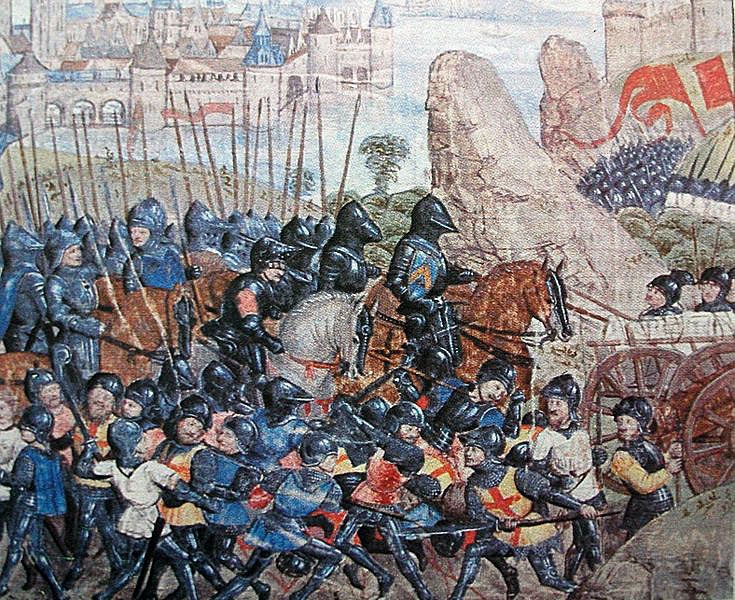
At four in the afternoon of 3rd May 1471 the Lancastrian army led by Margaret of Anjou arrived at Tewkesbury in Gloucestershire in order to cross the River Severn to Wales. However, by that time they had marched for a night and a day and it was decided that they should rest for the night. Queen Margaret was concerned according to the contemporary Historie of the Arrivall that ‘afore them and on every hand of them, were foul lanes and deep dykes, and many hedges with hills and valleys, a right evil place to approach as could well have been devised.’ The Yorkist army led by King Edward IV had marched at that time thirty miles through the Cotswolds in pursuit of the Lancastrian force.
The following day on 4th May 1471 the military commander of the Lancastrians Edmund Beaufort 4th Duke of Somerset deployed his army of around 6,000 men south of Tewkesbury Abbey. Somerset led the right wing, Lord Wenlock and Edward Prince of Wales the centre and John Courtenay 15th Earl of Devon the left. Queen Margaret retired to the rear with her retinue.
King Edward arrived later that morning and arranged his army of about 5500 men in battle order with Richard Duke of Gloucester on the left wing , himself and the Duke of Clarence commanding the centre and William Lord Hastings the right. King Edward also positioned a force of 200 mounted spearmen in the nearby park on his left in case of an ambush.
The battle commenced with a storm of arrows and cannon fire with which the Lancastrian army suffered heavily in the exchanges.
The Duke of Somerset therefore ordered an attack of his right wing calling for Lord Wenlock in the centre to join him. However, this attack was stoutly resisted by the Yorkist left commanded by the Duke of Gloucester joined by King Edward’s centre. The 200 mounted spearmen also joined in the attack on the Lancastrian right which was soon put to flight to the rear and through the Bloody Meadow near the river Avon. According to one account the furious Duke of Somerset rode to the centre of his army which had not joined in the attack, called Lord Wenlock a traitor and dashed out his brains with a battle axe.
King Edward took advantage of the confusion in the Lancastrian ranks and ordered a general advance which put the remainder of the Lancastrian army to flight. Around 2,000 Lancastrian soldiers were killed including the Earl of Devon and Edward Prince of Wales whom according to the Arrivall ‘was taken fleeing to the townwards and slain in the field.’ The Duke of Somerset and many other Lancastrians tried to claim sanctuary at Tewkesbury Abbey although it did not have those rights.
On 6th May 1471 Somerset and fourteen other fugitives were dragged out of Tewkesbury Abbey and tried for treason at the marketplace by Richard Duke of Gloucester Constable of England and the Duke of Norfolk Marshall of England. The verdict was never in doubt and those tried were soon beheaded and buried at the abbey together with Edward Prince of Wales son of Margaret of Anjou.
Queen Margaret was later found at ‘a poor religious house’ by Sir William Stanley, brought before King Edward and later accompanied him back to London, arriving on 21st May 1471.
That night King Henry VI was put to death at the Tower of London according to the Warkworth Chronicle ‘being then at the Tower the Duke of Gloucester, brother to King Edward and many other.’
Below is a painting by Graham Turner which shows the attack of the 200 Yorkist spearmen against the Lancastrian right wing with John Beaufort Marquess of Dorset, Somerset’s younger brother attempting to warn his men.



 SummerSimo Travel Troubles Notes and The Purring Page
Leave a comment