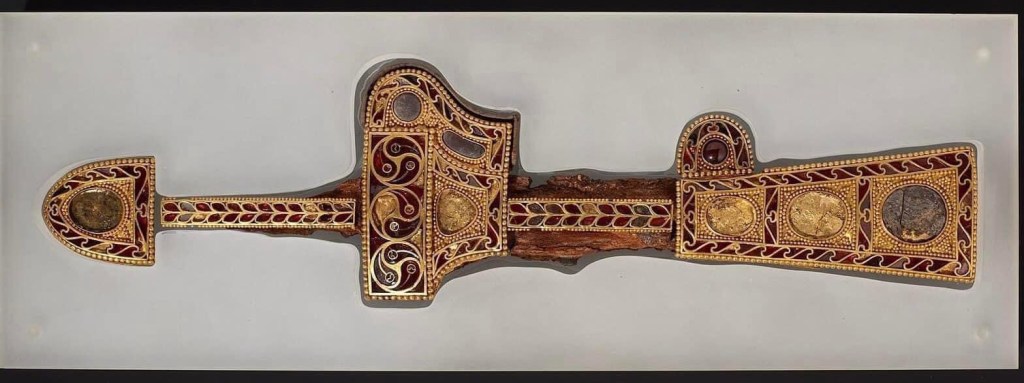
During construction of the Gyerim-ro road east of Daerunwon in 1973, 55 Silla tombs were discovered, including bank tombs and wooden chamber tombs with stone embankment. One of them was named Tomb No. 14 Gerim-Ro, which became the center of attention after a golden dagger was pulled from there.
The red gems — garnets — were encrusted in the golden surface of the dagger’s handle and feathers, which enhanced their luster. Inlaid pieces of glass were also used as a finish. Similar artifacts, decorated with grenades and gold-encrusted glass, were found in a grave in Borovy in Kazakhstan and in Taganroz, located on the coast of the Sea of Azov, which is the northeastern extension of the Black Sea.
The Golden Dagger is significantly different from other village swords in form, manufacturing technique and way of wearing. This proves that he was a foreign import. Similar daggers were found in a grave in Borovomu, located in Kazakhstan, Central Asia. They have also been seen on the murals of the Kyzyl caves in Xinjiang, China, and on the murales of the Afrasiab Castle, located in Samarkand, Uzbekistan. So it looks like this type of dagger was popular in the Black Sea of Central Asia.

 SummerSimo Travel Troubles Notes and The Purring Page
Leave a comment