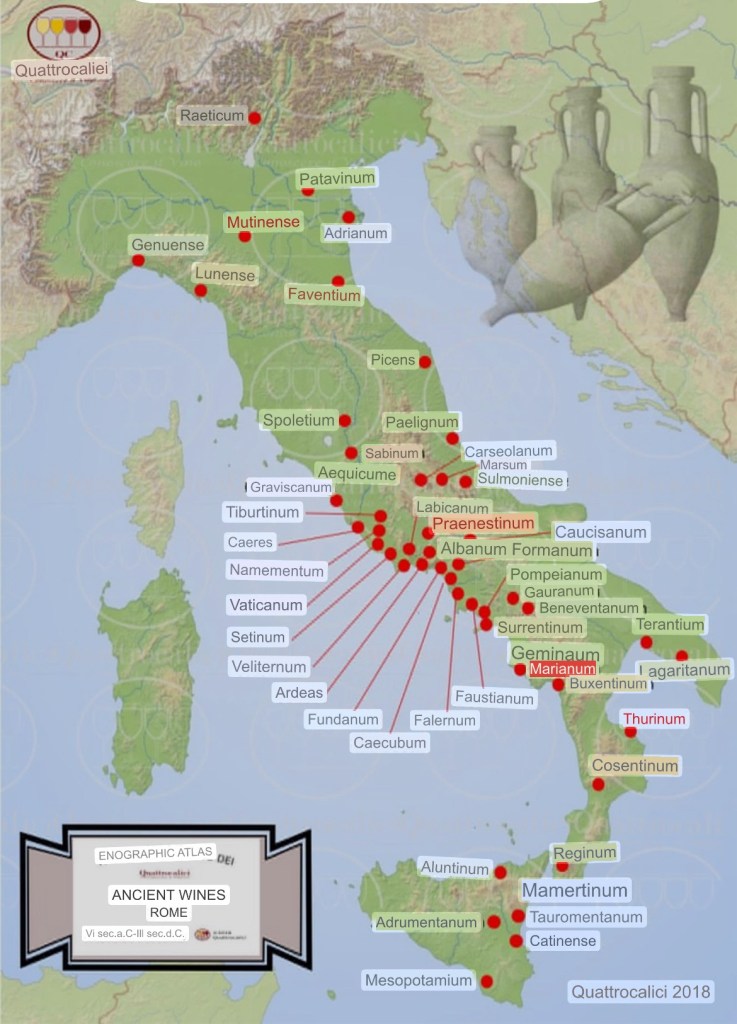
In early times, wine came from vineyards located near the marshy areas and hills of Latium. The vines were low to almost the ground, had no supports, and produced poor wine. The wine was used in rituals with sacrifices: if so, it was not to have been produced from grapes crushed by feet bearing wounds, nor from vines that had not been pruned, struck by lightning or near which a hanging had taken place. All this was sacrilegious. Rome, in the cultivation of vines, was influenced by the Etruscans and Greeks. The Etruscans were already cultivating vines before the arrival of the Greeks, and by domesticating wild vines through wooden supports, they obtained better quality wines. During the period of Greek colonization, between the 8th and 6th centuries B.C., there was the spread of the cult of Dionysus, the patron god of viticulture, which passed from the Etruscans to the Romans under the name of Bacchus. These two peoples helped create a diversification of plants and grape varieties, with repercussions that are still felt today: some grape varieties are believed to be the direct descendants of those of ancient Rome. Pliny surveyed eighty qualities of wine, two-thirds of which were produced in Italy. In the first half of the second century B.C., wrote Cato in De Agricoltura, the vineyard is now the most widespread crop. Its management is no longer family-based, but highly professional: vineyards are efficient and well-structured farms, with an average of 200 hectares of arable land and many slaves organized in a quasi-military manner, forced to work within a precise and systematic production process. Wine imposed itself as the most important drink on the tables of every Roman citizen. But it was not only men who drank; wine mixed with water was made to be drunk as an invigorating drink even by some beasts of burden, such as overheated oxen and lean horses. Methods of storing wine differed according to climate. In Alpine regions, wooden containers reinforced with hoops (following a technique of Gallic origin) were used, and in winter it was protected from frost by lighting fires. In milder regions, it was stored in huge earthenware jars (dolium, doglio) treated with pitch, washed with salt water, sprinkled with ashes, allowed to dry, scented with myrrh and buried. Another method of preserving wine was smoking, which was widely practiced in the city of Marseille. The wine arrived in Rome aboard special ships (vinariae), contained in amphorae with a capacity of about twenty liters. The amphorae were corked and sealed with pitch, clay, and plaster; the contents and vintage year of the wine were identified by an inscription on the amphora or on a label (pittacium). Rome had a port (portus vinarius) and a market (forum vinarium), dedicated to the unloading and sale of wine. In ancient Rome, what mainly interested people about wine was its euphorizing and socializing effect and its alleged therapeutic virtues. Romans never drank pure wine, and those who did were considered drunkards; it was diluted with water, allowing it to be drunk in large quantities. Wine was also made from figs, dates, carobs, pears, apples, cornelian cherries, myrtle, medlars, sorbs, dried blackberries, and pine nuts. Very often it was flavored with the many spices and other products available on the market: myrrh, spikenard, calamus, cinnamon, cinnamon, cinnamon, saffron, palm, asaro, laurel, honey, dates, pepper, cloves, ginger, amber, resin, musk, plum. Fennel was also widely used, and has been so over the centuries: in modern times, it will be used to mask the taste of wine gone bad. From this habit came the word infinocchiare. A widely drunk type of wine was mulsum, a wine sweetened with honey, but sometimes also with figs and dates. According to one legend, the first person to mix honey with wine was Aristaeus in Thrace: the wine was that of Maronea, which, according to Homer, Odysseus offered to Polyphemus to get him drunk. Wine was also obtained from dried grapes, famous was that of Crete, and it was also customary to consume the wine by melting snow on it or filtering it in a soft linen bag. Greenhouses were already known, some vines were in fact grown inside glass constructions. At the end of the Republic, members of the upper classes had the opportunity to taste wines of different provenance and quality and to be able to appreciate their different peculiarities. Great prestige had Cecubo wine, which soon disappeared due to the producers’ fault, the small size of the fields, and the land expropriations carried out by Nero in view of the construction of a navigable canal. Emperor Augustus preferred over all the wine of Sezze, produced at the beginning of the Pontine plain southwest of Rome; while Martial loved the Spanish wine of Tarragona, which he considered inferior only to wines from Campania. An idea of what the finest wines of the time were comes to us from Caesar, who, on the occasion of his triumph, offered two Greeks, produced in Chios and Lesbos, and two Italians: the Sicilian Mamertino and the Campanian Falerno. Falernum was produced in the Ager Falernus, between Calenus and Sinuessa in Campania, near Mount Massico. This is to be considered, probably, the first territory that produced a wine with a Denominazione di Origine Controllata (DOC) designation: the amphorae of Falernum, in fact, bore written not only the date of production but also the place of origin. This wine was distinguished from others by its ability to age. In the third century A.D., with the end of territorial expansion and the consequent smaller number of prisoners of war to enslave, wine production also changed in Rome, reverting to less optimized forms; this was compounded by the strong moralizing thrust of the Christian tradition, with the affirmation of a more morose view of life and customs; yet it was paradoxically thanks to the Church that wine technology and viticulture managed to survive, wine being a fundamental element for the celebration of the Mass.
Taken from the book Passions and Amusements in Ancient Rome
Pliny the Elder, Naturalis historia, book XIV, 23.
Columella, De re rustica, II, 3,2 and VI, 30,1.
Pliny the Elder, Naturalis historia, book XIV, 27.
Martial Epigrams, book X, 36.
Pliny the Elder, Naturalis historia, book XIV, 8, 19.
Homer, Odyssey, IX, 450-452, 461-462
Martial, Epigrams, book V, 64.
Martial, Epigrams, book I, 87; VIII, 45.
Martial, Epigrams, book VIII, 68.
Pliny the Elder, Naturalis historia, book XIV, 8.
Suetonius, Lives of the Caesars, 31, 5.
Pliny the Elder, Naturalis historia, book VIII, 43.
Martial, Epigrams, Xenia, 118.
Pliny the Elder, Naturalis historia, book XIV, 17.

 SummerSimo Travel Troubles Notes and The Purring Page
Leave a comment