Write about your first computer.
The Commodore 64 was not just a technological marvel of its time; it was a pedagogical revolution. It arrived in homes and schools, not merely as a tool for work, but as an educational catalyst. For many of us, it was the first time we encountered the concept of personal computing, a device that demystified the digital world.
It introduced us to the fundamentals of programming. With no internet to offer instant solutions, we relied on trial and error, on manuals and magazine tutorials that guided our first steps into coding. It taught us patience and persistence, as we keyed in lines of code, debugging programs character by character.
Schools started to integrate it into their curriculum, recognizing the potential of computer literacy as a cornerstone for future careers. Students who might have struggled with traditional subjects found a new avenue for creativity and problem-solving. It was a level playing field where only your skill and imagination set the limits.
Parents and teachers, often unfamiliar with this new technology, had to adapt, learning alongside the younger generation. It became a shared journey, with children sometimes becoming the tutors, empowering them and altering family dynamics.
As technology evolved, so did the pedagogical approaches. Simplicity gave way to complexity, and the solitary learning of the Commodore 64 era morphed into collaborative and networked experiences. The seeds planted by those early experiences with the Commodore bore fruit in a populace more prepared for the digital age, capable of critical thinking and adaptability in the face of ever-changing technological landscapes.
The Commodore 64, in its own quaint way, laid the groundwork for the digital fluency we see today. It was a stepping stone that allowed us to transition into the advanced computational world, carrying the lessons it taught us into the fabric of our current digital society.
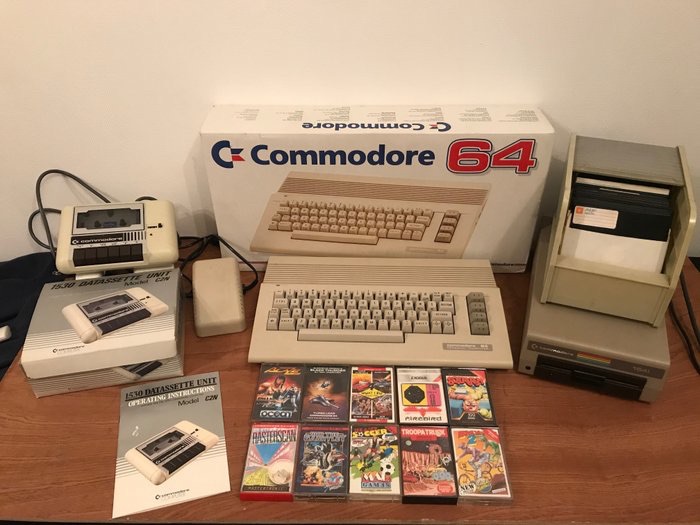
The first time I saw a Commodore 64, it was like gazing into a box of magic. The beige chassis, the hum of its data tape, it was more than a computer—it was the future resting on my childhood desk. I remember the weight of the manual in my hands, the smell of plastic and possibility.
My fingers danced on the keys, coding in BASIC, as if I were casting spells. Each time the screen flickered to life, my heart raced. I was a digital pioneer, exploring pixelated frontiers. The world outside faded; my room became a capsule, timeless.
When I programmed my first game, a simple maze of asterisks and spaces, I felt like a god in a universe of my own creation. The joystick was my scepter, the 8-bit sounds my symphony. Friends would huddle around as I showed off my latest creations, their eyes wide with wonder.
Nowadays, kids have devices a thousand times more powerful in their pockets. Yet, when I hear the name ‘Commodore 64,’ a smile tugs at my lips. It’s a tender ache, a whisper from a simpler time when every discovery felt monumental, every command line a conquest.
Nostalgia is a gentle wave washing over me, carrying me back to that little desk, where every problem had a solution, and every ending could be followed by a ‘RUN’ command. It’s not just a memory; it’s where part of me will always be—forever young, forever in awe.
The Commodore 64 was not just a technological marvel of its time; it was a pedagogical revolution. It arrived in homes and schools, not merely as a tool for work, but as an educational catalyst. For many of us, it was the first time we encountered the concept of personal computing, a device that demystified the digital world.
It introduced us to the fundamentals of programming. With no internet to offer instant solutions, we relied on trial and error, on manuals and magazine tutorials that guided our first steps into coding. It taught us patience and persistence, as we keyed in lines of code, debugging programs character by character.
Schools started to integrate it into their curriculum, recognizing the potential of computer literacy as a cornerstone for future careers. Students who might have struggled with traditional subjects found a new avenue for creativity and problem-solving. It was a level playing field where only your skill and imagination set the limits.
Parents and teachers, often unfamiliar with this new technology, had to adapt, learning alongside the younger generation. It became a shared journey, with children sometimes becoming the tutors, empowering them and altering family dynamics.
As technology evolved, so did the pedagogical approaches. Simplicity gave way to complexity, and the solitary learning of the Commodore 64 era morphed into collaborative and networked experiences. The seeds planted by those early experiences with the Commodore bore fruit in a populace more prepared for the digital age, capable of critical thinking and adaptability in the face of ever-changing technological landscapes.
The Commodore 64, in its own quaint way, laid the groundwork for the digital fluency we see today. It was a stepping stone that allowed us to transition into the advanced computational world, carrying the lessons it taught us into the fabric of our current digital society.


 SummerSimo Travel Troubles Notes and The Purring Page
Leave a comment