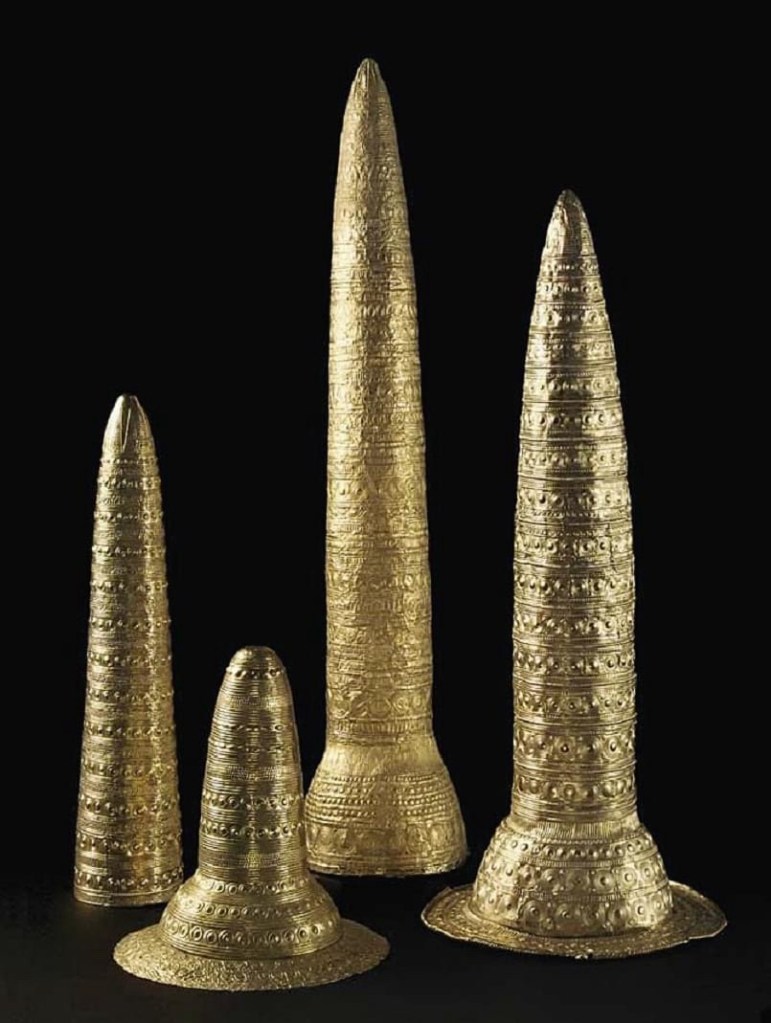
Occasionally, an astonishing find provides surprising new information about the civilizations of the past, challenging our understanding of ancient cultures. In this instance we have four astonishing finds, excavated at different times from different locations, all of them cone-shaped golden hats from the Bronze Age.
They appear to have been created sometime between 1400 – 800 BCE, and as such can be associated with the Urnfield culture which extended over much of Central Europe and is so named because the dead were cremated, put in an urn, and buried in a field. It seems to have been a dangerous age, since people lived in small heavily fortified settlements atop a hill, by the protective fold of a river, or in the middle of a marsh. Warriors wore heavy bronze armor, helmets and shields, and used a leaf-shape sword which could be used for slashing, instead of the stabbing swords that had been used by the previous Tumulus culture whose dead were buried beneath burial mounds.
All golden hats were made by hammering an ingot into paper-thin sheets of gold which were then decorated and wrapped around long conical brimmed headdresses made of some organic material, with oval openings that fit a human skull. Their metal composition is similar: about 88% gold, 11% silver, and less than 1% each of copper and tin. Their decorations are also similar, bands of orderly, systematic sequences of concentric circles and eye-like ovals, topped by – in three of the hats – a sun-like starburst design.
The first hat was discovered in 1835 at Schifferstadt in the German Rhineland. It is 29.6 cm high, it was made sometime between 1400–1300 BCE and it was buried with three bronze axes.
The second one was discovered in 1844 in Avanton, Western France. It is 55 cm high, it was made sometime between 1000-900 BCE, and is the only once missing a brim, though there are signs that there was one at some point.
The third one was discovered in 1953 near Ezelsdorf, Bavaria w. 88 cm tall, it was made between 1000-900 BCE.
The fourth was bought in 1995 by the Berlin Museum, its provenance unknown, though they think it came from southern Germany or Switzerland. 75 cm tall, it was probably made sometimes between 1000 and 800 BCE.
The Berlin hat is the best preserved and most extensively studied of all the Golden Hats.
It has 1,739 Sun and half-Moon symbols, which the curator of the museum believes represent a sophisticated code that accurately matches the Metonic cycle, a period of 19 years in which there are 235 lunations and 6,940 days. This cycle forms the basis of the Greek and Hebrew calendars, and is still used each year to decide the date for Easter.
There is a depiction of this 19-year cycle in a manuscript from the 9th century, showing a circle filled with concentric lines broken into sections, each containing a description of the moon phase and the position of the sun. It’s not difficult to imagine this drawing in 3D, pulling the center upward so that the lines become bands in a cone.
If the theory is right, it means that the user knew how to calculate the motions of the sun and moon, and could decide the best times for planting and harvesting crops. This knowledge could have turned the wearer into a sort of king-priest, which are known to have existed in prehistoric Europe.
Unfortunately, none were uncovered in thoroughly studied archaeological excavations. As a result, they lack much meaningful archaeological context, other than some knowledge of the site. Hence, we know nothing about them, and can only make guesses about their use.
What they do tell us is that the Bronze Age was a period during which complicated ideas and technologies were shared over large and diverse territories by societies that were a lot more sophisticated than previously considered…. and that in truth, we still know very little about our collective past.

 SummerSimo Travel Troubles Notes and The Purring Page
Leave a comment