Job offer wages received by job seekers and job seekers’ wage expectations rose in July, in another sign that inflation is leaving its mark on the labor market, and it is not retreating at all, on the contrary, and so the agitation begins that much higher wages will lead to even higher inflation. Indeed, “Core” inflation. , net of energy and agricultural products, is just going to stay high in the U.S.
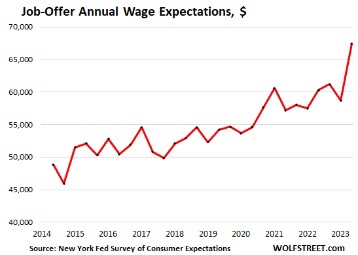
The wages that job seekers-not just the unemployed, but also employed job seekers looking for another job-expect to get in their job offers increased by $7,105, or 11.8 percent, from a year ago to an average of $67,400, according to the New York Fed’s Survey of Consumer Expectations (SCE) this morning. This part of the SCE is conducted three times a year, in July, November and March, as also reported by Wolfstreet.
This was the largest increase in wage expectations in terms of labor supply in the SCE data, dating back to 2014. It is clear that job seekers feel emboldened and that their wage expectations are at an all-time high: Employers, who still struggle to find qualified staff, seem to be playing along in order to hire. The average full-time salary of job offers that job seekers actually received increased by $8,711 over the previous year, or 14 percent, to a record $69,500 in July, according to SCE.
The lowest wage that job seekers would be willing to accept to accept a new job-the average reservation wage-increased 7.9 percent from the previous year to $78,600.
These are massive increases in what job seekers expect and what is offered to them. And this is happening against a backdrop in which unions are pushing for much higher wages and are not giving up union action to emphasize their demands. Minimum wages in states, counties and cities that provide them have also been increased, in some cases substantially.
In July, the average effective hourly wage for “production and non-supervisory employees”-the bulk of total employment-accelerated sharply, rising 0.45 percent from June, the largest monthly increase since November, amounting to a 5.5 percent year-on-year increase. This figure is based on the Bureau of Labor Statistics’ surveys of employers, which we previously reported on in August.
The effect of these pushes will be an increase in inflation, as we said, especially Core inflation. The FED will respond in a way that is correct from a financial point of view and most painful from a social and personal point of view: it will raise rates to the point of causing such a crisis that workers’ income expectations will be lowered. A most painful cure and one that politically will have harsh consequences in the election year.


 SummerSimo Travel Troubles Notes and The Purring Page
Leave a comment