Renowned numismatic auction house Stack’s Bowers Galleries unveiled in a press release an extraordinary ancient coin that is set to steal the show in the upcoming Global Showcase auction in August 2023 and is a very important piece of Roman history.
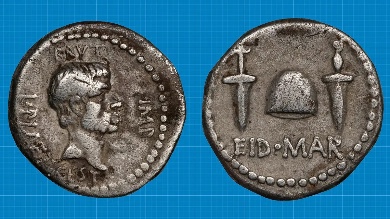
The centerpiece of the auction is the iconic EID MAR denarius, minted by Marcus Junius Brutus, Julius Caesar’s infamous assassin but formerly his friend, to whom the Dictator addressed with the famous words “Tu quoque, Brute, filii mi” The importance of the coin in the context of ancient numismatics is unparalleled and makes it a timeless masterpiece. This historically significant coin was minted around 42 B.C., some two and a half years after the assassination of Julius Caesar. The coin’s intriguing iconography tells a powerful story: two daggers represent the means of Caesar’s death, while the Phrygian cap symbolizes the Republic’s freedom from tyranny.
In addition, the coin explicitly mentions the date of the assassination, designated as “EID MAR” in the Roman calendar, which commemorates the Ides of March, when the betrayal occurred. Experts predict that the EID MAR denarius will fetch a considerable price at auction, given the recent surge in popularity of these ancient coins. Earlier this year, similar specimens fetched staggering prices of around $600,000 and $720,000. The rarity and historical importance of this coin ensures that the fervor at Stack’s Bowers auction will be equally enthusiastic. Two years ago the extremely rare gold version of the same coin , an aureus, was sold for about $4 million and is one of the oldest coins.
The intriguing story of Julius Caesar’s assassin.
The story of the EID MAR Denarius is as fascinating as the coin itself. Julius Caesar declared himself “perpetual dictator” after a series of military victories, causing unrest among politicians who saw his power as excessive, with the risk of him proclaiming himself king, something unacceptable for an ancient Roman.
A group of Roman senators, led by Marcus Junius Brutus and Cassius, orchestrated a plot to assassinate Caesar, ending his life on the Ides of March in 44 BCE.
After carrying out their deed, they expected to be hailed as heroes by the people, but instead found themselves isolated and opposed by Caesar’s supporters, including his heir Octavian and his lieutenant Mark Antony. Brutus and Cassius were forced to flee Rome and seek allies in other provinces of the empire.
For two years, Brutus and Cassius fought a civil war against the forces of Octavian and Antony, who wanted to avenge Caesar and consolidate their power. The decisive battle took place at Philippi, Macedonia, in 42 BC. Brutus and Cassius had a larger but less trained and motivated army. Moreover, they were divided between them by disagreements and suspicions. In the first phase of the battle, Cassius was defeated by Antony and committed suicide, mistakenly believing that Brutus had also been beaten. In the second phase, Brutus managed to hold out for a while, but then he was surrounded by enemy troops and stabbed himself with the same sword with which he had killed Caesar.
Brutus and Cassius died as they had lived: convinced that they had acted for the good of the republic, but in reality victims of their ambition and political blindness. Their deaths marked the end of the republican era and the beginning of the imperial era in Rome.
The EID MAR denarius was born during the Battle of Philippi, when Brutus minted the coin to pay his soldiers. The obverse features the bust of Brutus and the inscription “BRUT IMP,” indicating the commander Brutus. At the time, it was enough to have silver or gold to mint coinage, which, with these inscriptions, also became a means of communication.
The journey of a rare coin to auction
The upcoming auction at Stack’s Bowers Galleries will be the third in the prestigious Dr. Michael Rogers Collection. Previous sales of this collection have already set impressive records, with auras of Elagabalus, Macrinus and Othon achieving remarkable prices.
The silver denarius EID MAR, which is expected to reach $300,000, is an extraordinary find among ancient coins. Although hundreds of thousands of these coins were minted at the time, only about 100 survive today.
Most of them were found in Greece, but some have surfaced in various other countries, revealing the coin’s wide circulation at least as far back as 4 BCE.
As numismatic enthusiasts eagerly await the auction, the rare EID MAR denarius is poised to make history once again, attracting collectors from all corners of the world to vie for this timeless piece of ancient history.
This article was written and edited by a human being, with the help of generative AI tools. To learn more about our AI-based writing policy, click here.


 SummerSimo Travel Troubles Notes and The Purring Page
Leave a comment