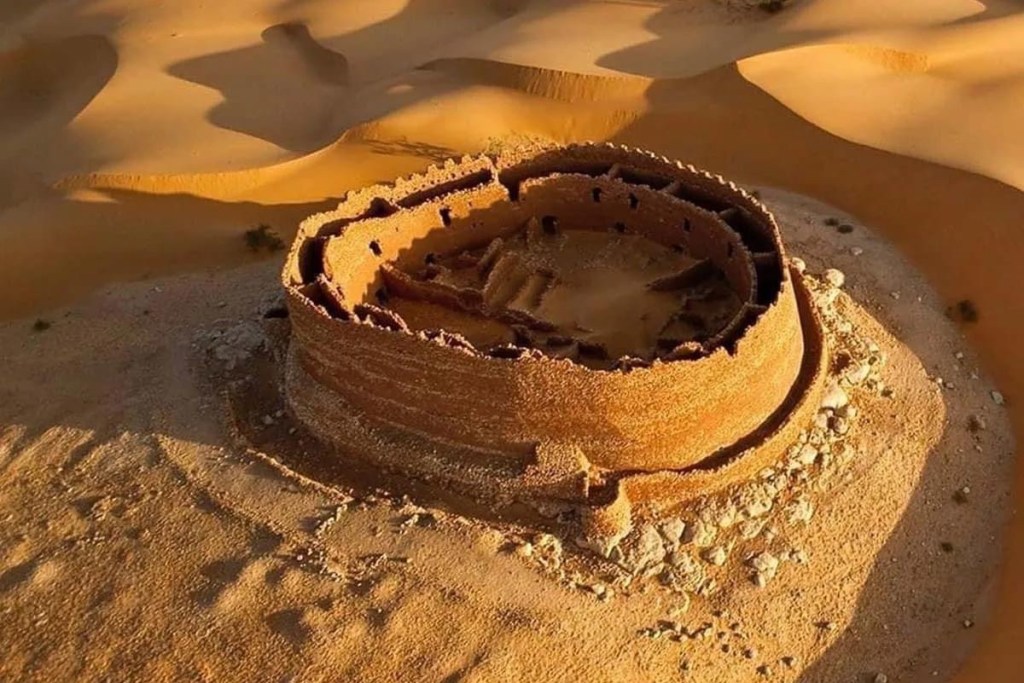
With its distinctive circular shape, the Ksar of Draa towers in the middle of the Sahara Desert. Its history has been lost in the shapes of the dunes : what remains of the original structure today is insufficient to understand its function.
It is surrounded by a circular wall 2 meters high, with a single access point to the north and a series of rooms arranged on three levels but without communicating compartments.
It is believed to date back to the year 1000 and has been fighting tirelessly against cold, heat or wind storms at the beginning of each spring ever since.
Around the ksar stories and legends have been woven over time : in the absence of written references left by historians or chroniclers of the past, speculation of all kinds is the order of the day.
According to some it was a kind of caravanserai, other scholars consider it a place where Jews who fled from Tamentit took refuge during the famous Tuat war that pitted Sheikh Maghili against the Jewish community located at the gateway to the Sahara.
Impressive from the outside, with its circular shape built on a hillock, the #Ksar was built of stone, toub, palm wood, cob, clay and earthen plaster.
Upon entering, one discovers a multitude of tiny rooms; all around, in elevation, a gallery allowed circulation and surveillance to prevent any attack fomented by desert brigands.
Much of the site’s fascination is due to the mystery attached to its function and also to who built it…only the desert guards its secret
𝙏𝙃𝙀 𝙈𝙔𝙎𝙏𝙀𝙍𝙄𝙊𝙐𝙎 𝙆𝙎𝘼𝙍 𝙊𝙁 𝘿𝙍𝘼𝘼 𝙄𝙉 𝙏𝙄𝙈𝙄𝙈𝙊𝙐𝙉, 𝘼𝙇𝙂𝙀𝙍𝙄𝘼
With its particular circular shape, the Ksar of Draa stands out in the middle of the Sahara desert. Its history has been lost in the shapes of the dunes: what remains of the original structure today is not enough to understand its function.
It is surrounded by a circular boundary wall 2 meters high, with a single access point to the north and a series of rooms arranged on three levels but without communicating rooms.
It is believed to date back to the year 1000 and has since tirelessly battled the cold, heat or windstorms at the start of each spring.
Over time, stories and legends have intertwined around the ksar: in the absence of written references left by historians or chroniclers of the past, speculation of all kinds is the order of the day.
According to some it was a sort of caravanserai, other scholars consider it a place where the Jews who fled from Tamentit took refuge during the famous Tuat war which pitted the sheikh Maghili against the Jewish community located at the gates of the Sahara.
Impressive from the outside, with its circular shape built on a hillock, the Ksar was built of stone, toub, palm wood, cob, clay and earthen plaster.
Upon entering, one discovers a multitude of tiny rooms, all around, in elevation, a gallery made it possible to circulate and to keep watch to prevent any attack fomented by the brigands of the desert.
Much of the charm of the site is due to the mystery linked to its function and also to whoever built it … only the desert keeps its secret
With its particular circular shape, the Ksar of Draa stands out in the middle of the Sahara desert. Its history has been lost in the shapes of the dunes: what remains of the original structure today is not enough to understand its function.It is surrounded by a circular perimeter wall 2 meters high, with a single access from the north and a series of rooms arranged on three levels but without communicating rooms.It is believed to date back to the year 1000 and since then has fought tirelessly against cold, heat or windstorms at the beginning of each spring.Over time, stories and legends have intertwined around the ksar: in the absence of written references left by historians or chroniclers of the past, speculations of all kinds are the order of the day.According to some, it was a kind of caravanserai, while other scholars consider it a place where Jews fleeing from Tamentit took refuge during the famous Tuat war that pitted Sheikh Maghili against the Jewish community located at the gates of the Sahara.Impressive from the outside, with its circular shape built on a hill, the Ksar was built with stone, toub, palm wood, cob, clay and earthen plaster.Upon entering, one discovers a multitude of tiny rooms, around, in elevation, a gallery that allowed to circulate and watch to prevent any attack encouraged by the bandits of the desert.Much of the charm of the site is due to the mystery linked to its function and also to who built it … only the desert keeps its secret.


 SummerSimo Travel Troubles Notes and The Purring Page
Leave a comment