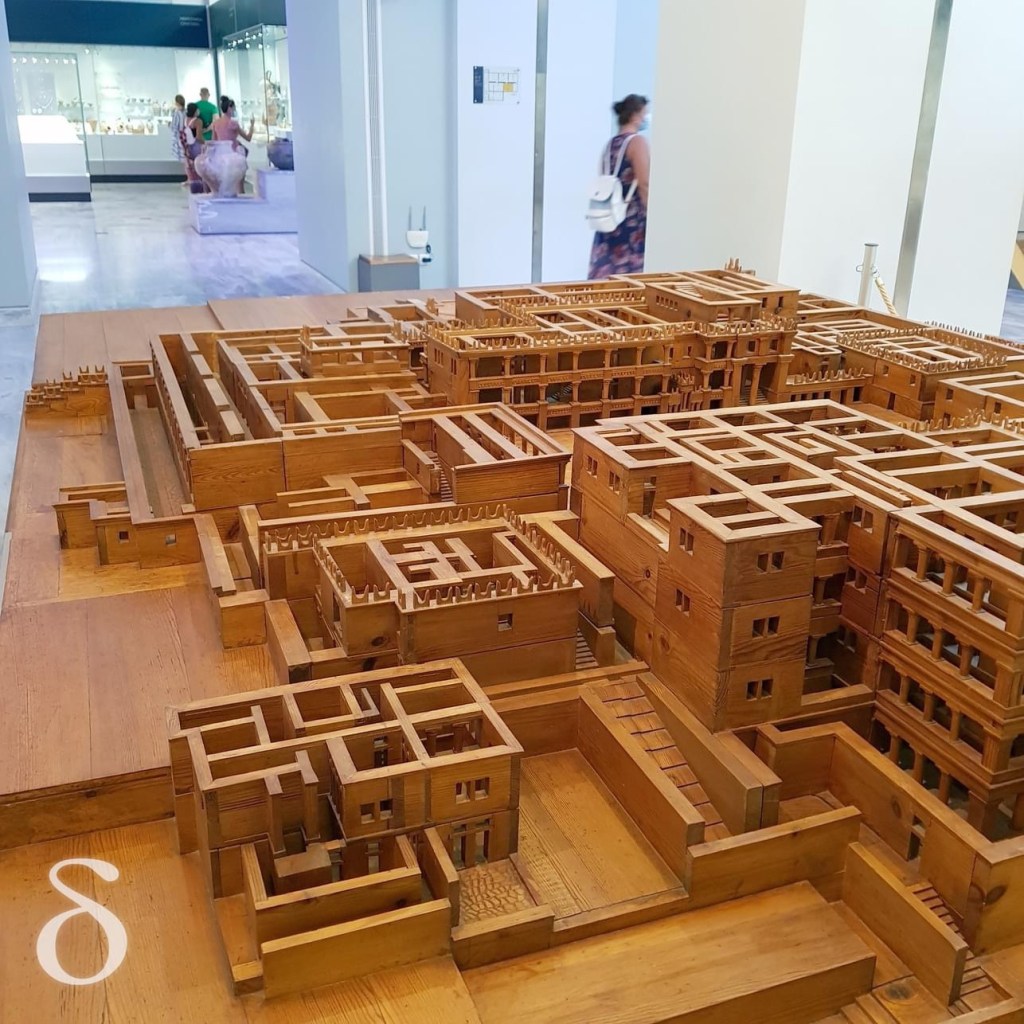
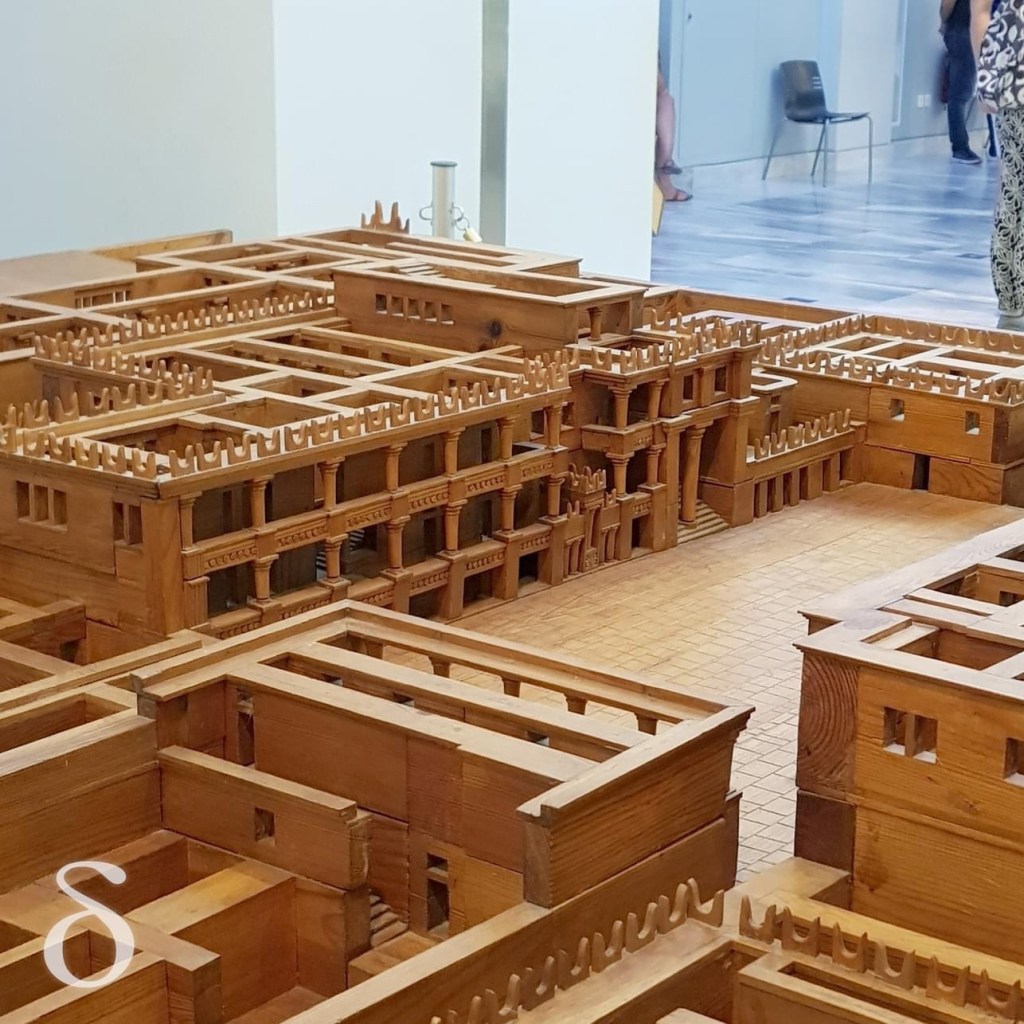
This is the impressive wooden model representing the Palace of Knossos during the Neopalatial period (1750 BC–1450 BC) at the Heraklion Archaeological Museum, work of Zacharias S. Kanakis, conservator of the Archaeological Society of Athens, 1968.
The Palace of Knossos is an archaeological site located on the island of Crete in Greece. It is one of the largest and most important archaeological sites in the Aegean region, and is believed to be the site of the ancient Minoan civilization.
The Palace of Knossos was built around 1900 BC and served as a royal residence, administrative center, and religious site for the Minoan people. The palace was destroyed and rebuilt several times over the centuries, and was finally abandoned in the 14th century BC.
The site was rediscovered in the late 19th century by British archaeologist Arthur Evans, who conducted excavations at the site and reconstructed many of the palace’s buildings and structures. Today, the Palace of Knossos is a popular tourist attraction and a UNESCO World Heritage Site.
The palace complex covers an area of approximately 20,000 square meters and features several buildings and structures, including a central court, a throne room, several residential quarters, and numerous storerooms and workshops. The palace is also known for its elaborate frescoes and decorative motifs, which depict scenes of Minoan life and culture.
Visitors to the Palace of Knossos can explore the site on a self-guided tour or with the help of a licensed guide. The site is open to visitors year-round, and there are several information panels and displays throughout the site that provide more information about the history and culture of the Minoan civilization.
The Palace of Knossos is a complex of interconnected rooms and buildings, many of which are well-preserved and open to visitors. Here are some of the most notable rooms and areas within the palace complex:
- Central Court: The Central Court is the heart of the palace complex and was likely used for official ceremonies and gatherings. It is a large rectangular space surrounded by several columns and features a central altar.
- Throne Room: The Throne Room is one of the most impressive rooms in the palace and is believed to have been used by the king for meetings with his subjects. It features a large throne carved from stone, as well as several frescoes depicting bull-leaping and other scenes.
- Residential Quarters: The palace complex includes several residential quarters that were likely used by members of the royal family and other high-ranking officials. These quarters feature several rooms arranged around a central courtyard, and often include decorative frescoes and other artwork.
- Storage Rooms: The palace complex includes numerous storage rooms that were used to store food, supplies, and other goods. These rooms often feature large pithoi (ceramic storage jars) and were likely critical to the functioning of the palace.
- Workshops: The palace complex includes several workshops where artisans likely created pottery, textiles, and other goods. These workshops often feature evidence of the tools and materials used by the artisans, as well as examples of their finished products.
In recent years, the Palace of Knossos has been digitally reconstructed using 3D modeling techniques, providing a new way to explore and understand the site. Here are some of the most notable 3D models of the Palace of Knossos:
- Virtual Reality Tour: The British School at Athens has created a virtual reality tour of the Palace of Knossos that allows visitors to explore the site in a fully immersive way. The tour includes detailed 3D models of the palace’s architecture and artwork, as well as informative audio commentary.
- 3D Reconstruction Project: The University of Cincinnati has created a 3D reconstruction of the Palace of Knossos that includes over 1,000 individual models of the site’s buildings, rooms, and features. The project is available online and allows visitors to explore the site from any angle.
- Interactive Map: The Greek Ministry of Culture has created an interactive map of the Palace of Knossos that includes 3D models of the site’s buildings and features. The map is available online and allows visitors to click on different areas of the site to learn more about its history and significance.





 SummerSimo Travel Troubles Notes and The Purring Page
Leave a comment