John Bruce was awestruck by the spectacle before him. The most severe storm of 1897 had unearthed several ancient ruins hidden beneath the sand of his estate on Sumburgh Head. As the lands had been in the Bruce family for hundreds of years, and the presence of these buildings had only been rumored, that meant that they must have been older than he could comprehend. Little did the 11thLord of Sumburgh know the actual age was beyond his wildest dreams.
Let’s face it, what most of us know about the Shetland Islands pretty much revolves around a diminutive, little pony that children are allowed to ride at carnivals or use as load bearing animals in the mines. That the archipelago lies in the middle of an ocean (110 miles north of mainland Scotland and 140 miles west of Norway), in a somewhat remote part of the world, tends to lead us to erroneously believe civilization ignored it for thousands of years. Also, that local resources, such as timber, have always been limited, suggests that no one would bother with populating the windswept islands. In an era when ships were propelled by either wind or manpower, the Shetland Islands would not exactly be an attractive place to settle.
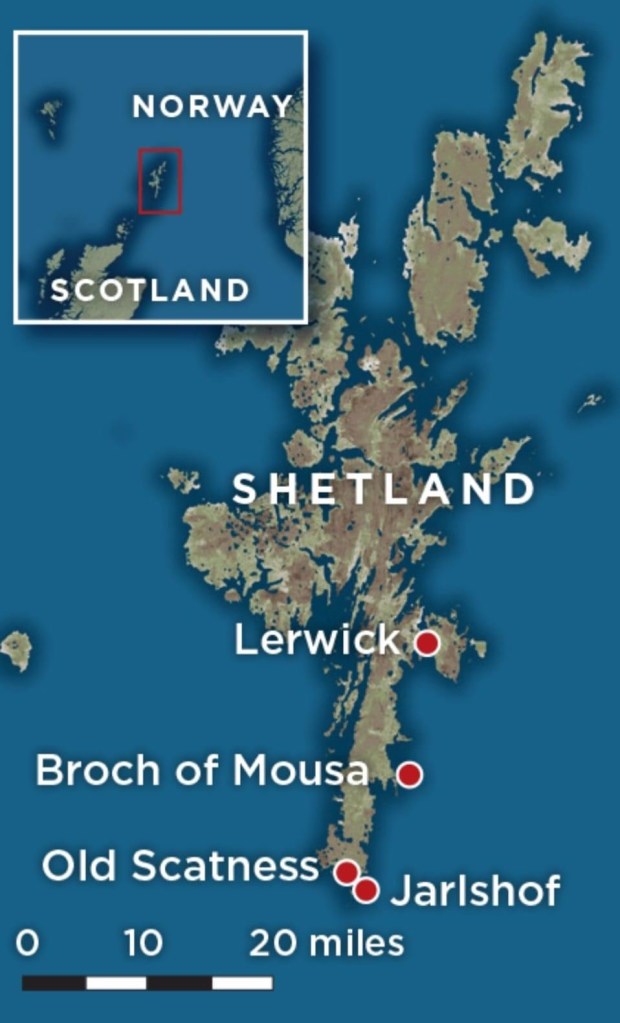
The Shetland archipelago consists of about one hundred islands, of which only sixteen are inhabited today. The largest of the group is Mainland, at 373 square miles, the fifth largest of the British Isles. The rest of the islands amount to an area of less than two hundred square miles combined. Today, Lerwick is the capital of the Islands, and about half of Shetland’s population of 23,000 people, live around the small city. The Islands also sit on the border between two bodies of water, the Atlantic to the west, the North Sea to the east. The Orkney Islands are just to the south, the Faroes to the northwest, as well as Norway to the east, setting the Shetlands up as a steppingstone for Viking raids and exploration. In fact, the Archipelago was a part of Norway, along with the Orkneys, and parts of northeast Scotland, from the late ninth century until Norway’s king, Christian l was forced to relinquish Norwegian territories to Scotland’s James lll, in 1469, as a settlement of a dowry dispute.
The name “Shetland” is believed to be derived from “Hjaltland,” an Old Norse name that may have referred to an ancient Celtic tribe that inhabited the islands, before the Norse invasions. Old Gaelic literature refers to the islands as “Insi Catt,” or “Isle of the Catts,” Catts being the name of the Pictish tribe, centered around Caithness, Scotland, whose territory included the distant islands. The “C,” in “Catt,” was discovered, in a letter written by the Norse Earl of Orkney, Hjaltland, and Caithness, to have been softened to be pronounced as an “H.” in 1190, and by the 15th century, the islands were referred to as “Hetland.” In the 15th century, the “H” was replaced by a combination of Old Scots and local dialect letter, now extinct, “yogh” The symbol for “yogh” was similar to the letter “Z”, thus the name was soon changed to “Zetland”. The evolution of the name soon became anglicized to “Shetland,” a journey eerily similar to that of Jarlshof, itself.
Jarlshof is located on the southern tip of Mainland (an unimaginative name for Shetland’s main island), on the east side of West Voe, a small bay that was home to a fishing port, typical of several found on the 1679 miles of Shetland coastline. Jarlshof, and the surrounding lands of Sumburgh had been in the possession of the Bruce family since the late 16th century, minus a short occupation by Robert and Patrick Stewart, with John Bruce (1837-1907) the 11th Earl of Sumburgh. Bruce commenced archaeological work on Jarlshof almost immediately, and continued until 1906, a year before his death.
Even after the passing of the 11th of Sumburgh, work on the site continued. For the next half decade, a parade of prominent archaeologists continued Bruce’s legacy at Jarlshof. The site was passed into state care in 1925. The list of esteemed researchers: included Alexander Curle, who served as Directors of the National Museum of Scotland, the Royal Scottish Museum, and Commissioner of the Royal Commission on the Ancient Monuments of Scotland. V.G Childe, an Australian Archaeologist who specialized in European History, working most of his life in the United Kingdom., first at the University of Edinburgh, then the Institute of Archaeology, London. Childe wrote twenty-six books during his career. And James Richardson, who was the first Inspector of Ancient Monuments for Scotland and produced a series of guidebooks on those same monuments. In 1950 John R C Hamilton directed the excavations, producing an up-to-date account on the site, published in 1956. While the archaeologists were top of the line researchers, at the time, they lacked the technology to give definitive dates’ Radiocarbon Dating, for example was first experimented with in 1939, and not perfected until decades later.
After Hamilton’s work, large scale excavations ceased, but a more modest dig was performed in 2004, by archaeologists Dr. .Stephen J Dockrill (Senior Lecturer in Archaeology, University of Bradford), Julie Bond (Associate Professor, School of Archaeological and Forensic Sciences, University of Bradford) , and Dr. Colleen E Batey (PHD, Visiting Fellow St. Johns College, Honorary Fellow in Archaeology, University of Durham), using modern processes. The results produced the incredible age span of the site.The Bronze Age settlement appears to have been covered by a layer of sand, separating it from the next strata, the Iron Age Settlement. The Iron Age, when man began making weapons and tools out of iron and steel, covers roughly 800 BC to the first century AD. The highlight of Jarlshof Iron Age village is a huge double walled round tower, a broch, which was commonly found throughout northern Scotland. Probably a defensive structure, only about 8 feet of the Jarlshof broch now remains, but comparative analysis to a nearby broch, Old Scatness only a mile away, and the Broch of Moussa, one of the most complete of these fortifications, appears to confirm the identity of the structure at Jarlshof. Several wheelhouses, or civilian dwellings, circular in shape, with “spokes,” or stone piers that support the corbelled roof, architecture synonymous with the region, were also unearthed. In most cases, in the region, where there is a broch, there are wheelhouses. Two of the wheelhouses feature souterrain passages, possibly for food storage. Dates on the wheelhouses and their contents range from 200 BC to 800 AD, covering the age of the Picts. A number or artefacts found on site, including bone pins, painted pebbles, and one of only two Pictish symbol stones, discovered on Shetland, were found at Jarlshof, further suggesting the Iron Age settlement was Pict (the Catts?).
The third layer of settlement dates from the 800s AD to the late 1200s. During his time on the site, Alexander Curle discovered the first known Viking roundhouse in Britain, in the 1930s, Hamilton’s work some 20 years later suggested that the occupants engaged in farming and fishing activities, raising livestock, eating seafood. Though as many as 7 Norse dwelling are believed to be on site, researchers doubt any more than 2 were in use at the same time. The largest building was about 60’ X 16’, with doors at each end, wooden benches along the walls, and a large hearth in the middle. All Norse structures had ridged timber frames, distinguishing them from the conical thatched roofs of the earlier eras. Several outbuildings were also constructed, usually at 90* angles to the longhouse, including what appears to be a sauna and a corn-drying room. Loom weights found on site signal the importance of wool to the inhabitants, line weights and other iron fishing implements, indicate deep-sea fishing was a common source of food. Iron for the tools indicate the material came from local bogs or swamps, while some timber, pine, and oak, was likely imported, as only hazel, birch, and willow grew in the area. Drawings, scratched on slate, and basement structures on at least two buildings, as well as other artefacts indicate a melding of Norse and Pictish styles. The Viking settlement appeared to be abandoned by the late 13th century, in favor of a farmhouse, barn, and corn kilns built east of the site.
The fourth different era represented on the tiny plot, is the building that dominates the site, the Old House of Sumburgh, or “The Earls House” itself. It was built after Shetland (as well as Orkney, and Caithness) was passed from the Norwegian king, Christian I, to Scotland’s King James III, due to a dowry settlement. Robert Stewart, 1stEarl of Orkney converted a stone medieval farmhouse into a fortified house. His son, the notorious “Black Patie,” or Patrick Stewart, 2nd Earl of Orkney inherited the house in the early 17th century and renamed the “New Hall” to “The Old House of Sumburgh,” the “burgh,” in “Sumburgh,” derived from the Old Norse “Borg,” meaning “fort.” The “Black Patie” modernized the house, though he probably lived down to his reputation, and oversaw the renovations tyrannically, in doing so. Patrick Stewart was executed for treason in 1615, adding to the intrigue of Jarlshof.
Sir Walter Scott visited the Shetlands in 1814, along with the Commissioners of Northern Lighthouses. The board was formed in 1786, by an Act of Parliament, with the goal of overseeing the construction and operation of four new Scottish Lighthouses. After the initial goal was achieved, the mission expanded. The most famous of the board’s engineers was Robert Stevenson, who would design and build the lighthouse at Sumburgh Head, completed 7 years later. Stevenson, while accomplished in his own right, was overshadowed in history by his grandson, author Robert Lewis Stevenson. As they approached West Voe, the manor, the only visible ruin at the time, dominated the landscape. It had such an impression on Scott, that a sizable portion of “The Pirate” (1822), part of a popular series of 19th century novels, was set in the “Old House of Sumburgh”. In his novel, Scott renamed the mansion “Jarlshof,” Old Norse for “The Earl’s House, marking up to 5,000 years of history.



 SummerSimo Travel Troubles Notes and The Purring Page
Leave a comment