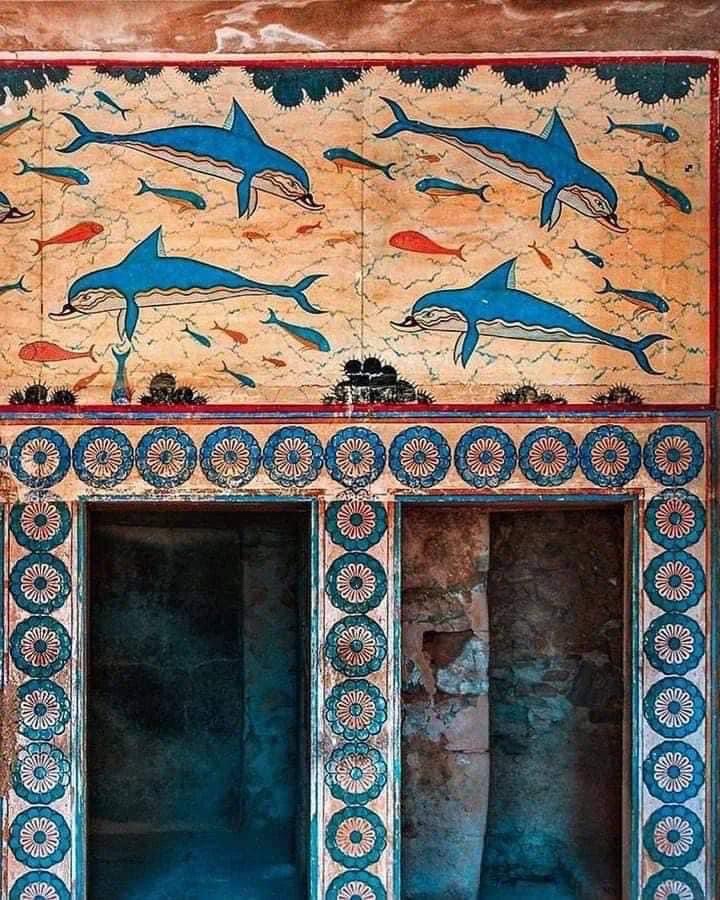
The Palace of Knossos is located on the island of Crete in Greece and is one of the most important archaeological sites in Europe. The palace was the center of the Minoan civilization, which flourished on Crete from around 2700 BC to 1450 BC.
The Megaron was a central room in the palace and was used for official ceremonies and other important events. The Queen’s Megaron was a specific room within the Megaron complex that was likely used by the queen or other female members of the royal family.
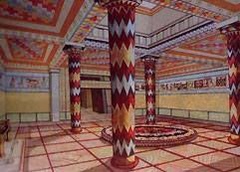
The northern part of the Queen’s Megaron was extensively restored in the early 20th century by British archaeologist Arthur Evans, who led the excavation and restoration of the Palace of Knossos. The restoration work aimed to reconstruct the room as it would have looked during the Minoan period, based on archaeological evidence and artistic depictions.
Today, visitors to the Palace of Knossos can see the restored northern part of the Queen’s Megaron, which includes a raised platform, a central hearth, and a bench built into the wall. The walls and ceiling of the room are decorated with brightly colored frescoes depicting Minoan life and mythology.
The restoration of the Queen’s Megaron, along with the rest of the Palace of Knossos, is an important achievement in the field of archaeology and has helped to shed light on the complex and sophisticated civilization that thrived on Crete over 3000 years ago.
The Megaron complex was the central and most important part of the Palace of Knossos, and it included several different rooms and spaces. In addition to the Queen’s Megaron, which you mentioned earlier, there were several other rooms in the complex. Here are some of the most important ones:
- The Throne Room: This was the largest room in the Megaron complex and was used for official ceremonies and receptions. It was located at the center of the complex and featured a raised platform where the king or queen would sit on a throne.
- The Central Court: This was an open-air space located in the center of the complex. It was surrounded by columns and was used for public gatherings and events.
- The Royal Apartments: These were a series of rooms located on the upper floors of the Megaron complex. They were used by the king and queen as living quarters and included private bedrooms, bathrooms, and other amenities.
- The Storage Rooms: These were large rooms located on the ground floor of the complex. They were used for storing food, wine, and other supplies.
- The Workshops: These were rooms located on the ground floor of the complex that were used for various crafts and trades, including pottery-making and metalworking.
Overall, the Megaron complex was a complex and multi-functional space that served as the center of political, social, and cultural life in the Minoan civilization.
The raised platform in the Throne Room of the Palace of Knossos was likely used by the king or queen to sit on a throne during official ceremonies and receptions. The platform was located at the center of the room and was elevated several steps above the level of the floor. This would have made the king or queen more visible and prominent during public events and would have emphasized their status and authority.
The Throne Room was the largest and most important room in the Megaron complex, and it was likely used for a wide range of official functions, including diplomatic receptions, religious ceremonies, and public assemblies. The room was decorated with frescoes depicting scenes of Minoan life and mythology, including images of bulls, dancers, and other symbols of power and fertility.
The use of a raised platform in the Throne Room is similar to other ancient cultures, where thrones or raised seats were used by rulers to signify their status and power. In the case of the Palace of Knossos, the use of the raised platform in the Throne Room was a reflection of the central role that the palace played in the political and cultural life of the Minoan civilization.




 SummerSimo Travel Troubles Notes and The Purring Page
Leave a comment