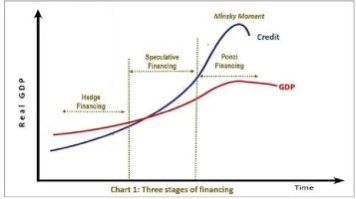
What is a “Minsky Moment,” the Minsky Moment? Minsky Moment refers to the beginning of a market crash caused by reckless speculative activity that defines an unsustainable bullish period. It is the “Redde rationame” when the collapse begins, driven by speculative credit that has over-expanded relative to GDP and eventually implodes on itself. Minsky Moment crises generally occur because investors, engaged in overly aggressive speculation, take on additional credit risk during bullish markets.
Real estate markets are at this point in the hands of central banks, which we can divide into three categories: those that put monetary stability second to the welfare of citizens and economic growth, such as the RBNZ, the RBA (and in Australia there is not really the goal of financial stability, but that of generic protection of citizens’ assets), the BoJ and the PBOC;
those, like the ECB, that are ready to sacrifice firstborns for price stability, and are doing so, given the European demographic crisis;
those like the FED and BoE that appear tough for now, unless they change their minds at supersonic speed as soon as the market shows a figurine of Mr. Minsky, although by then it will be too late.
Happy Minsky moment everyone, also because this will vary from country to country
Minsky Moment defines the tipping point at which speculative activity reaches an unsustainable extreme, leading to rapid price deflation and an unpreventable market collapse.
A Minsky Moment is based on the idea that periods of bullish speculation, if they last long enough, will eventually lead to crisis, and the longer the speculation occurs, the more severe the crisis will be, because the greater the speculation and exposures put in place by market participants. The term was invented for Russia’s financial collapse in 1998, but also applied to eastern markets and the greatest “Minsky moment” in history, the 2007 U.S. housing market. Have we reached our “Minsky moment?” Let’s think about it for a moment:
Recent PMI and GDP data from China show that manufacturing remains under pressure and that the positive momentum associated with the end of the Covid-19 period and lockdowns is running out Rabobank’s China expert, Teeuwe Mevissen, has been clear and expects that any stimulus effort will be much more modest than we have seen in the past because of China’s problems with the high debt load at the local government level and the latent real estate crisis that Xi Xinping has repeatedly failed to prevent through tightening bank credit. There is an expectation that we might have aid targeted to certain sectors, but nothing sprinkled in. Those who expect Xi Jinping to pull chestnuts out of the fire for everyone with a hyper-expansionary policy risk disappointment.
Commercial real estate valuations in the West face some very strong challenges, amid rising interest rates, creeping economic crisis and falling disposable income for households. Gillian Tett notes in the Financial Times that $270 billion of commercial real estate debt instruments are expected to be refinanced this year and up to $1.5 trillion over the next three years. The declining valuations have been driven by lower demand for office space, which could mean that commercial real estate has moved from Minsky’s definition of speculative financing (where cash flows on the asset are sufficient to meet financial liabilities, but not sufficient to repay principal) to Ponzi scheme financing, whereby cash flows on the asset are no longer sufficient to repay principal or interest charged at prevailing market rates, but serve only to buy time and delude the banking system . A taste of this was there with the failure of the U.S. regional banks.
The housing market problems appear particularly acute in the UK, where there is a growing chorus of calls for government assistance with mortgage payments, now intolerable due to the combined combination of high interest, revidable interest contracts and rising interest. Of course, the very idea of “mortgage relief” is completely contrary to the policy prescriptions of the Bank of England, which, however, must choose between ruining families and businesses and inflation. So far, attempts have been made to kick the can down the road by extending the life of the mortgage, but when the life of the mortgage exceeds the life of the borrower, what sense will this make? It would have been better to avoid excessive real estate values, but it is too late now, and Minsky is on his way. RightMove’s latest real estate report shows inc prices up 0.2 percent in nominal terms in one month, while zero was expected, meaning that the mpunto of negative value is getting closer and closer.


 SummerSimo Travel Troubles Notes and The Purring Page
Leave a comment