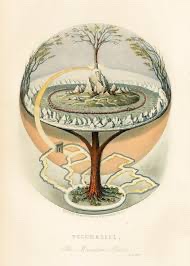
Yggdrasil, in Norse mythology, is certainly a fascinating mystery. He is represented as a towering cosmic tree that connects the worlds of gods, men, and giants. His figure assumes a central role within the Norse universe, providing a symbolic infrastructure for the workings of the world.
According to ancient Viking beliefs, Yggdrasil provides support and nourishment for the gods and the entire creation. Its deep roots reach underground kingdoms such as Niflheim and the land of giants, while its fronds extend to Ásgard, the abode of the gods, and other important kingdoms such as Jotunheim and Svartálfaheim. The animals that reside in Yggdrasil, such as the dragon Níðhǫggr and the eagle named Veðrfǫlnir, help maintain cosmic order.
The symbolic meaning of Yggdrasil may vary according to interpretation, but some of the central concepts associated with it are the connection between worlds, life and death, the interdependence of all things, and the pursuit of wisdom. Its image is often considered a powerful symbol of the immensity, strength and majesty of nature itself.
Viking culture, known for its fervent mythology, has influenced many modern works of art, literature, and film productions, prompting further exploration of the stories and legends of epic characters such as Thor, Odin, and Loki. If you are interested in exploring this fascinating mythological world further, I recommend reading the ancient Edda, a collection of written sagas recounting Norse mythology.
The Vikings, specifically Norse explorers, are believed to have reached North America before Columbus. Around 1000 AD, Leif Erikson, a Norse explorer, is said to have landed in areas that are now part of Canada, such as Newfoundland and Labrador. This evidence comes from the archaeological site at L’Anse aux Meadows, which was discovered in the 1960s and is considered the only confirmed Norse settlement in North America.
According to Norse sagas, they referred to the lands they discovered as Vinland or Vinland the Good, which is believed to be a part of present-day Newfoundland. These Norse expeditions were likely part of a broader pattern of exploration by Norse seafarers known for their maritime skills and voyages across the North Atlantic.
It’s important to note that the Norse exploration of America was not followed by permanent settlement or sustained contact with Native American cultures. The Norse expeditions did not leave a significant lasting impact, and their knowledge of America seems to have been forgotten or less emphasized in subsequent European exploration and colonization.
Nonetheless, the Norse exploration of America is an intriguing aspect of history, demonstrating the far-reaching voyages and capabilities of Viking seafaring culture. The evidence of their presence serves as a reminder of the interconnectedness and exploration efforts across different parts of the world during that time.
It is believed that there may have been an Irish connection to the exploration of America as well. According to some theories and historical evidence, Irish monks known as “holy men of the sea” were sailing across the Atlantic before the Vikings.
One famous example often mentioned is the story of Saint Brendan, an Irish monk who, according to legend, embarked on a voyage across the Atlantic in a wooden boat made of ox hides called a curragh. The tale, known as “The Voyage of St. Brendan,” describes his adventures and encounters with various islands and mystical creatures.
While the exact historical accuracy of Saint Brendan’s voyage is debated, there are resulting stories and legends that suggest the possibility of Irish encounters with North America. For example, the story of “Hy-Brasil,” an island said to have existed off the western coast of Ireland, is sometimes connected to these Irish voyages.
However, it is crucial to note that the evidence for Irish exploration of America is less substantial than that of the Norse. The Norse settlement at L’Anse aux Meadows provides concrete archaeological proof, while the Irish connection remains largely based on myths, legends, and oral traditions.
Regardless of the extent of Irish involvement in the exploration of America, it is fascinating to consider the various possibilities and the interconnectedness of different seafaring cultures during ancient times. The exploration and expansion of early civilizations continue to be a subject of ongoing research, adding depth to our understanding of human history.
Indeed, the Norse and Irish mythologies share common themes and elements, yet there are also distinct differences between the two.
Norse mythology, as mentioned earlier, is rooted in the traditions of the ancient Norse people of Scandinavia. It revolves around a pantheon of gods and goddesses, such as Odin, Thor, Loki, and Freya, and encompasses grand tales of creation, heroic deeds, battles, and the inevitable Ragnarok, the apocalyptic battle that marks the end of the world.
On the other hand, Irish mythology originates from the ancient Celtic peoples of Ireland and focuses on gods and legendary figures, such as Lugh, Brigid, and the Morrigan. It includes stories of heroic warriors, magical creatures, and epic battles between the Tuatha Dé Danann (the divine beings) and the Fomorians (the monstrous beings). Sacred sites and mystical elements like the Otherworld and the Sidhe (fairies) also feature prominently.
While both mythologies involve gods, heroes, and supernatural beings, Norse mythology tends to have a more somber and fatalistic tone. It emphasizes valiant but doomed battles, the cyclical nature of life and death, and the ultimate destruction of the world in Ragnarok. Irish mythology, on the other hand, often portrays a supernatural realm parallel to our own, the Otherworld, which is associated with beauty, music, and eternal youth.
Another notable aspect is the influence of Christianity. Both Norse and Irish mythologies were impacted by the arrival and spread of Christianity, with Christian elements being incorporated or coexisting with earlier beliefs. In Norse mythology, this is evident in the figure of Baldr, a god associated with light and innocence, who is often likened to Christ. In Irish mythology, Christian influences can be seen in how earlier mythological figures were adapted into Christian saints, such as Brigid becoming Saint Brigid.
The confrontation between the two mythologies themselves did not occur in a direct sense, as they developed within separate cultural contexts. However, with the spread of Christianity and the eventual conversion of both Norse and Irish societies, aspects of their respective mythologies would have inevitably come into greater contact and been influenced by Christian ideas.
Overall, the Norse and Irish mythologies reflect the rich cultural traditions and beliefs of their respective people, expressing their collective worldview and offering insights into their understanding of the mysteries of the world and the human condition.



 SummerSimo Travel Troubles Notes and The Purring Page
Leave a comment