The Phoenician alphabet is a writing system that was developed by the Phoenicians in the 12th century BCE. The Phoenicians were a maritime people who lived in the eastern Mediterranean, in what is now modern-day Lebanon, Israel, and Syria. They were known for their seafaring skills, trade, and commerce.
The Phoenician alphabet was an important innovation in the history of writing because it was the first writing system to use symbols to represent individual sounds, rather than whole words or concepts. This made the writing system much simpler and more versatile than earlier systems, which relied on pictograms or syllabic writing.
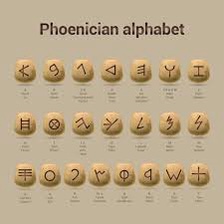
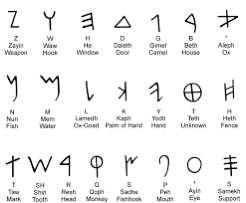
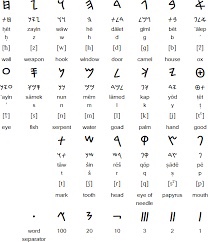
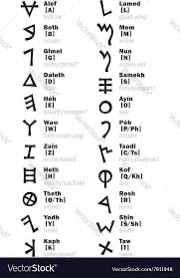
The Phoenician alphabet consisted of 22 consonant symbols, with each symbol representing a different sound in the Phoenician language. There were no symbols for vowels, which were indicated by diacritical marks or left to the reader to infer.
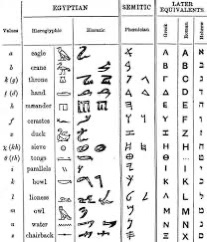
The Phoenician alphabet was widely used throughout the Mediterranean region and was adopted and adapted by many other cultures, including the Greeks, Romans, and Hebrews. The Greek alphabet, for example, was based on the Phoenician alphabet, with the addition of vowel symbols.
The Phoenician alphabet was an important precursor to many modern writing systems, including the Latin alphabet, which is used in many languages around the world today. The legacy of the Phoenician alphabet can still be seen in the names of letters in many alphabets, including alpha, beta, gamma, and delta, which are derived from the Phoenician names for those letters.
The Phoenician alphabet is an ancient writing system that was used by the Phoenician people, who were seafaring traders from the eastern Mediterranean around 1200-500 BCE. It is considered one of the earliest known alphabets and was a significant influence on the development of other writing systems, including the Greek and Latin alphabets.
The Phoenician alphabet consisted of 22 consonant symbols, with no vowel indication. This means that you had to rely on context or memory to determine the vowels in a word. It was primarily used for trading and record-keeping purposes.
One of the key reasons for the Phoenician alphabet’s success was its simplicity and adaptability. Its 22 consonant symbols made it easy to learn and to write quickly. Additionally, as the Phoenicians traveled and traded, the alphabet spread and was adopted by other cultures, eventually evolving into the alphabets we use today.
There are indeed some mysteries and unanswered questions surrounding the Phoenician alphabet.
One mystery is the origin of the Phoenician alphabet itself. While it is clear that the Phoenicians were the ones who popularized and spread the alphabet, its precise origins are still a subject of debate among scholars. Some theories suggest that the Phoenician alphabet was derived from earlier Egyptian or Semitic scripts, while others propose a more independent development by the Phoenicians themselves.
Another mystery is the precise relationship between the Phoenician alphabet and other ancient writing systems. While it is widely recognized that the Phoenician alphabet influenced the Greek and Latin alphabets, as well as several others, the exact manner in which this influence occurred is still not fully understood. Some scholars believe that the adoption of the Phoenician alphabet by other cultures was a gradual process, while others argue for a more direct and intentional borrowing.
Additionally, the lack of vowel indications in the Phoenician alphabet has also puzzled researchers. It is unclear why the Phoenicians chose not to include vowels in their writing system. Some propose that it may have been due to the Semitic languages’ tendency to place a greater emphasis on consonants, but this question remains a point of conjecture.
The study of ancient scripts and alphabets is an ongoing field of research, so it is possible that new information and theories will emerge to shed more light on these mysteries in the future.

 SummerSimo Travel Troubles Notes and The Purring Page
Leave a comment