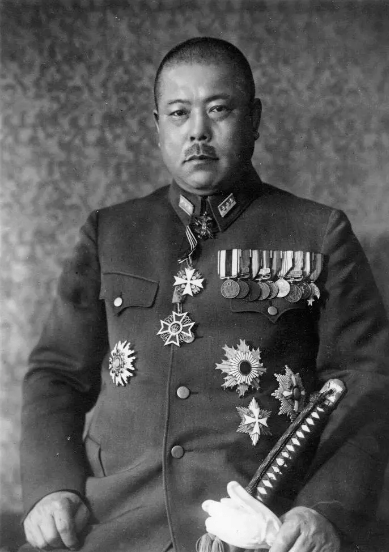
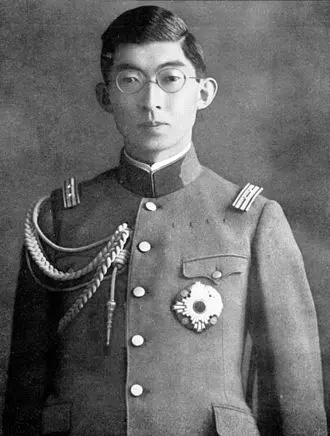
There is a myth in the East similar to the European myth of Hitler’s Gold, but one whose existence is intertwined with Philippine political events and which still fascinates many prospectors. Tomoyuchi Yamashida was a well-known Japanese general, the author of the lightning fast and devastating advance of the Imperial Army in 1942 in Malaya and the author of the conquest of Singapore from the British, who was shot in February 1946 in the Philippines for war crimes. Japan, like Germany, systematically devoted itself to plundering the resources of occupied territories, from China to Indonesia to Vietnam, Laos, Malaysia, Cambodia and the Philippines. According to myth even the Showa Emperor’s brother, i.e., Hiro Hito, Yasuhito Chichibu, led this wealth-gathering operation under the guise of Operation Golden Lily. The Yakuza, the Japanese mafia, would also participate in the gold collection with its own less than light methods. Prince Chichibu, who died in 1953, always denied this role, saying that during the war he was mainly busy nursing his weak health in Japan. These enormous riches would have been collected in the Philippines, waiting to be shipped to Japan, but by 1943 navigation between the two archipelagos was incredibly dangerous: the Japanese navy no longer had control of the routes from Indonesia to Japan, which were beaten first by submarines and then by American planes, so General Yamashida decided to hide the gold in various locations in the Philippines. This was a huge amount of gold remelted into bars, coins and precious objects of various kinds, and the general hoped to recover it after the war to rebuild Japan, but the war willed otherwise.
What happened to this treasure?
What happened to this wealth? According to what was written in two books by treasure hunters Peggy and Sterling Seagrave the 6,000 tons of gold were, at least in part, found by Edward Lansdale and Severino Garcia Diaz Santa Romana, who had interviewed and tortured some of Yamashida’s command officers. One of these, a major acting as a driver, would confess the locations where the gold was hidden and this would be partly recovered and brought to the U.S. in hidden accounts. Landsdale was a CIA agent and used them in several covert operations in Viet Nam and against Fidel Castro, as well as in other U.S. covert operations. The strange story of Rogelio Roxas
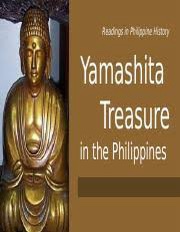
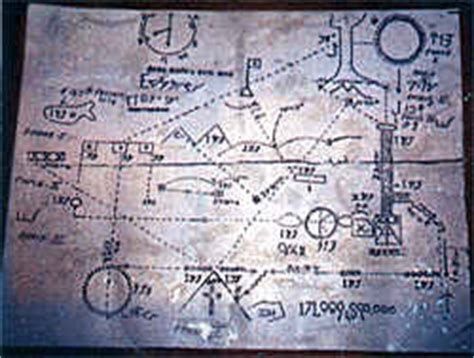
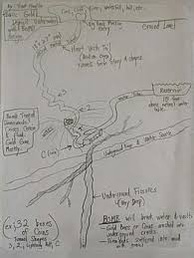
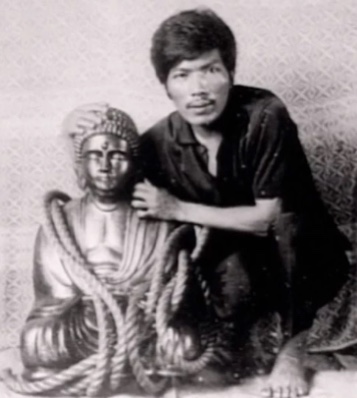
Rogelio Roxas is another chapter in this strange story. This treasure seeker would learn from a former Japanese soldier the possible location of some treasure. He would have descended into a maze of underground tunnels near Bagulo and there, in addition to the skeletons of several soldiers, weapons and samurai swords, he would have found a golden Buddha, with a removable head, very heavy, which then hid diamonds inside. Then he would find a pit covered with concrete in which he would find several wooden boxes. He took one of them and it turned out to be full of gold bars and coins. At that point he took the Buddha and a box, but he had the levity to publish photos of the statue in an attempt to sell it and to sell seven gold bars. One day he was arrested by the police of dictator Ferdinand Marcos arrested and tortured him to make him reveal the location of the treasure. In 1986 he managed^ to escape to Hawaii, taking advantage of the change of power, and there he filed a lawsuit against the Philippine government to get back what he had lost. He died that the lawsuit was not yet over, but his son was awarded a $22 billion refund by the Hawaii Supreme Court, money that, of course, he and his associates never received from the government.
So if you are adventurous you can try to travel to the Philippines and look for Yamashida’s gold. Many are already doing so.
If you want to learn more:qui e qui

 SummerSimo Travel Troubles Notes and The Purring Page
Leave a comment