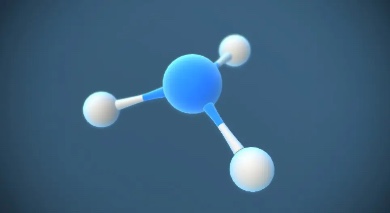
Researchers at the RIKEN Center for Emergent Matter Science (CEMS) in Japan have found a simple and inexpensive way to store ammonia, an important chemical for a range of industries. The discovery could also contribute to the creation of a hydrogen-based economy.
Ammonia, written chemically as NH3, is widely used in a variety of industries, from textiles to pharmaceuticals, and is an important component in fertilizer production. For its current use, ammonia is stored in pressure-resistant containers after being liquefied at temperatures of -27 Fahrenheit (-33 degrees Celsius). Alternative methods of storing ammonia in porous compounds have been studied. The storage and recovery process can be carried out at room temperature, but the storage capacity of these compounds is limited.
A research team led by Masuki Kawamoto at RIKEN CEMS has now discovered that perovskites, crystalline structures associated with improving the energy conversion efficiency of solar panels, can also serve as an excellent medium for ammonia storage and recovery. Perovskite as an ammonia carrier
Kawamoto’s team found that lead perovskite ethyl ammonium iodide (EAPbI3) reacts with ammonia at room temperature and pressure to produce lead iodide hydroxide, or Pb(OH)I. Lead ethyl ammonium iodide has a one-dimensional columnar structure but, after reaction with ammonia, forms a two-dimensional layered structure.
Ammonia is a highly corrosive gas, but the chemical reaction with perovskite allows its safe storage and requires no special equipment for storage. The recovery process is also very simple. Under vacuum, lead ethyl ammonium iodide can be heated to 122 Fahrenheit (50 degrees Celsius) to release the ammonia gas. In comparison, ammonia stored in porous compounds needs temperatures around 302 Fahrenheit (150 degrees Celsius) to be recovered.
Toward a hydrogen economy
The discovery of the role of perovskite is very important because it also offers a way to store hydrogen. Each ammonia molecule contains three hydrogen atoms, which make up 20 percent of the molecule’s weight.
By itself, hydrogen is highly combustible, but ammonia does not burn easily, making it a good means of storing it until needed.
The perovskite-ammonia reaction is completely reversible, and perovskite can be reused to store ammonia again once recovery is complete. Interestingly, perovskite also changes color, turning white when storing ammonia and returning to its original yellow color after recovering the ammonia. Scientists can exploit this feature to make color-based sensors to determine the amount of ammonia stored in perovskite.
Our attempts to move away from fossil fuels will probably prove futile if we cannot find alternatives to carry out activities such as long-range and heavy-duty transportation. Hydrogen’s power density is nearly three times that of gasoline or diesel, but its combustible nature poses high risks.
A simple and inexpensive method that allows hydrogen to be extracted at the place of need, only in the quantities needed, will pave a faster path to a hydrogen-based economy in the near future.

 SummerSimo Travel Troubles Notes and The Purring Page
Leave a comment