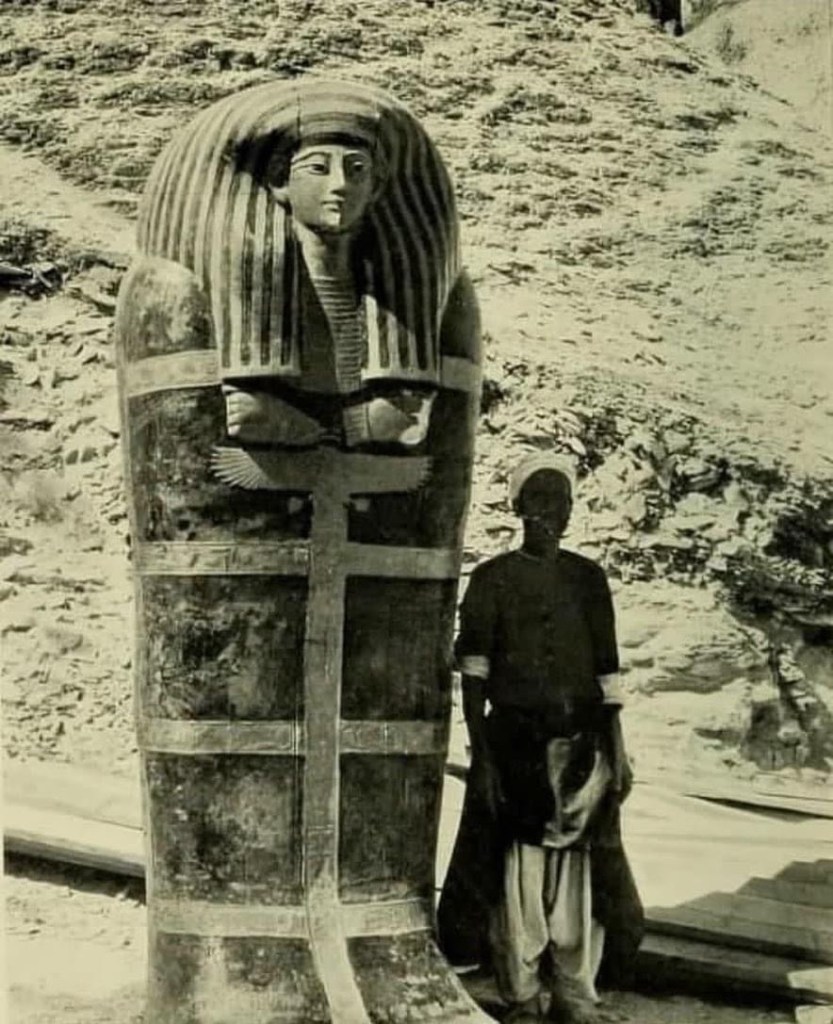
The tomb of Yuya was discovered in 1905 in the Valley of the Kings in Thebes, which is now known as Luxor, Egypt. Yuya was an Egyptian nobleman and official who lived during the 18th dynasty of ancient Egypt, around 3,300 years ago.
The discovery of Yuya’s tomb was significant because it contained well-preserved artifacts and decorations, including a gold mask that covered Yuya’s mummy. The tomb was also significant because it was one of the few non-royal tombs in the Valley of the Kings to survive relatively intact, giving researchers a unique glimpse into the burial practices and beliefs of ancient Egyptian non-royal elites.
Yuya’s daughter, Queen Tiye, was the wife of Pharaoh Amenhotep III and the mother of the famous pharaoh Akhenaten, who is known for his religious reforms and the establishment of a new capital city at Amarna. Yuya’s tomb and its contents are now housed in the Egyptian Museum in Cairo.
Queen Tiye was a significant figure in ancient Egyptian history for several reasons. She was the wife of Pharaoh Amenhotep III and the mother of the famous pharaoh Akhenaten, who is known for his religious reforms and the establishment of a new capital city at Amarna.
One of Queen Tiye’s most significant contributions was her role in diplomatic relations with other kingdoms. She was known for her intelligence and diplomatic skills, and she played a key role in maintaining political alliances and negotiating treaties with foreign powers. She also had a close relationship with her husband and was influential in his decision-making, which helped to maintain stability and prosperity during his reign.
After the death of her husband, Queen Tiye played an important role in the reign of her son Akhenaten. She was one of his closest advisors and was involved in the establishment of his new religion, which emphasized the worship of the sun disk Aten. She also played a key role in diplomatic relations during her son’s reign, helping to maintain alliances and negotiate treaties.
Queen Tiye was also known for her artistic patronage, commissioning many sculptures and monuments during her lifetime. Her influence can be seen in the depictions of her in art, which show her as a powerful and respected figure.
Queen Tiye was a significant figure in ancient Egypt for her political savvy, diplomatic skills, and artistic patronage. She played a key role in maintaining stability and prosperity during the reigns of her husband and son and was a respected figure in her own right.
Akhenaten’s new religion was significant in ancient Egyptian history for several reasons. The religion emphasized the worship of the sun disk Aten as the sole god, and Akhenaten moved the capital of Egypt to a new city, Amarna, which was dedicated to the worship of the Aten. The new religion also abolished the traditional polytheistic worship of many gods and goddesses, which had been the dominant religion in Egypt for centuries.
Queen Tiye played a significant role in the establishment of Akhenaten’s new religion. As Akhenaten’s mother, she was likely a close advisor and confidant, and it is believed that she was involved in the decision-making process behind the establishment of the new religion. Some scholars have suggested that Queen Tiye may have been a key proponent of the worship of the Aten and may have influenced her son’s decision to establish the new religion.
Queen Tiye was also portrayed in art as a key figure in the new religion, often shown with her husband and son worshipping the Aten. She was depicted in many reliefs and statues, often with distinctive features such as a sun disk with rays emanating from it, which was a symbol of the Aten. Some scholars believe that Queen Tiye may have been a co-regent with her son during the early years of his reign, and may have played a more active role in the establishment of the new religion than previously thought.
Queen Tiye played a significant role in the establishment of Akhenaten’s new religion, both as a key advisor and as a prominent figure in the religion’s iconography. Her contributions helped to shape one of the most significant religious reforms in ancient Egyptian history.
Akhenaten, also known as Amenhotep IV, introduced several other reforms during his reign in ancient Egypt. Here are a few of the most significant:
- The establishment of a new capital city: Akhenaten moved the capital of Egypt from Thebes to a new city, which he called Akhetaten (now known as Amarna). The city was dedicated to the worship of the sun disk Aten and was designed to reflect the ideals of the new religion.
- Changes in art and architecture: Akhenaten introduced a new style of art and architecture that emphasized naturalistic forms and a more relaxed, informal style. He also introduced new iconography that emphasized the worship of the Aten, such as the sun disk with rays emanating from it.
- Changes in language and writing: Akhenaten introduced a new form of the Egyptian language that was simpler and more direct than the traditional hieroglyphic script. He also introduced a new script, known as the Amarna script, which was used for official correspondence during his reign.
- Changes in religion: As mentioned earlier, Akhenaten introduced a new religion that emphasized the worship of the sun disk Aten as the sole god. He abolished the traditional polytheistic worship of many gods and goddesses, which had been the dominant religion in Egypt for centuries.
- Changes in political structure: Akhenaten centralized political power around himself and his family, and he introduced new titles and ranks for members of the royal court. He also established a new priesthood to oversee the worship of the Aten.
Akhenaten’s reign was marked by significant changes in art, religion, language, and politics. While his reforms were controversial and did not survive his death, they had a lasting impact on the history and culture of ancient Egypt.
The new language and writing system introduced by Akhenaten had a significant impact on the people of ancient Egypt. The new language, known as “Amarna Egyptian” or “Middle Egyptian,” was simpler and more direct than the traditional hieroglyphic script, which made it easier for people to learn and use.
The new writing system, known as the Amarna script, was also simpler and more phonetic than the traditional hieroglyphic script. This made it easier for scribes to write quickly and efficiently, and it made written communication more accessible to a wider range of people.
However, the changes also had some negative consequences. Many of the traditional religious texts and inscriptions were destroyed or defaced during Akhenaten’s reign, which led to a loss of knowledge about traditional Egyptian religion and culture. The use of the new language and writing system also declined after Akhenaten’s death, which made it more difficult for later generations to understand the records and documents from his reign.
This meant the new language and writing system introduced by Akhenaten had both positive and negative effects on the people of ancient Egypt. While it made written communication more accessible and efficient, it also contributed to a loss of knowledge about traditional Egyptian culture and religion.

 SummerSimo Travel Troubles Notes and The Purring Page