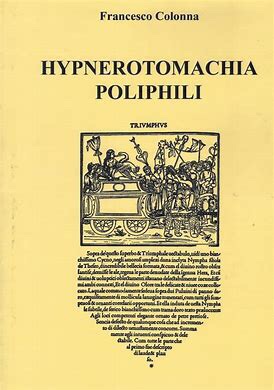
The Hypnerotomachia Poliphili is a highly unusual and enigmatic work of Renaissance literature, printed in Venice in 1499 by Aldus Manutius. The book’s full title is Hypnerotomachia Poliphili, ubi humana omnia non nisi somnium esse docet (The Strife of Love in a Dream, which teaches that all human things are but a dream).
The book tells the story of a man named Poliphilo, who falls asleep and dreams of a journey through a fantastical landscape populated by strange creatures and architectural wonders. Along the way, he is accompanied by his love interest, Polia, and the two engage in a series of erotic and intellectual encounters.
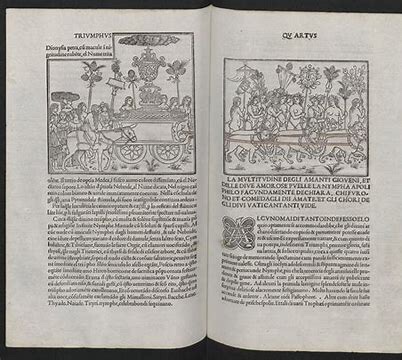
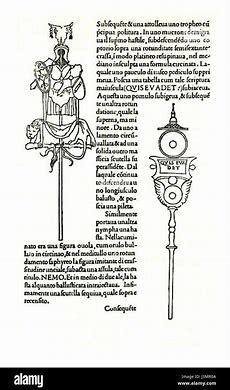
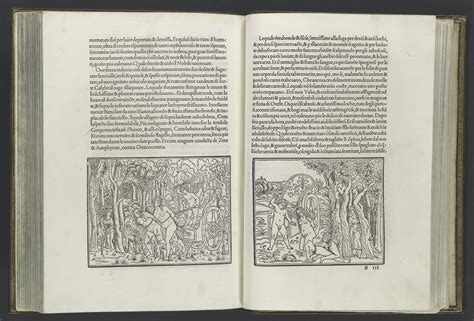
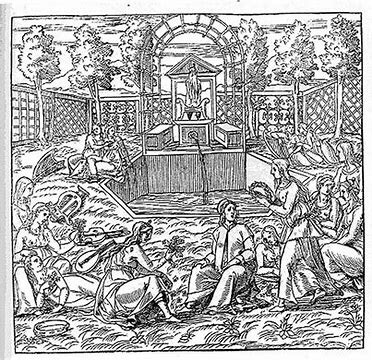
The text is written in a highly ornate and complex style, mixing Latin and Italian, and features over 170 woodcut illustrations that are intricately interwoven with the text. The illustrations are highly stylized and symbolic, often depicting architectural details, landscapes, and strange creatures in a way that is both beautiful and surreal.
The authorship of the Hypnerotomachia Poliphili is uncertain, although it is commonly attributed to a Dominican monk named Francesco Colonna. The book is notable for its uniqueness and complexity, and has been the subject of much scholarly debate and interpretation over the centuries.
The Hypnerotomachia Poliphili is considered one of the most beautiful books of the Renaissance, and is highly prized by collectors and scholars for its artistic and literary value. It is also notable for its influence on subsequent generations of writers and artists, and has inspired works ranging from the surrealist paintings of Salvador Dali to the modern architectural designs of Le Corbusier.
The Hypnerotomachia Poliphili has been the subject of numerous interpretations and scholarly debates over the centuries. Here are a few notable interpretations:
- Erotic Allegory: One of the most common interpretations of the Hypnerotomachia Poliphili is that it is an allegory for the joys and struggles of love. The book’s title, which translates to “The Strife of Love in a Dream,” suggests that the dream journey of Poliphilo and his love interest Polia is a metaphor for the challenges and triumphs of romantic love.
- Neoplatonic Philosophy: The Hypnerotomachia Poliphili has also been interpreted as a work of Neoplatonic philosophy, which emphasizes the pursuit of knowledge and spiritual enlightenment. In this reading, Poliphilo’s journey through the dream landscape represents a quest for knowledge and self-discovery.
- Architectural Treatise: The book’s intricate and highly detailed illustrations of architectural features and landscapes have led some scholars to interpret the Hypnerotomachia Poliphili as a treatise on Renaissance architecture. The book’s descriptions of architectural details and design principles have been studied and analyzed by architects and historians for their historical and artistic significance.
- Esoteric Mysticism: Some scholars have interpreted the Hypnerotomachia Poliphili as a work of esoteric mysticism, with the book’s dream journey representing a journey through the mysteries of the universe. In this interpretation, the book’s highly symbolic imagery is seen as a means of communicating hidden spiritual truths.
The Hypnerotomachia Poliphili is a highly complex and enigmatic work that has been the subject of many different interpretations and readings. Its unique blend of literary, artistic, and philosophical elements has made it a perennial favorite among scholars and enthusiasts of Renaissance culture.
The Hypnerotomachia Poliphili has had a significant influence on modern architecture, particularly in the early 20th century. The book’s intricate and highly stylized illustrations of classical architecture and landscapes, as well as its emphasis on the use of proportional systems and geometric forms, helped to inspire a new generation of architects who sought to break away from the ornate and decorative styles of the past.
One of the most notable architects influenced by the Hypnerotomachia Poliphili was the Swiss architect Le Corbusier. In his book “Towards a New Architecture,” published in 1923, Le Corbusier cites the Hypnerotomachia Poliphili as a major influence on his work, particularly in his use of simple geometric forms and his emphasis on proportion and symmetry.
Le Corbusier also drew inspiration from the book’s emphasis on the use of light and shadow to create spatial effects. He believed that the play of light and shadow was an essential element of architecture, and that it could be used to create dynamic and engaging spaces.
The Hypnerotomachia Poliphili has had a lasting impact on the field of architecture, helping to inspire new ideas and approaches to design, and contributing to the development of modernist and minimalist styles.
Other architects and designers who have been influenced by the Hypnerotomachia Poliphili include the Italian architect Carlo Scarpa, the American architect Louis Kahn, and the Dutch designer Gerrit Rietveld. All of these designers were drawn to the book’s emphasis on simplicity, proportion, and geometric form, and sought to incorporate these principles into their own work.
The Hypnerotomachia Poliphili contains numerous descriptions of architectural features and design elements that are both imaginative and highly detailed. Here are a few of the most interesting features:
- Water Features: The book contains numerous descriptions of fountains, water features, and pools. These features are often described in great detail, with intricate carvings and decorative elements, and are used to create a sense of tranquility and serenity.
- Labyrinths: The book contains several descriptions of labyrinths, which are described as complex and intricate mazes that are both beautiful and challenging. These labyrinths are often used as metaphors for the journey of life, and are associated with themes of knowledge, discovery, and self-discovery.
- Classical Columns: The Hypnerotomachia Poliphili contains numerous descriptions of classical columns and architectural elements, such as the Ionic, Doric, and Corinthian orders. These columns are often described in great detail, with intricate carvings and decorative elements, and are used to create a sense of elegance and grandeur.
- Gardens: The book contains several descriptions of gardens, which are often described as idyllic and peaceful spaces that are filled with lush vegetation and colorful flowers. These gardens are often used as metaphors for the journey of life, and are associated with themes of growth, renewal, and transformation.
- Ruins: The book contains several descriptions of ruins, which are often described as haunting and melancholy spaces that are filled with the ghosts of the past. These ruins are often used as metaphors for the impermanence of life, and are associated with themes of decay, loss, and mortality.
The architectural features described in the Hypnerotomachia Poliphili are both imaginative and highly detailed, and offer a fascinating glimpse into the architectural and design practices of the Renaissance period.

 SummerSimo Travel Troubles Notes and The Purring Page