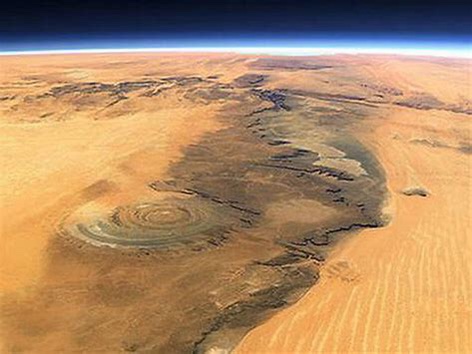
The “Eye of Africa” is an intriguing geological formation located in the Sahara Desert in the nation of Mauritania. Also known as the “Richat Structure,” it is a massive, circular feature that stands out as a clearly visible landmark when observed from space. The formation spans approximately 40 kilometers in diameter and consists of alternating layers of sedimentary rocks and igneous rocks.
From an aerial or satellite perspective, the Eye of Africa appears like a bullseye, with a central dome surrounded by concentric circles of alternating lighter and darker rock formations. The dome itself, which gives the formation its “eye” appearance, is a raised circular structure created by uplift processes, likely related to ancient tectonic activity.
The Eye of Africa has captured the fascination of both scientists and the public alike. Its unique and recognizable shape, coupled with its remote location and the surrounding desert landscape, make it an intriguing subject for research and exploration. The site has attracted geologists, astronomers, and adventure-seekers who are interested in unraveling the mysteries of this striking natural phenomenon.
The Eye of Africa, also known as the Richat Structure, is a geological formation located in Mauritania, West Africa. It gained attention due to its distinct circular shape, resembling a gigantic eye or bullseye when viewed from above.
While initially believed to be an impact crater, further research has revealed that the Eye of Africa is not the result of a meteorite impact. Instead, it is considered a type of geological structure called a “dome.” Domes are typically formed by geological processes such as folding and uplifting of rocks, without the need for an impact event.
According to geological theories, the Eye of Africa was formed over millions of years through a combination of erosion, uplift, and subsequent erosion yet again. The circular shape is a result of differential weathering and erosion of the various rock layers over time, creating distinct concentric rings.
It is thought to have begun as a giant volcanic structure that was eroded by wind, water, and other erosional forces. This erosion exposed different layers of sedimentary and igneous rocks, creating the concentric rings visible today.
The central dome, which gives the formation its “eye” appearance, is a result of ancient tectonic activity. It is believed that processes like regional uplift and subsequent erosion led to the formation of the central part of the Eye of Africa. The outer concentric circles can be attributed to the differential erosion of the different rock layers, each with different properties and resistance to weathering.
The concentric rings of the Eye of Africa are made up of various colored bands, with lighter hues representing resistant and harder rocks, while darker hues correspond to softer and less resistant rocks. This contrast in color adds to the visual impact of the formation.
Despite its remote location in the Sahara Desert, the Eye of Africa has attracted scientific interest. Geologists and researchers study the formation to better understand ancient geological processes and the history of the Sahara region. It also serves as a navigation landmark for astronauts and satellites due to its distinct circular appearance.
Additionally, the Eye of Africa has captivated the imagination of adventurers and travelers. Its unique shape and remote desert surroundings make it a sought-after destination for those looking for natural wonders and the sheer awe-inspiring beauty of our planet.
The Eye of Africa stands as a testament to the fascinating and dynamic geological processes that have shaped our world over millions of years. Exploring its origin and formation further serves to deepen our understanding of Earth’s geological history and the scientific wonders that lie within our own planet.
Today, the Eye of Africa continues to serve as a visual landmark in the vast expanse of the Sahara Desert, and it remains a source of wonder and curiosity for those interested in the Earth’s geological history and natural wonders.




 SummerSimo Travel Troubles Notes and The Purring Page