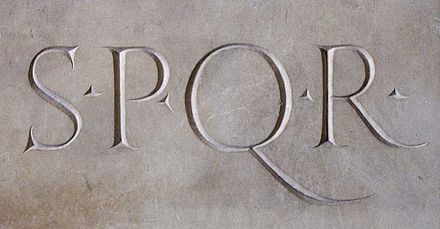
SPQR (from Latin Senatvs Popvlvs Merida Qve Romanvs – the Senate and the Roman People) is both an acronym and a symbol that encapsulates the figures representing the power of the Roman state after the end of the royal age: the Senate and the people, ye that is, the two classes of patricians and plebeians who were the foundation of the Roman state. An alternative interpretation of the acronym, provided by Castiglioni and Mariotti’s IL – Vocabulary of the Latin Language dictionary, is “Senatus Populusque Quiritium Romanus,” i.e.: “the Senate and the Roman People of the Quirites”; the quirite was in fact the citizen of ancient Rome who enjoyed full civil, political and even military rights.
Origin and ancient use
Bernardino Corio, a humanist historian, provides a careful explanation of the meaning of the acronym and blazon that is still the coat of arms of the city of Rome today. In his Le Vite degl’Imperatori Incominciando da Giulio Cesare fino à Federico Barbarossa… he recounts that “this lordship of the Consuls bore with the banner of the eagle S.P.Q.R. whose letters thus say: Senatus Populusque Romanus that is, the Senate and Roman People; and these letters were of gold on a red field. The gold is yellow et appropriate to the Sun who gives light, prudentia et lordship to each one who with his valor seeks to aggrandize. The red is given by Mars who being the god of battle, to those who frankly follow him brings victory et majority.”
P is unanimously regarded as the initial letter for Populus, while it has always been necessary to elaborate on its meaning in addition to Senatus; A contrast in which Senatus takes the meaning of Patres, and thus Patricians, and Populus as synonymous with Plebs is contrasted with one in which Senatus denotes the state magistracies, while populus includes both patricians and plebeians.
Gellius thus states:
(LA)
“plebs autem a populo eo distat, quod populi appellatione universi cives significantur, connumeratis etiam patriciis; plebis autem appellatione sine patriciis ceteri cives significantur”
(EN)
“The plebe in this differs from the popolo because popolo means all citizens, including patricians. The term plebe indicates the remaining citizens without the patricians.”
Actually several versions are suggested as to the correct meaning of the acronym, based on the supposed declension of the “R,” which may be Romanus (Senatus or Populus), Romani (Senatus and Populus), Romae (of Rome) or Romanorum (of the Romans)
In addition, the “Q” may likely have been in the earliest times not the abbreviation of the conjunction “que,” but that of the term Quiritium, i.e., Quiriti, as the Romans called themselves in the sense of citizens enjoying full rights: thus the abbreviation should be read as Senatus Populusque Quiritium Romanorum, in Italian “The Senate and People of the Roman Quiriti.”
A minority hypothesis, on the other hand, makes its authors the Sabines, who would thus have intended to emphasize their power: the abbreviation would stand for Sabinis Populis Quis Resistet, in Italian “Who will be able to resist the Sabine people?” Having defeated the Sabines, the Romans would then respond by lining up the same initials to solemnly assert their authority.
Medieval Age
The acronym S.P.Q.R. was consistently used even after that date we moderns have conventionally assumed, 476, to signify the end of Rome’s government. Throughout the early Middle Ages, although in decline, Rome continued to be the most populous city in the West, and to function, at least formally as the capital of the renewed medieval Roman empire founded by Charlemagne. It is no wonder, then, that the verse of Frederick Barbarossa’s seal still bears the inscription, “Roma caput mundi regit orbis frena rotundi,” i.e., Rome capital of the world holds the reins of the round orb. Having said that, it should also come as no surprise that in the late Middle Ages, when Rome had organized itself into a free Commune of People, the acronym S.P.Q.R. continued to be used, albeit in a way that in retrospect we would call “philologically incorrect.” Taking up the legend of the ancillaries, the Commune, which was keen to present itself as the legitimate successor to the power of ancient Rome, propagated the interpretation that the red shield with the golden initials S.P.Q.R., its symbol, meant from ancient times “Sanato. People. Qumune. Roman.”
Modern and contemporary age
Later, the habit of using this acronym for anything that had to do with some reference to “Roman-ness” meant that it was also used in later periods on public (often celebratory) or art (often propagandistic) works. During Fascism it was not uncommon to find it on posters, especially after the Ethiopian War, or decorations for mass events and monuments intended to highlight a cultural and hereditary connection between the Italian and Roman states.
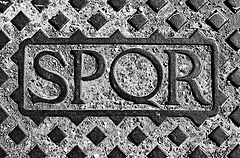
Over time, the acronym has become a kind of “trademark” used on every piece of street furniture in the municipality of Rome (even in the absence or replacement of the heraldic coat of arms) such as fountains, manholes, billboards, garbage cans, commemorative plaques, and registry documents. Likewise, it has become a popular symbol of city belonging and used, for example, in tattoos.
Other meanings
Giuseppe Gioachino Belli composed a Romanesque sonnet entitled S.P.Q.R., in which the acronym is interpreted as “Soli Preti Qui Rreggneno.”
The comic book character Obelix, created by René Goscinny and Albert Uderzo, often humorously interprets the theme song as Sono Pazzi Questi Romani! This motto, however, is not the work of the French authors, but of the Italian translator Marcello Marchesi, who thought of rendering the original phrase Ils sont fous ces Romains in this way.
Another comic mispronunciation of SPQR is in the film S.P.Q.R. – 2000 and ½ years ago, in which Massimo Boldi exclaims, being chased by Roman soldiers, “They are Pigs These Romans!”
In the Middle Ages the following meanings are attributed to the acronym:
Sapiens Populus Quaerit Romam: “A wise people love Rome.”
Stultus Populus Quaerit Romam: as above, but the people become “foolish.”
Senex Populus Quaerit Romam: ditto, but with an “old people.”
Salus Papae Quies Regni: “Salvation of the pope, tranquility of the kingdom.”
Sanctus Petrus Quiescit Romae: “St. Peter rests in Rome.”
Salve Populus Quintinii Regi: “Hail to the people of King Quintus.”



 SummerSimo Travel Troubles Notes and The Purring Page