Salius (from Latin: Salius, pl. Salii), also known as Palatine Salium (Salius palatinus pl. Salii palatini), was a “jumping priest” (from the verb salio, “to jump”) who performed the cult of Mars Gradivo, that is, the Mars who precedes all the combatants in battle, or the one who fights in the front row, which is the same thing. Other authors derive gradivo from divus, but one only has to look at the Athena Gradiva i.e., the Promachos, to understand that she stands with a step forward like all “gradive” statues.

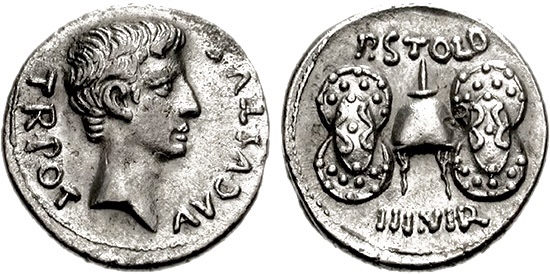
Tradition has it that the Salii Palatini were established by King Numa Pompilius (r. 715-673 b.c.) who formed a priestly college composed of 12 Salios chosen from among young patricians, with the purpose of guarding the shield delivered by Mars Gradivo to Numa Pompilius (in the eighth year of the king’s reign, during a plague epidemic) as a pledge of Rome’s eternal salvation and invincibility.
As suggested to the king by the nymph Egeria, Numa commissioned the blacksmith Mamurio Veturio (of the gens Veturia) to forge 11 more shields identical to the Ancile, so that it would be impossible for Rome’s enemies to steal the authentic one, and he ordered that they be stored in the Palace and preserved by the priest Flamine Diale and entrusted, for sacred rites, to the new priestly college of the Salii Palatini.
The shields were kept in the Palatine shrine of Mars, which would give rise to the distinctive name of the Salii Palatini.
There is mention of a certain Nummius Attidianus Tusco mentioned as Palatine Salius in 191, pontiff in 199 (Borghesi Oeuvres IV, 510), and consul in 206 along with Lucius Fulvius Aemilianus (Klein fasti; C. /. L V, 4347).

THE ORIGINS.
- According to ancient authors cited by Servius Honoratus and Macrobius, the Salios would have existed in Tivoli, Tusculum and Veio before their creation in Rome.
- According to the Etruscans, the foundation was attributed to Morio, king of Veio.
- According to other authors, however, the Salios would have been associated with Dardanus, son of Zeus and Electra and founder of Dardania (narrow region of the Dardanelles).
- According to others it was Salios, a young inhabitant of Acarnia (Greece) with compatriots of his own, who would have come to Italy with Evander (see Aeneid) for competition in the funeral games of Ankise.
- According to Marcus Terentius Varro Salius had reached the Italic peninsula with Evander, the Acarnanian king to whom various Roman religious institutions were attributed.
SALIOS COLINOS
Livy relates that King Tullus Hostilius (Thullus Hostilius – r. between 673 and 643 b.c.) is said to have established another college of Salians called Salios Colinos in fulfillment of a vow he allegedly made during wars fought against Fidene and Veio. They too were 12 in number, also chosen from among the patricians, and seem to have been dedicated to the service of the god Quirinus. They would be known as salios colinos (Latin: salii colini ), agonais (agonales) or agonenses (agonenses).

COSTUMES.
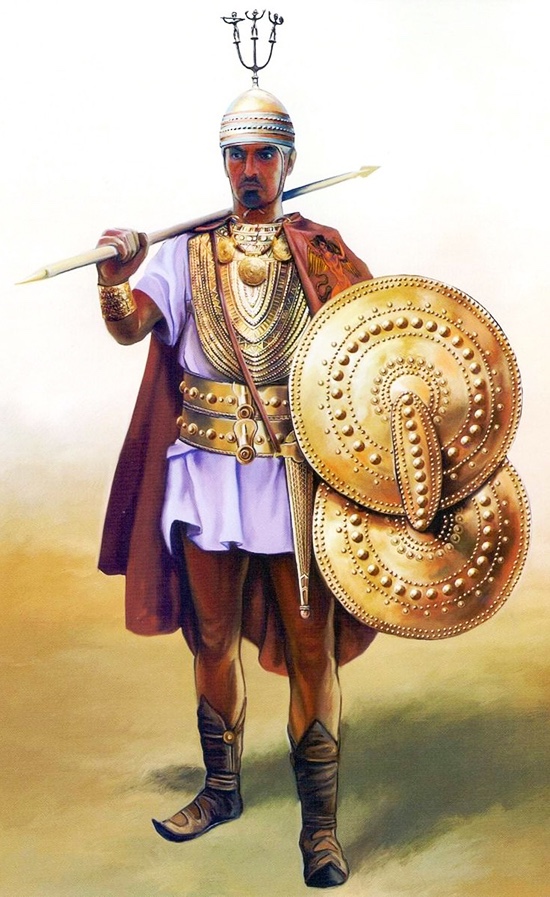
The Salios were dressed as archaic warriors, thus with:
- the trabea (a toga adorned with horizontal purple, saffron and scarlet stripes as asserted by Marius Servius Honoratus, according to whom there were three types: one totally purple, sacred to the gods ; one purple and white, as royal dress attached to the kings of Rome; and one purple and saffron/scarlet that was used by priests),
- the bronze breastplate,
- the patta (cloak attached to the right shoulder worn by military commanders),
- the sword on the right side,
- the spear or a staff on the left side,
- the shield on the left shoulder,
- the apex (the cone-shaped cap adorned with the olive rod).
The Salii Palatini were charged with the protection of the twelve sacred shields ( ancilia ) of Mars and with the holding of a festival dedicated to the deity in which they crossed Rome. carrying shields, dancing and singing, for the worship of Quirinus on Mount Quirinal. Their special prerogative was to mark the transition in the Roman year from military to civil time, and vice versa.

VIRGINS OF SALIAE
Festus in his work “On the Meaning of Words” states, quoting Cyncio and Aelius Estilao, that there were “saliae virgins.” Wearing palms and the apex of the sages, these very young girls were “hired” to help the pontiffs operate in the sacrifices made in the Regia.
According to some scholars, however, the Festus passage would describe an initiation ritual in disguise. An earlier explanation states that these women played the role of absent warriors in a kind of “vicarious sacrifice” or “atoning sacrifice.” One wondered about the criterion by which they were hired. Surely they were chosen by the magister from among the very young Roman patricians.

THE DANCES.
The fact that they danced by leaping suggests tribal war dances of which remnants certainly advanced at that time. The dance served in very ancient times both to incite war and to celebrate victory.
Their main function was to protect the twelve sacred shields (ancilia) of Mars; they celebrated a festival dedicated to Mars for several days from March I. On this occasion they went around Rome in their special costumes carrying the sacred shields over their left shoulder while dancing and singing.
The Salii were presided over by a Magister, who was flanked by the Praesul, who directed the dances by showing the steps and figures of the amptrurare dance to the other priests who then had to repeat them (reamptrurare), and the Vates, the choir director.
Also kept in the building were the statue of Mars, the instruments of worship for the salii priests, who were in charge precisely of the ceremony, that is, the weapons for killing the victims, as well as the priests’ robes, containers, the necessities for the fire, braziers and symbols of the ceremony.
In this dance, the Salios beat their shields with sticks in order to keep time with the voices and dance movements. The songs or hymns performed, called the songs of the Salios, in Latin “saliaria carmina” were called “Asamenta,” “Assamenta” or Axamenta,” the etymology of which is disputed.
THE SONGS
The chants invoked the gods of the Roman pantheon and such Mamurius Veturius, thought to be the armorer who made the 11 copies of the original sacred shield that fell from the sky. Later, however, Augustus, Germanicus and Lucius Verus were incorporated into the carme. At the conclusion of the festivities, the Sages participated in splendid performances at the Temple of Mars, which were famous everywhere.
MAMURIO VETURIO
Mamurio was an alleged Roman blacksmith of Sabine origin who lived during the reign of Numa Pompilius (r. 715-673 B.C.), the one who created the 11 holy shields by making them exactly the same as those sent from heaven during an epidemic in Numa’s time in order to protect him from being stolen.
His works were mentioned in the “songs of the Sages,” but his existence was also questioned among the ancients, with Marcus Terentius Boar (116 B.C.-27 B.C.) analyzing his name as equivalent to vetus memoria (“old memory”). Some modern authors associate him instead with the Etruscan artist who made a bronze statue in honor of the god Vertumno.
INTERPRETATIONS
Georges Dumezil interprets the Salic ritual as a sign of the opening and closing of the annual season of war. The opening would coincide with Martial Agony Day on March 19, and the closing with Armilustrium Day, October 19.
The first date would be about “moving the sacred shields” (ancilia movere), and the second as “maintaining (or concealing) the sacred shields” (ancilia condere). Dumézil sees the two groups of Salios, one representing Mars and the other Quirinus, as a basic relationship of Roman life that highlights the interdependence of economic, civic, and military functions in Roman society.
For classical philologist Georg Wissowa, the Salian ritual is a war or sword dance, with its figures and movements clearly indicating its military origin. Wissowa compares the sages with the young nobleman dancing the Trojan Game ( Lusus Troiae ).
Because the early Roman calendar began in March, Hermann Usener suggested that the ceremony of ancilia movere was a ritual of ending the old year, represented by the mysterious figure of Mamurius Veturius, to pave the way for birth. from the god Mars on March I, when in a certain ceremony called Mamuralia, a man, ritually named Mamurius Veturius, was beaten with long white rods, which Usener said would be a kind of scapegoat ritual.
According to Hermann Usener and Ludwig Preller, Mars would be a god of war and fertility (but they may be alluding to Mavor ancient god of the fields, while Mammonium Veturius would be Ancient Mars. Mars is himself a dancer, and the leader of the Salian dancers.
BIBLIO
- William Smith – Dictionary of Greek and Roman Biography and Mythology Vol. III (1875).
- Dionysius of Halicarnassus – Roman Antiquities – Milan 1823
- Marcus Terentius Varro – G. Piras, Varro and the poetica verba. – A study of the seventh book of “De lingua Latina,” Bologna, R. Patron, 1998.

 SummerSimo Travel Troubles Notes and The Purring Page