The Ancilia were the twelve (oval and cut on the sides) sacred shields used by the Salii brothers in their processions and rites of archaic Rome. etymologies. For some it comes from the Greek ἀγκύλος, “curved.” Varro derives it from ab Ancisu, being arched or cut on both sides, like Thracian shields, called peltæ. Plutarch thought the word derived from the Greek άγκών, “elbow,” the weapon being worn on the elbow. According to Ovid
(LA)
“Idque ancile vocat, quod ab omni parte recisum est,
Quemque notes oculis, angulus omnis abest.”
(EN)
“And call ancile that which is severed on every side, and if you look at it, all angles vanish.”
(Ovid, Fasti iii)
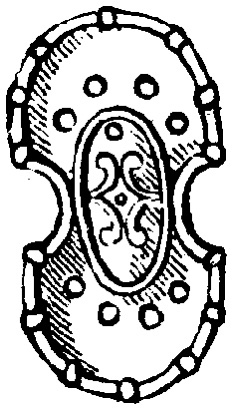
These shields were made of bronze but only one was the original sent by Mars Gradivo to King Numa Pompilius as a pledge of Rome’s eternal invincibility. Tradition has it that during a plague a bilobate shield descended from the sky and the epidemic immediately ceased.
The nymph Egeria had revealed that whoever possessed this shield would become very powerful, so Numa commissioned the blacksmith Mamurio Veturio (of the gens Veturia), to forge 11 other shields identical to the Ancile, so that it would be impossible for Rome’s enemies to steal the authentic one, just as had happened to the Palladium of Troy by Odysseus. The Ancile thus became one of Rome’s seven tokens of command (pignora imperii).
(LA)
“septem fuerunt pignora, quae imperium Romanum tenent: acus matris deum, quadriga fictilis Veientanorum, cineres Orestis, sceptrum Priami, velum Ilionae, palladium, ancilia.”
(EN)
“there were seven sureties to hold power in Rome: the needle of the Mother of the Gods, the clay quadriga of the Veientans, the ashes of Orestes, the sceptre of Priam, the veil of Iliona, the palladium, the ancilia “

Numa entrusted the shields to twelve young patricians called Salii who guarded them in the Regia. On the Ides of March the Salii carried the ancilia in procession through the streets of Rome, striking them with their poles and singing hymns to Mars dancing in a three-step rhythm.At the end of the month they were solemnly put away, and it was forbidden to undertake military operations before that date. Oton, who set out to war without waiting for the deposition of the ancilia, lost the war.

 SummerSimo Travel Troubles Notes and The Purring Page