The new economy is a term that refers to the phase of rapid development driven by the diffusion of information and digital technologies, such as internet, mobile phones, personal computers, and digital products. The new economy emerged in the late 20th century, starting from the United States and then spreading to other industrialized countries of the world1. These new technologies gave rise to a speculative bubble that heated up the financial markets at the turn of the millennium, and then fueled the growth of the industrial countries in the last years of the century until the onset of the global crisis.
The new economy is not a static concept, but rather a dynamic and evolving one that adapts to the changing business landscape and consumer preferences. In this article, we will explore some of the key trends that are influencing the new economy in 2023 and beyond.
- Stagflation Risk Looms
One of the major challenges facing the global economy in 2023 is the risk of stagflation, which is a situation of low growth and high inflation. According to The World Bank and other economists, the United States and the global economy are at risk of stagflation in the near future. Stagflation is particularly difficult to correct because the usual correction methods used for one issue can make the other issues worse.
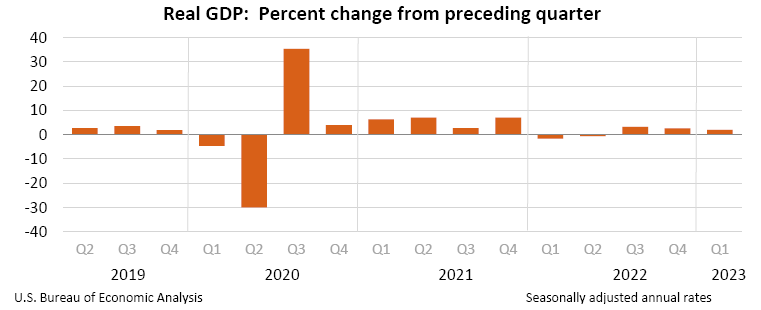
Gross Domestic Product (Third Estimate), Corporate Profits (Revised Estimate), and GDP by Industry, First Quarter 2023
Real gross domestic product (GDP) increased at an annual rate of 2.0 percent in the first quarter of 2023 (table 1), according to the “third” estimate released by the Bureau of Economic Analysis. In the fourth quarter, real GDP increased 2.6 percent.
The GDP estimate released today is based on more complete source data than were available for the “second” estimate issued last month. In the second estimate, the increase in real GDP was 1.3 percent. The updated estimates primarily reflected upward revisions to exports and consumer spending that were partly offset by downward revisions to nonresidential fixed investment and federal government spending. Imports, which are a subtraction in the calculation of GDP, were revised down (refer to “Updates to GDP”).
The increase in real GDP in the first quarter reflected increases in consumer spending, exports, state and local government spending, federal government spending, and nonresidential fixed investment that were partly offset by decreases in private inventory investment and residential fixed investment. Imports increased (table 2).
However, according to a survey by the Securities Industry and Financial Markets Association, 80% of economists say stagflation is a long-term risk to the economy A survey from Bank of America came up with a similar opinion among economists: 83% say they expect little growth and high inflation to hamper the economy throughout 2022.
Stagflation can have negative impacts on businesses and consumers alike. Businesses may face higher costs of production and lower demand for their products and services. Consumers may face lower purchasing power and higher uncertainty about their future income and wealth.
To cope with stagflation, businesses and consumers needs to be flexible and adaptable to changing market conditions. Businesses may need to diversify their sources of revenue, optimize their operations, and invest in innovation. Consumers may need to adjust their spending habits, save more, and look for alternative sources of income.
- Spending on Durable Goods Remains High in Industry, Drops Among Consumers
Another trend that reflects the state of the economy is the spending on durable goods, which are expensive items that will last at least three years. The basic premise is this: when people feel confident about the economy, they are more likely to purchase durable goods. If they are leery of the economy, they will put off these big purchases.
The durable goods market in the United States is valued at about $1 trillion Data regarding the purchasing of durable goods can give us a peek into the health of the economy.
In 2022, spending on durable goods remained high in the industry, but dropped among consumers. This suggests that businesses were optimistic about their future prospects and invested in capital equipment and machinery to boost their productivity and competitiveness. However, consumers were more cautious about their spending and postponed buying big-ticket items such as cars, furniture, and appliances.
This trend may continue in 2023 as businesses seek to take advantage of new technologies and opportunities in the new economy while consumers face higher inflation and uncertainty about their income and wealth.
To succeed in this environment, businesses need to offer durable goods that are innovative, affordable, and sustainable. Consumers need to be more selective and rational about their purchases and look for durable goods that offer value, quality, and durability.
- New Analytics Approaches Powered by Artificial Intelligence
One of the key drivers of the new economy is the advancement of artificial intelligence (AI), which is the ability of machines to perform tasks that normally require human intelligence, such as reasoning, learning, and decision-making. AI can help businesses and consumers analyze data, identify patterns, and anticipate trends in real time, thus improving their performance and outcomes.
According to the World Economic Forum, new analytics approaches powered by AI are one of the key market trends reshaping business success in 2023 and beyond. Relying on historical analytics models and past performance data may not be fully relevant in today’s ever-changing business landscape. New analytics approaches powered by AI can help businesses and consumers adapt to changing market conditions, customer preferences, and competitive forces.
For example, AI can help businesses to optimize their pricing strategies, personalize their marketing campaigns, enhance their customer service, and streamline their operations. AI can also help consumers find the best deals, compare products and services, and make informed decisions.
To leverage the power of AI, businesses and consumers need to have access to reliable and relevant data sources, as well as the skills and tools to interpret and apply the insights generated by AI. Businesses and consumers also need to be aware of the ethical and social implications of using AI, such as privacy, security, bias, and accountability.


 SummerSimo Travel Troubles Notes and The Purring Page