Part XII
In 1212 the Mongols invaded Jin again, but the invasion was cut short because their leader Genghis Khan was wounded by an arrow. The following year, the Mongols returned and caused more devastation. Meanwhile, Hushahu, the Jin commander who had lost the battle against the Mongols at the Young Badger’s Mouth pass in 1211 (Part XI), turned against the Jin emperor, Wanyan Yongji (Prince Shao of Wei), slaughtered his soldiers, and assassinated him. He then placed his uncle, Xuanzong, on the throne. Shortly afterwards, the Mongols approached the Jin capital city, Zhongdu, present-day Beijing, where the new Jin emperor was located. Hushahu sent a commander, Gaoqi, with several thousand men to attack the Mongol army and he told him that death awaited him if he failed. Gaoqi did fail, but he returned and decapitated Hushahu on the spot. The assassin had been assassinated. In an audacious display of courage, Gaoqi carried Hushahu’s head to Emperor Xuanzong and confessed to his deed. In a remarkable turn of events for Gaoqi, the desperate emperor made him vice-commander of the Jin Empire.
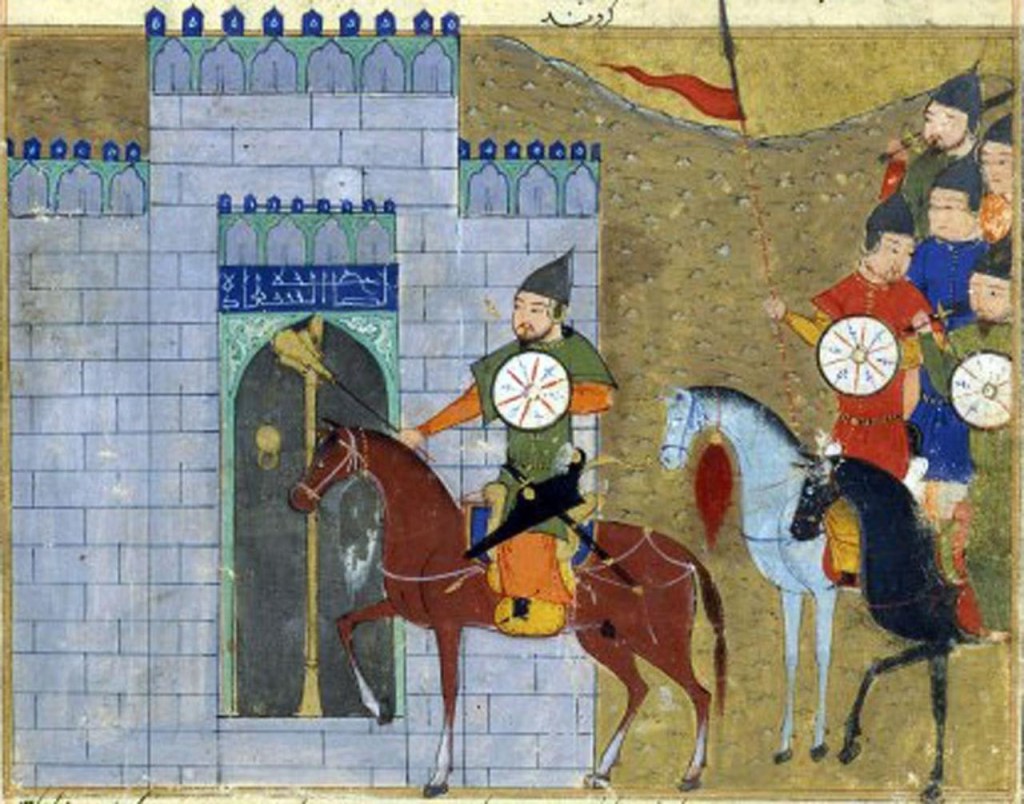
The Mongols besieged Beijing for a year. But the capital was a very difficult city to capture. According to John Man in his book, The Mongol Empire:
“A century before, it [Zhongdu/Beijing] had been turned into a very tough nut, even for a regular army. Outside the walls were four fortress-villages, each with its own granary and arsenal, each linked to the capital by a tunnel. Three moats fed from Kumming Lake protected the walls themselves, which formed a rectangle some 15 kilometres around and some 15 metres thick at the base. A crenellated parapet rose 12 metres above the ground, with thirteen gates and a guard tower every 15 metres – over 900 of them in all.
Inside these formidable defences, the inhabitants deployed equally formidable weapons. Double-and-triple-bow crossbows could fire 3-metre arrows a kilometre. Artillery was in the form of catapults known as traction trebuchets. All of these weapons could be adapted to fire a weird variety of incendiary devices, for these were the days of early gunpowder. Fire-arrows from siege bows and fireballs from trebuchets were used to set alight scaling ladders and assault towers. Naphtha could be tossed in pots or thrown in battles, like Molotov cocktails. Another means of defence was to use distilled petroleum, known as Greek fire in the West, to make crude but effective flamethrowers. To take and hold cities, the Mongols would have to capture and master these weapons.”
The Mongols made no serious attempt on the city on this occasion. By spring 1214, both the Mongols and the inhabitants of Beijing were suffering. Genghis offered to withdraw provided he was given concessions from the emperor. Xuanzong agreed and offered him a princess, 500 boys and girls, 3,000 horses, and 10,000 bolts of silk. The Mongols, happy with the deal, headed back north to the grasslands.
Following the siege, the Jin emperor realised the vulnerability of Beijing and moved his capital to Kaifeng, beyond the Yellow River, which provided natural defence. When Genghis heard word of this, he returned to Beijing and by September he had once again laid siege to the city. The Mongols again made no serious attempt to attack the city; instead they decided to starve the inhabitants into submission. By May 1215, the people of Beijing were starving and had resorted to eating their own animals and their own dead. Leadership within the city crumbled: one of the city’s commanders committed suicide and another fled, only to be executed for his treachery. Eventually the city surrendered and with Genghis absent, the Mongols ran riot, killing thousands. The palace went up in flames and some parts of the city apparently burned for a month.
Shortly afterwards, an ambassador from Khwarezmia travelled to Beijing. Shocked that a well-defended city could fall to mere nomads, he reported that the bones of the dead formed mountains and that the soil was greasy with human fat. Even with the usual exaggerations, what he witnessed that day would soon be unleashed upon Khwarezmia

 SummerSimo Travel Troubles Notes and The Purring Page